Monday, 14 October 2013

The coronation feast of James II and Queen Mary

One of the many printed books contained in the Cathedral library is a lavishly illustrated account of the coronation of James II and Queen Mary, which took place on Tuesday 23rd April, 1685.

This book was commissioned to commemorate James II's coronation and was given to his Majesty as a gift upon his visit to Worcester in 1687. It is a very detailed account of the preparations for the occasion; a description of the clothing, robes, crowns and sceptres, personnel, seating arrangements and menus for the day. As this is a very precise (and lengthy) account of the ceremony, I have chosen to discuss the coronation feast and menu, which visitors to the library often express interest in.

Below is an exquisite engraving depicting the feast in Westminster Hall, in which you can see the Lords and Ladies tucking into an array of foods, as well as the servers located at the sides of the halls.
 
 
James II's coronation feast (1685). Photograph reproduced by the permission of the Dean and Chapter of Worcester Cathedral (U.K.).
 
 
Their Majesties table alone is described as containing "99 dishes of the most excellent and choicest of all sorts of cold meats, both flesh and fish, excellently well dressed and ordered all manner of ways, [...] brought up by the gentlemen who served at their majesties cupboards." The engraving certainly conveys the author's point that there was "little vacancy between the dishes, which were set upon stands of several heights, and all so equally mixed, that it made an extraordinary good appearance”. At feasts or banquets today, a table is rarely as fully laden with dishes as we see here. This coronation feast makes Christmas dinner look like a light snack!
 
Another engraving, pictured below, depicts the table layout of the 145 dishes served at the table of King James and Queen Mary. The King's table was located at the upper end of Westminster Hall.You can see that each dish has a small number on it. Below is a list of the dishes to which each number corresponds. Besides these 145 dishes, there were 30 more served up to their Majesties table at the second course, making 175 dishes in all…!!! 

We'd love it if you could pick your favourite item and tell us which dish, if you could, you would order as part of your coronation dinner.

Table of dishes corresponding with numbers below. Photograph reproduced by the permission of the Dean and Chapter of Worcester Cathedral (U.K.)


The dishes served at the table of King James and Queen Mary:
 
1.Pistacio cream in glasses.                            
2.Anchoviz (anchovies)                                          
3.Custards        )                                                         
4.Collar Veal    )  Cold
5.Lamb – stones
6.Cocks-combs  )
7.Marrow patie  )  Hot
8.Jelly   )
9.Sallet )   Cold
10.Stags tongues.
11.Sweet-breads.
12.Patty pidgeon.
13.Petty-toes.
14.Cray Fish.
15.Blumange              )      
16.Bolonia Sausages  )  Cold
17.Collops and Eggs.
18.Frigase Chick   )
19.Rabbets Ragou )  Hot
20.Oysters pickled  )
21.Portugal Eggs    )  Cold
22Dutch Beef         )
23.Andolioes.
24.Mushrooms  )
25.Veal              )  Hot
26.Hogs tongues  )
27.Cheese cakes  )  Cold
28.Ciprus Birds.
29.Tansy.
30.Asparagus  )
31.A Pudding  )  Hot
32.Ragou of Oysters  )
33.Scallops                )  Cold
34.Salamagundy.
35.Three dozen glasses of lemon Jelly.
36.Five Neats Tongues  (Cold).
37.Four dozen wild Pidgeons,12 larded, (Hot).
38.A whole Salmon  (Cold).
39.Eight Pheasants,3 larded  (Cold).
40.Nine small Pidgeon Pies  (Cold).
41.Twenty Four fat Chickens,6 larded  (Hot).
42.Twelve Crabs  (Cold).
43.Twenty Four Partridges,6 larded, (Hot).
44.A dish of tarts.
45.Soles marinetted, (Cold).
46.Twenty Four Tame Pidgeons,6 larded, (Hot)
47.Four Fawns,2 larded, (Hot).
48.Four Pullets La Dobe.           )  
49.Twelve Quails                       )  (Hot)           
50.Four Partridges – Halved      )
51.Ten Oyster Pies, (Hot)                                                 
52.Sallet.
53.Pease.
54.Four Dozen of Puddings,(Hot)
55.Artichokes.
56.Beef a La Royal, (Hot).
57.An Oglio, (Hot).
58.Pease.
59.A Batalia Pie
60.Artichokes.
61.Sallet.
62.Three Turkeys a La Royal, (Hot).
63.Four Chicks        )     
64.Bacon Gammon  ) (Hot).
65.Spinage               )
66.Three Piggs (Hot)
67.Almond Puff.
68.Twelve Stump Pies, (Cold).
69.A square pyramide, rising from four large dishes on the angles, and four  lesser dishes on the sides, containing the several fruits in season, and all manner of sweet-meats.
70.A whole Lamb, larded, (Hot).
71.Twelve Ruffs.
72.Four dozen Egg –Pies, (Cold).
73.A very large circular pyramide in the middle of the table, rising from twelve dishes in the circumference, six of which were large, and the others six less, containing the several fruits in season, and all manner of sweet-meats.
74.Six Mullets, large souc’d.
75.Eight Godwits.
76.Eight Neats Tongues and Udders roasted, (Hot).
77.A square pyramide, rising from four large dishes on the angles, and four lesser on the sides, containing the several fruits in season, and all manner of sweet-meats.
78.Eighteen Minc’d Pies, (Cold).
79.Marrow Tofts.
80.Eight wild Ducks, marinated, (Hot).
81.Gooseberry Tarts   )
82.Lampreys               ) (Cold).
83.Shrimps                  )
84.Twenty Four Puffins, (Cold).
85.Smelts.
86.Trufles.
87Four Dozen of Petit-Paties, (Hot).
88.Morels.
89.Five Carps, (Cold).
90.Blewmange in shells, (Cold)
91.Mushrooms.
92.Four Dozen of Almond Puddings, (Hot).
93.Asparagus.
94.Eight Ortelans.
95.Lamb Sallet, (Cold).

96.Five Partridge Pies    )
97.Smelts marinated       )  (Cold)
98.Turt.de Moil              )
99.Eighteen Turkey Chicks, six larded, (Hot).
100.Twelve Lobsters, (Cold).
101.Nine Pullets, for larded, (Hot).
102.Bacon,two Gammons, (Cold).
103.Twelve Leverets, four larded, (Hot).
104,Sturgeon, (Cold).
105.Twenty Four Ducklings, six larded, (Hot).
106.Collar’d Beef, (Cold).
107.Eight Capons, three larded, (Hot).
108.Five Pullet Pies, (Cold).
109.Eight Geese, three larded, (Hot).
110.Three souc’d Pigs, (Cold).
111.Three Dozen glasses of Jelly.
112.Botargo            )
113.Gerkins            ) (Cold)     
114.Souc’d Trout   )
115.Sheeps Tongues.      )
116.Skirrets                     )  (Hot)
117.Cabbadge Pudding   )
118.Eight Teals Marin    )
119.French Beans           )  (Cold).
120.Leveret Pie               )
121.Lemon Sallet          )
122.Smelts Pickled        )  (Cold).
123.Periwinkles             )
124.Chicks marl’d     )
125.Cavear                 ) (Cold)
126.Olives                  )
127.Prawns            )
128.Samphire         )  (Cold)
129.Trotter Pie       )
130.Taffata Tarts     )
131.Razor Fish        )  (Cold)
132.Broom Buds     )
133.Collar’d Pigs.
134.Parmazan   )
135.Capers       )  (Cold).
136.Spinage Tart.
137.Whitings marinated   )
138.Cockles                      )  (Cold).
139.Pickled Mushrooms  )
140.Prawns                      )  (Cold).
141.Mangoes                   )
142.Bacon Pie           )
143.Cardoons            )  (Cold)
144.Souc’d Tench     )
145.Three Dozen Glasses of Blumange, (Cold).
 

As you can see, many of the items are familiar to us to-day, although some, if not many, have gone out of fashion. Others are not so recognizable. All in all this was not a table for the faint hearted….!!!

Clarification of a number of the menu items may well be required. I hope that the following will help with this; if some are wrong then please feel free to advise the correct explanation.

There is also a record, of the dishes served at the other  tables. They do differ in some cases to that of their Majesties, but in general they are a large number of common dishes.
 
Some spellings are different to what we are familiar with now, and these I have left in their traditional form.
The more, possibly obscure items, I have attempted to translate;

Item 4: Collar Veal – Meat that is rolled up and tied with string, also to cut up and press into a roll.
Item 5: Lambs-stones  (Testicles)
Item 6: Cocks-combs  - the red fleshy crest on the head of the domestic fowl.
Item 7: Marrow Patie – (Bone Marrow pate.)                                   
Item 9: Sallet – (Salad.)
Item 11: Sweet-breads – (the pancreas or thymus gland of an animal – heart, stomach, belly, throat, gullet or neck, - looked upon as a delicacy.)
Item 13: Petty –toes  (pigs feet).
Item 17: Collops and Eggs  (an egg fried on bacon).
Item 21: Portugal Eggs  (egg tart pastry, similar to custard tart).
Item 23: Andolioes  (ANDOLIANS – the guts of a hog, cooked with salt, pepper, cloves, mace and coriander).
Item 28: Ciprus Birds  (Preserved Fig Peckers-Beccafico – considered a dainty when it was fattened on figs and grapes)
Item 29: Tansy  (a pudding, omelette, or the like, flavoured with juice of tansy (an Herbaceous plant).
Item 34: Salamagundy (a type of salad, made with lettuce, finely chopped chicken and anchovies, garnished with small poached onions and scalded grapes.)
Item 36: Neats Tongues  (an Ox or Bullock,a Cow or Heifer).
Item 37,39,41,43,46,47,70,99,101,103,105,107 & 109  (Larded – to insert small strips of bacon into, before cooking.)
Item 48: Pullets la Dobe  (Chicken Stew)
Item 57:Oglio  (a very large stew with extensive ingredients)
Item 59:Batalia Pie  (a Fish pie)
Item 68: Stump Pies  (Mutton/Lamb Pie)  [ ]
Item 71: Ruffs  (either a small freshwater fish or a male bird of the sandpiper family)
Item 74,110,114 & 144: Souc’d  (Meat, Fish – prepared or preserved in vinegar/pickle.
Item 75: Godwits  (A type of marshland bird)
Item 79: Marrow Tofts  (Toasts)
Item 82: Lampreys (An eel like sucker fish)
Item 85:Smelts  (small fish)
Item 88: Morels  (type of mushroom)
Item 90: Blewmange: (probably a chicken meat dish served in pastry shells)
Item 94: Ortelans:  (a small bird of the bunting family: they were captured alive, force fed, then drowned in armagnac, roasted, then eaten whole, bones and all..!!).
Item 98: Turt de Moil: (a puff pastry dish containing bone marrow, butter, sweet-meats, cream, eggs, orange-flower-water and sweetened with sugar.)
Item 103: Leverets (young Hares)
Item 107: Capon  (castrated domestic cock).
Item 112: Botargo (a relish made of Mullet roe or Tunny).
Item 116: Skirrets: (a species of water parsnip).
Item 118: Teals:  (species of wild duck).
Item 128: Samphire:  (sea shore plant, growing on rocks, who’s aromatic, saline, fleshy leaves were used in pickles).
Item 130: Taffata Tart: ( was a word  applied for a cream dish i.e. a cream tart/pie).
Item 131: Razor Fish: (a mollusc having a long narrow shell like the handle of a razor).
Item 143: Cardoons:  (edible part of the artichoke).
Item 15 & 145: Blumange:  (a meat concoction)  [  ].

Item 8,35 & 111: Jelly:  (dishes of Jelly – probably refer to gelatine, flavoured with either Lemon or Orange).

by Adrian Skipp.

Friday, 4 October 2013

Monastic maladies and cures for the plague

Magazine and newspaper articles are forever telling us to stop smoking, start exercising, eat “superfoods”, cut out bread, drink less coffee and so on. This week I take a look at some late medieval dietary advice and cures for diseases scribbled by the monks of Worcester Cathedral priory in a sixteenth-century register.  These snippets on  monastic diet and medicine feature as part of the library’s current exhibition, ‘Life in a Benedictine monastery’, so be sure to call to the North and West cloisters of Worcester Cathedral to see photographs and full transcriptions.


Poster for the library's exhibition, 'Life in a Benedictine monastery', located in the north and West cloisters until October 16th 2013. Copyright © Dean and Chapter of Worcester Cathedral (U.K.)
 
The collection of cures and dietary advice in a sixteenth-century monastic register is a mere four folios in length, written by one scribe in middle English, dating to around 1540. At the bottom of the first of the four folios  (pictured below) is a rather amusing list of foods “which dothe hurte the eyes”. The list of foods that hurt the eyes include some obvious candidates, such as onions (a nemesis of your blogger), and garlic. The list also warns that reading immediately after supper is bad for the eyes, as is “drunkenness, lechery […] sweet wynes and thycke wynes”.

 
Recipes: "meates whiche hurteth the tethe", "meates ingendryng flewme", and "meates whiche dothe hurte the eyes". Photograph of AXII, fol. 166 v. Reproduced by the permission of the Dean and Chapter of Worcester Cathedral (U.K.)


The thickness of wine, how watered down it should be, and the implications that this would have on health was a matter of debate in the middle ages. The Dominican General Chapter regulations from Narbonne (1243), for example, stated that the infirm and young members of the Order should only drink watered down wine. The Fransiscan Minister-Gerald of Odone was perhaps too well acquainted with the problems of consuming thick wines; he wrote in 1331 of the headaches, digestive problems, and corruption to the four humours that could be caused by drinking wine. Written in a fifteenth-century hand in the margin of a manuscript held in the Cathedral Library is the below recipe for a hangover cure, suggesting that the monks at Worcester similarly had experience of the damage potent wines could do. Titled “A medicine for drunken men”, the author advises:

“Give to him that is prone to drunkenness the lung of a sheep or a ram for meat.  Afterwards, however much he drinks, he shall feel no drunkenness.  Similarly give to him that is drunk the burnt ashes of a swallow and he shall never be drunk.  Experience says that it is certain.”


 Whilst the author claims “experience says that it is certain” that upon consuming the above a person will be cured of drunkenness, I wouldn’t recommend trying this one at home. I would recommend pizza as my preferred cure for drunkenness.
In addition to foods that damage the eyes, the sixteenth-century monastic register also contains lists of foods that hurt the teeth and engender phlegm (see above), and you can see transcriptions of these too in the current exhibition in the Cathedral’s north and west cloister.

Of particular interest to your blogger, who curated the exhibition, were the recipes on the last two of the four folios, aimed at curing specific diseases. One recipe is described as “a medcyne for the gowt”.
Gout or podagra was a common medieval ailment, linked to the overconsumption of luxury foods, sugars and beers. Given the variety of spices, meats, fish and so forth that  made up the Benedictine diet over the course of a year, it is unsurprising that the monks would have sought out a cure for gout. Here is a modernized transcription of the remedy (cat owners- BE WARNED)  


“Take good grains and sit in them up to the knees for the space of an hour and a half and then after […] dry your legs clean and for one day and knight sit your legs before the fire and after that take a wild cat’s skin and lay the flesh-side to the sore”.

Gout was similar to rheumatism in terms of pain and so sitting by a fire, warming the inflamed skin and soothing it with a soft material like cat’s skin, was probably fairly comforting to the sufferer. If anyone has knowledge of the use of catskin or other skins in medieval medicine, I’d be interested to know what the healing properties of these skins were thought to be, and to how widely they were used.  


"Yf a man be stryken w[t] the plage". Photograph of AXII, fol. 170 r. Reproduced by the permission of the Dean and Chapter of Worcester Cathedral (U.K.)
 
Finally, the register also includes two “cures” for the plague, pictured above. Neither of the two plague cures refer to sores on the skin, nor to swellings, making it likely that they were intended to treat pneumonic plague rather than the bubonic strand of the disease. The author of the first of the plague cures is Dr. Bentley, who was the physician to King Henry VIII. The language of the instructions is typical of medieval cures, in so far as they provide rather vague measurements of quantity and time: “take a handful of sage and a handful of rue and a handful of elder leaves and a handful of red brier leaves and stamp them all together in a mortar and strain them through a linen cloth” etc. 
This first plague cure tells us that over the course of a fortnight you should drink one spoonful of the cure daily after a period of fasting. Yet somewhat worryingly, as soon as you take the first spoonful, the author kindly informs us that you will come down with a fever for the next 33 days! Apparently, things don’t get any better with this “cure” as, after you’ve taken the fifteenth and presumably final spoonful, you come down with a fever for the rest of the year.
Phew, these recipes make me rather appreciative of lemsip. If you want to find out more about these medieval recipes or read them up-close, pop into the cloisters of Worcester Cathedral where you will see them on the exhibition board entitled, “Caring for the sick”. Please leave your comments in the visitor comments book. ‘Life in a Benedictine monastery’ is free to view until the 16th of October, 09:00-17:00.

Monday, 23 September 2013

Victorian women's fashion and debates on dressmaking

A Cathedral library and archive is not the usual place you'd head to learn about women's fashion. This week in our store room, however, we made a discovery that may be of interest to enthusiasts of women's history and fashion alike. We came across four pages of a December 1st, 1888 edition of The Queen, The Lady’s Newspaper. Presumably, these pages were kept because they had fine engravings of Yorkshire's ruined monastic abbeys. Until now, though, no one seems to have noticed that the periodical contains a magnificent engraving of ladies having "'5 o'clock tea" (see below), and a range of articles on Victorian women's clothing and accessories.

The Lady’s Newspaper was created in 1847 and joined with The Queen, a more popular women’s paper, in 1863. Published weekly, this paper takes the form of a broadsheet, featuring articles thought to be of particular interest to women published in three columns. Pitching itself at the wealthiest ladies of England’s upper echelons, The Queen, The Lady’s Newspaper is packed full of lavish illustrations of contemporary fashions and advertisements.
 
Photograph, "5 o'clock tea". Reproduced by the permission of the Dean & Chapter of Worcester Cathedral (U.K.)
 

DIY dressmaking: a heated debate.

The pages of December 1st 1888 edition we found in our store contain a series of intriguing articles that debate whether upper-class women should make their own dresses or employ professionals to do so. The first article on page 725 seems, to the modern reader, overly didactic. Titled “Dress at the leading dressmakers”, the article provides an overview of the best materials, colours and cuts to be styled in, and explains exactly where to go to buy them. Apparently “Woolen garments are well suited to our climate, and to British faces, figures and habits” because “We are an energetic people, taking much outdoor exercise”. Petticoats are described as being “very tempting this season” with Mademoiselle Carroll’s store in New Bond Street stocking “a new kind, with beautiful borders in real lace attached to a spotted centre; a most becoming and really a ladylike appendage to a hat or bonnet”.
The two articles that follow (“New fans of the season” and “New costumes and trimmings”) similarly dazzle the female consumer with an array of choice, emphasizing her purchasing power. “New fans of the season” seems to say that if you are a young woman, you will undoubtedly want a fan as a Christmas present; if you are a more mature lady, then you should buy a fan for a younger relative this Christmas, because they cost on average less than £2 each, making them an excellent gift.   To your blogger it sounds like a nightmarish present my uncle would give me for Christmas, but one of the most desirable fans of the season is described as having:
“cats’ heads of every kind and colour nestled close together over the gauze or fine muslin surface. The effect is extremely quaint, and the heads are about the size of furry toy cats that babies love to fondle”.

Whereas the articles described thus far have encouraged women’s spending, the final article of the third column of page 725 takes an outwardly political stance against women making their own dresses, claiming that this work should be confined to the lower classes. Written by Irene, an occasional correspondent, the article is titled “Home Dressmaking- a caution” and condemns young, middle to upper-class women for making their own dresses, because it supposedly puts working-class seamstresses out of pocket, and even out of work. According to Irene, “the really poor lady may be compelled to make her own clothes, but it is not so with the majority who are taking up this craze”. Irene concludes with a rather loaded statement: “Let them reflect that they are thoughtlessly sacrificing others, driving others to starvation and to perhaps sin in the mere pursuit of personal vanity, whilst at the same time squandering God’s own gifts of time and intellect on one of the least of ennobling tastes”.
The editor responds briefly at the bottom of this article, stating that “manual skill is so valuable at the present time that we cannot agree with our correspondent in wishing to discourage young ladies from making their own dresses”.  Despite this, one can’t help but notice that these seem like empty words. The Lady, The Queen’s Newsletter, as historians of the Victorian era often comment, is jam packed full of advertisements for commercial dressmakers, tailors, chemists, and so forth. Indeed the illustration above demonstrates the publication’s tendency toward lavish and exuberant fashions, and naming the who’s who in the dressmaking industry. When The Lady’s Newsletter amalgamated with The Queen in 1863, it branded itself as addressing the 10,000 of Britain’s upper class women. Despite including articles on women’s education, legislative reform and employment, it was never openly an advocate of any of these issues.


Exemplifying this aloof attitude toward women's politics, the penultimate article on page 725 is on the meeting of the Rational Dress Society in London. The Rational Dress Society was formed in 1881 and was dedicated to reforming the impractical and uncomfortable items of Victorian women's clothing, such as corsets. At the meeting described in this article we hear of how a series of speeches were given by Viscountess Harberton, Mrs Taylor on "the moral side of the question", and Miss Sharman on "the tortures women had gone through at the hands of fashion within the last 30 years".

 Written in the third person, the author of the article comments passively on the proceedings of the meeting of the Rational Dress Society in London, and carefully avoids openly encouraging the development of fashion away from the tightfitting corsets and voluminous skirts to a more practical garb for women. The article ends by stating that “a depot for the sale of hygienic clothing and patterns of rational costumes approved of by the society would shortly be opened in Sloane Street”. Little glitz and glamour surrounds this collection by comparison to the dresses described in the “Dress at the leading dressmakers” article. The reader is not urged to rush to Sloane street, cash-in-hand to buy these new, more comfortable designs.
The penultimate article on the meeting of the Rational Dress society complains of how, in a carriage, a woman could take up as much space as three men due to impractical fashions and also warns of the health issues (“chronic indigestion” and “shortness of breath” that servant girls experience whilst doing manual labour in such tight-fitting clothing. These are said to result from serving girls having foolishly adopted the fashions of the elite. Yet as impractical as the layers of skirts and petticoats are described for the elite ladies’ daily chores of travel, packing, shopping, it ultimately seems to be this very style of dress that the illustration of the “5 o’clock tea party” depicts as the height of fashion and, indeed, encourages readers to emulate when carefully choosing their tea gowns.
To conclude, it is interesting to consider that this edition of The Queen articulates a somewhat outdated view, one at odds with other contemporary publications for women. With paper tax being removed in the mid nineteenth-century there was an unprecedented growth of women's magazines and papers at this time, many of which printed paper patterns for home dressmaking. We might best understand "Home Dressmaking- A caution" as a reactionary article against an already popular women's hobby to which few women probably paid any attention.


Tuesday, 3 September 2013

George Hickes, Dean of Worcester (1683-91)

George Hickes the most famous of the 17th century Deans of Worcester, was born in 1642 at Newsham near Thirsk in the West Riding of Yorkshire. Hickes was the fourth of seven children and the second of three brothers.  He was educated at the grammar school at Northallerton, where he absorbed the conviction of the sacred status of Kings as representatives of God on earth, then studied first at St John’s College, Oxford, and later at Magdalen College.   In 1664 he became a Fellow of Lincoln College, where he served as a tutor for seven years and made the acquaintance of Thomas Marshall, a leading scholar of Anglo-Saxon, who stimulated Hickes’ own interest in the Nordic languages.
Portrait of George Hickes. Photograph by Mr Christopher Guy, Worcester Cathedral archaeologist. Reproduced by the permission of the Chapter of Worcester Cathedral (U.K.)
Hickes was ordained in 1666.  In 1676 he met John Maitland, Duke of Lauderdale, the secretary of state for Scotland, who had considerable influence with Charles II and offered Hickes a chaplaincy.   The Duke took him with him to Scotland and commissioned from him “Ravaillac Redivivus”,  an account of the trial of the covenanter James Mitchell who had attempted to assassinate the Archbishop of St Andrews.  Besides his official duties, which involved reporting to the English court on Scottish ecclesiastical affairs, he continued to pursue his philological interests. 

In 1679 Hickes married Mrs Frances Marshall, a widow, and later that year he was created an Oxford Doctor of Divinity.  In 1680 he was named a Canon of Worcester and was preferred by Archbishop Sancroft to the vicarage of All Hallows Barking,  where he became acquainted with Samuel Pepys, who later accompanying James II on a visit to Worcester presented a couple of volumes to the Cathedral.  In 1681 Hickes gave up his fellowship and became a chaplain to King Charles II, and in 1683 he was promoted to the Deanery of Worcester.  Upon the death of the Bishop of Bristol in 1684 the King was asked to confer that bishopric on Hickes, but Charles is reputed to have said that it was too mean a bishopric for such a man, saying that he could hold the see in commendam with his deanery if he so wished, but Hickes declined the offer.  Had the King lived longer he would no doubt have considered him for a more important bishopric.

Dean George Hickes' portrait pride of place in the Cathedral Library. Photograph by David Morrison, Worcester Cathedral librarian/ archivist. Reproduced by the permission of the Chapter of Worcester Cathedral (U.K.)
In many ways Hickes’ churchmanship proved to be somewhat complex.  His father had been an adherent of Cromwell, while Hickes was always an ardent royalist.  Remarkably his elder brother, John, was a dissenting minister who became involved in the Monmouth rebellion and as a result was tried and executed despite his brother’s efforts to procure him a pardon.  Hickes was himself a strong supporter of the claims of the Church of England to legitimacy and was firmly anti-catholic.  However, after the exile of James II as a result of his loyalty to the Stuarts he became a non-juror, that is he felt unable to swear an oath of loyalty to William and Mary in contradiction of his oath to King James.  Ironically many of the non-jurors had earlier, like Hickes, crossed swords with James in opposition to his Declaration of Indulgence to catholics and non-conformists, but to them it was a matter of conscience.  There were a good many non-jurors in Worcestershire, among whom the best known, after Hickes, was Thomas Morris, a minor canon of the Cathedral, whose burial place in the cloisters is marked by a stone bearing the one word “Miserrimus”, so sad was he to have lost his position.     

George Hickes was deprived of office in February 1690, although he remained in possession for a further year.   Upon reading of the appointment of his successor, William Talbot, he affixed to the entrance of the Quire a statement of his right to the Deanery but withdrew to London and lived in seclusion for many years, moving about the country as an outlaw.  However, in 1699 Lord Somers, the Lord Chancellor, a Worcestershire man, convinced of Hickes’worth, procured an Act in Council ensuring that all legal proceedings against him should be stopped.


Photograph of George Hickes' Literaturae Septentrionalis. Anglo-Saxon script. Photograph by Mr. Christopher Guy, Worcester Cathedral Archaeologist. Reproduced by the permission of the Chapter of Worcester Cathedral (U.K.).
During these years Hickes continued his philological studies to include Old Icelandic as well as the Old English and Moeso-Gothic languages, culminating in the production of his major work, the Thesaurus Linguarum Veterum Septentrionalium, and was in contact with many English, Danish and Swedish scholars.  He did not however turn his back on the Church but was intent on leading what he considered was the surviving remnant of the true apostolic church.  In 1693 he was sent to France by Archbishop William Sancroft to confer with the exiled James II about a continuation of the Episcopal Succession among those who shared their views.  He had several audiences with James, who readily agreed to all that was proposed.  On his return to England he was secretly consecrated Bishop of Thetford as suffragan to the Archbishop of Canterbury by Sancroft and the Bishops of Norwich, Ely and  Peterborough, all of whom had been deprived of office as non-jurors.  Eventually Hickes became the only surviving non-juring bishop, and he secured the aid of two Scottish Bishops in consecrating three new Bishops,  bur his branch of the Church did not really develop and was eventually absorbed into the regular church body.
Photograph of George Hickes' Literaturae Septentrionalis. Scandinavian runes. Photograph by Mr. Christopher Guy, Worcester Cathedral Archaeologist. Reproduced by the permission of the Chapter of Worcester Cathedral (U.K.).

Hickes, who died in 1715, was generally regarded as an affable and courteous person.  His importance lies in the combination of religious and theological thought on the one hand with high principled antiquarian scholarship on the other.  There is a fine portrait in oils in the Library of Worcester Cathedral.  


Photograph of George Hickes' Literaturae Septentrionalis. Runic alphabet. Photograph by Mr. Christopher Guy, Worcester Cathedral Archaeologist. Reproduced by the permission of the Chapter of Worcester Cathedral (U.K.).

Friday, 16 August 2013

Lucy Hutchinson's Life of Colonel John Hutchinson.


By Joshua Baker-Cox and Henry Partridge

Photo reproduced by the permission of the Dean and
 Chapter of Worcester Cathedral (UK)
Lucy Hutchinson and her eldest son.
Hidden away in the forgotten depths of Worcester Cathedral’s library lies a fascinating glimpse of life during the turbulence of the English Civil War. Lucy Hutchinson (1620-81), was an unusual woman during this violent period because she was a biographer and writer. A printed copy of the biography of her husband, Colonel John Hutchinson’s life, whom she married on the 3rd of July 1638 is in the library. Kept secretly hidden from prying eyes for over one hundred and fifty years before being published, this valuable tome brings to vivid life the drudgery, pain and violence of this most difficult period in English history, when society learned that kings were not wholly indispensable. Through his wife's insight, you learn why Hutchinson signed the death warrant of King Charles I. The account of this incident shows the mentality and reasoning behind this monumental decision on Hutchinson’s part. He prayed to God for guidance and to open his eyes if he had made any error. He only signed the warrant after careful thought:

'……….and finding no check, but a confirmation in his conscience that it was his duty to act as he did.’

Despite occasions such as this, wherein the Colonel made potentially the most momentous decision of his life, there is also ample evidence of a natural and more mundane existence amidst the chaos of the Civil War. This can be seen when he was made Governor of Nottingham, wherein ‘sawcy’ people and disruptive elements caused difficulties in his attempt to serve the Parliamentarian cause:

'They were not so much open, profess’d enemies, as close, hipocriticall, false-hearted people.’

Photograph reproduced bt the permission of the Dean and Chapter of
Worcester Cathedral (UK)
Colonel John Hutchinson and his eldest son
This simple quote shows passionate sentiment and gives the reader an insight into the difficulties of a governor in the Parliamentarian north during this period. Obviously, however, there are clear accounts within this book of the violence and death which were a hallmark of the Civil War, tearing the country apart for love of the king.

The biography also talks about his military exploits and happenings. There is enough evidence to show us that Hutchinson was thoroughly involved in military matters.
During the siege of Newark, whilst he was Governor of Nottingham, it is reported that he had two particularly close calls: the first of which was when he, Colonel Poyntz, and another captain were riding to have a look at the town. Whilst doing this, a cannon ball shot past them when they were riding abreast, and the wave of pressure was so great, that without it touching the captain, he was killed. Secondly, when Hutchinson had just left his tent, another cannon ball ripped through the tent, destroying it and killing the sentry at the door.


The final part of the biography is about his death, and it gives remarkable accounts of how it affected those around him. As it was, eleven months after he was arrested on charges of treason on the 11th October 1663, he expired in the Tower of London on the 11th September 1664, from a fever which had 'seiz'd his head.' The best examples of how his death affected others are these two quotes:

'The two doctors, though mere strangers to him, were so mov'd, that they both wept as if it had bene their brother.'
And finally, a Dr. Jachin of Canterbury said 'he never in his whole life saw anyone receive death with more Christian courage, and constancy of mind, and steadfastnesse of faith.'

Colonel John Hutchinson is buried in the family vault at Owthorpe, in Nottinghamshire.   

Wednesday, 7 August 2013

Bell foundry and bell thievery in Worcester

Notable bell founders.

The oldest bell displayed in the cloister is dedicated to St Wulfstan and was cast by William Burford, a London bell-founder.  William Burford worked between 1371 and 1392, and only twenty two of his bells are known to exist. The inscription on the bell in Worcester Cathedral, "IN HONORE SCI WOLSTANI EPI", when translated reads, "In honour of St. Wulfstan, Bishop”. This dedication of a bell to St. Wulfstan is unique to Worcester Cathedral

Next to this bell is the oldest dated bell cast in the county of Worcestershire, which was cast at Worcester in 1480. Although it is not known for sure who cast this bell, the city of Worcester has had a long tradition of bell-founding from medieval times through to the mid-1690s.  


One of the most prominent bell-founders in the Cathedral Library records is a Richard le Belyeter, who on four occasions occupied the office of Bailiff. Le Belyeter occurs as a witness on many documents, from 1300 to 1322.  He held land in Sidbury in his own right. In 1976, when an archaeological dig took place of three medieval craftsmen's tenements in Sidbury, bell-founding waste was found in the medieval layers.  For those familiar with Worcester, look for the florists shop in Sidbury. This is the site that may have been Le Belyeter’s house and work-yard.


A lease of lands from Richard le Belyeter to Richard le Mercer, complete with a bell-founder's seal. Photograph reproduced by permission of the Chapter of Worcester Cathedral (U.K.) 


 A particularly rare document pertaining to bells in Worcester Cathedral Library is one in which Le Belyeter is leasing lands in Timberdine to Richard le Mercer. The document has affixed to it an exquisite specimen of his seal, a wide-mouthed bell, with the legend "Sigillum Ricardi le Belyeter".  This seal is one of only a handful of bell-founder seals surviving in the country.

Bell thievery in Worcester

Can you imagine churches without their bells? Here at Worcester Cathedral, on the east side of the cloister, are displayed some of the medieval bells of the cathedral which were decommissioned in the second half of the 1800s as part of the major Victorian restoration of the cathedral.

The "New Bells for Worcester Cathedral" manufactured by John Taylor and Co. as part of the Victorian programme of restoration. Photograph reproduced by the permission of the Chapter of Worcester Cathedral (U.K.)

Initially, there had been no plans for the replacing of these bells, but in May of 1863, when work on the great Victorian restoration of the cathedral was in progress, it was discovered that one of the bells had been stolen. Curiously, it seems that at the time of the theft no-one noticed a giant bell being stolen! No trace of the bell was ever found. It was the theft of this bell which led to the replacement of the remaining medieval bells by a new ring of twelve bells.

The Victorian theft was not the first time that a bell was stolen from the Cathedral. Legend has it that during an invasion of the city by the Danes one of the raiders attempted to steal the Sanctus bell but the townspeople caught him. He was punished by being flayed alive and his skin pinned to the Cathedral door. The less squeamish of you can view what is reputed to be a piece of this skin, displayed in a cabinet in the Cathedral Library, it is next to King John's thumb bone.
 
Bells in Worcester Cathedral today

The Cathedral’s tower now contains a ring of 15 bells, with a total weight of 16 tonnes, the fifth heaviest ring in the world and also generally acknowledged to be one of the finest rings in the country. These bells were cast in 1928 by John Taylor & Co. of Loughborough, from the metal of the previous bells cast for the Victorian restoration.  The non-swinging bourdon bell, which on its own weighs nearly a tonne, was cast in 1868, and is used by the clock to strike the hours.

by Vanda Bartoszuk


Monday, 29 July 2013

Conserving medieval registers

This week your blogger caught up with Katerina, our free-lance conservator here at Worcester Cathedral Library. Currently, Katerina is working on a project funded by a charitable trust to repair twenty medieval registers, and some post-medieval registers.  The purpose in repairing the registers is to make them more usable for researchers.

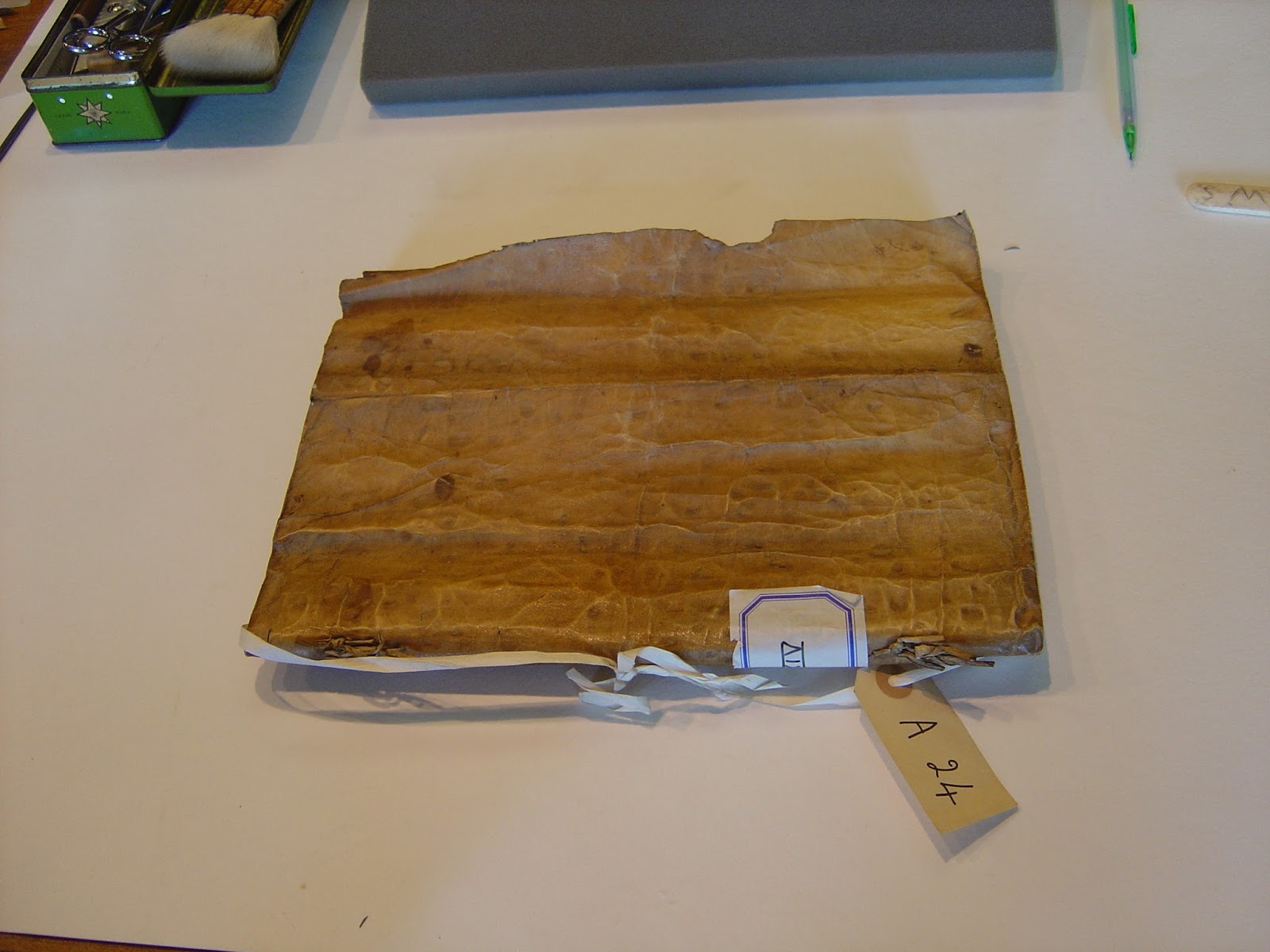
On Friday, Katerina was working on A. 24, a register from 1501-1510. A.24 is a register of leases and tithe payments, relating exclusively to land in Devon. There is a bit of a mystery  behind this register. The Cathedral priory, to our knowledge, never held any land in Devon, so we are all a bit stumped as to how or why this register which solely pertains to Devonshire properties has ended up at Worcester!

Nonetheless, I was interested to learn more about the construction of this register, and find out how Katerina will go about repairing it. Here’s what I found out.
Photograph, A.24. You can see the limp vellum cover and along the bottom of two tackets made of twilled parchment. These bind the quires to the cover. Photograph by K. Powell, conservator. Reproduced by the permission of the Chapter of Worcester Cathedral (U.K.)
 A.24 is a register is made up of two thick paper quires, tacketed or bound to a limp vellum cover, pictured above. The lower page has a flap on its outer edge. This flap would have originally wrapped around the register, and probably have been tied with an alum tawed skin tie, to offer additional protection. The vellum cover appears to have been re-used, and evidence of an earlier binding can be seen in holes on the front and back covers. This re-used vellum cover even has some earlier writing on it, which I have not attempted to decipher (yet.)


Photograph, A.24. You can see the severe curling of the edge of the leaves, and imagine the difficulty Caterina must have trying to unfold them all. Photograph by K. Powell, conservator. Reproduced by the permission of the Chapter of Worcester Cathedral (U.K.)

The binding was not done by a professional but more likely in house, perhaps at Worcester. It is an early type of stationary binding, a very basic construction. The tackets (the bits that hold the pages to its cover) are made from twirled parchment and run through two layers of parchment stays.
What I found interesting about A.24 is that, although the cover and the binding are made from parchment, the text-block or quires are all made of paper. This is probably because late medieval writers clung to using parchment as a binding material, often believing it to be far stronger than paper.

There is a large amount of surface dirt on both the binding and the text-block. Therefore, the first stage of conservation is cleaning. As a substantial portion of the text-block has edges that are severely curled, Katerina has to painstakingly uncurl the edges before she can begin the cleaning process with a smoke sponge. The cleaning process for A.24 will take Katerina one day.
Photograph, an earlier conservation project. Manuscript being undergoing treatment with gortex. Photograph by K. Powell, conservator. Reproduced by the permission of the Chapter of Worcester Cathedral (U.K.)
The next stage after cleaning is humidifying the paper. The pages will be humidified in a Gore-Tex and capillary matting sandwich. The matting is a polyester wadding like material which holds the moisture, Gore-Tex lets a small amount of the moisture through and gently humidifies the paper. Two pages can be humidified at the same time. The pages are then pressed between blotting papers until dry. This will flatten the curled edges.
The second issue needing attention is the tears that have resulted from the severe curling of the edges of the pages. These will be repaired by Katerina using Japanese paper and wheat starch paste. Japanese paper is especially useful in conservation because of its long fibres, which make it very strong and well suited to repair work.
Broadly speaking, Katerina uses Japanese paper along the grain on the tears because it shrinks less when used this way. For larger repairs to the text-block she often uses Japanese paper across the grain because this maximizes the strength of the repair.
A.24 will be completed over the next month, leaving around ten more registers to conserve. We are very grateful to Katerina and her colleagues for their continuing help and hard work. The medieval registers are one of a number of conservation projects we are currently involved in. The link below provides information on some of our other conservation work. If you feel that you would like to support the ongoing conservation work at Worcester Cathedral Library, click this link to find out how:
http://worcestercathedral.co.uk/index.php?pr=Library_Conservation