Wednesday, 22 January 2014

Henry Philpott Bishop of Worcester 1860 to 1890


If you visit Worcester Cathedral you might see the fine sculpture by Sir Thomas Brock of Henry Philpott, who was Bishop of Worcester between 1860 and 1890. The statue was originally positioned in the south Transept. Today, many visitors may not realize why a statue was made in his honour, and paid for by the public. This would surprise our Victorian ancestors who knew him as a great mathematician, an able administrator, and a man deeply committed to charity.

Bishop Henry Philpott of Worcester. Photography by permission of the Dean and Chapter of Worcester Cathedral (U.K.)


Henry Philpott, born in Chichester, was from an early age a gifted mathematician and classicist. As an undergraduate he was awarded the position of Senior Wrangler at Cambridge University, and was Smith’s Prizeman. His exam answers were kept for many years by the University because of their quality. He became a Fellow of St. Catherine’s College, and later went on to be the Master of the College from 1845 to 1860, and was Vice-Chancellor of Cambridge University on three occasions. He did this job so well that he impressed Prince Albert, who made him his Chaplain.


Autographed picture of Bishop Henry Philpott. Photograph by permission of the Dean and Chapter of Worcester Cathedral (U.K.)
Yet it was his actions as Bishop which made him beloved of his Diocese. He was a hard working man, who realised that debates are often pointless and that he could achieve far more in life by avoiding the House of Lords, meetings, congresses, Lambeth Conferences, and Convocations whenever possible. As a moderate Evangelical he devoted himself to his Diocese and to charitable work. He helped local churches in need of repair, offering sums of money from his own pocket. For example, he gave an acre of land to Lower Mitton when it needed an additional churchyard, and £1,250 to All Saints, Worcester. He also helped poor clergy. He had a substantial private income, and was frequently able to give away most of his official income to charities and charitable causes, both private and public. He also extended this charity to fellow Protestants in non-conformist churches in Worcester and Stourbridge. He founded scholarships, for example at Malvern Proprietary College in the 1860’s, and served as chairman of the Trustees at Bromsgrove school, where a stained glass window was erected in the school’s chapel in 1891. He was also interested in health matters and was a Governor of Worcester Infirmary, and was a patron of the Worcester Ophthalmic Hospital. He also attended meeting of Philanthropic societies in his Diocese.

Bishop Philpott was not a great public speaker. He only had three addresses for confirmation ceremonies. However, he was conscientious in replying to all correspondence and never relied upon a secretary. In 1881, he escaped being killed in his own library at Hartlebury Castle, when a large stone monument to Bishop Hurd above the door fell down only moments after he had been there.

In 1846 Philpott married Mary Jane, the daughter of the Marchese di Spineto. In 1878 the Bishop’s wife went blind. When he came home each evening Bishop Philpott would read to her. Despite her blindness she also enjoyed walks around the Castle’s gardens with her husband. The Bishop resigned the Bishopric in August 1890, and retired to his much-loved Cambridge, where he died. On his retirement money raised was put towards the gift of a silver ink stand, but the majority of the money established the ‘Philpott fund’ for the Pensions of the Clergy in the Diocese. This was because the poverty of the clergy at the time was an issue that Philpott was only too aware of. He is now buried at the Church of St. Mary at Bishop’s Wood in Hartlebury, which he built.


One volume of Dr. Samuel Johnson's works donated by Bishop Philpott to the Cathedral. Photograph by permission of the Dean and Chapter of Worcester Cathedral (U.K.)

Bishop Philpott generously donated many books from his own collection to the Cathedral Library. The cathedral’s archive also shows that the Bishop was involved in the administrative side of the Victorian restoration of the Cathedral, and provided the new Bishop’s throne. He died leaving a large sum of money, including generous legacies to the Church Pastoral Aid Society, and the Church Missionary Society.


The catalogue of books Henry Philpott gave to Worcester Cathedral. Photograph by permission of the Dean and Chapter of Worcester (U.K.)


When visiting Worcestershire, why not also look at Hartlebury Castle and its excellent Hurd Library. Their link is as follows: http://www.hurdlibrary.co.uk/


David Morrison, with thanks to Mr. David Everett for research.

Wednesday, 15 January 2014

Heritage and History of Wales - Part 2: South Wales

In a continuation of last month’s blog about Grose’s book of Welsh antiquary, with a focus upon North Wales, this month’s blog delves into the history and myth of the counties of South Wales, which Grose discovered on his travels in the late 18th Century.

A map of Wales 1696. By permission of the Dean and Chapter of Worcester Cathedral (UK).

            The county of Glamorganshire, located in the far south of Wales, encompassing Swansea and Cardiff, was notable in 1789 due to it being “fruitful, pleasant and populous”, to the extent that it was often called the “Garden of Wales”. Additionally, being home to over 25 castles and a number of abbeys and priories, demonstrates this county’s historical, strategic and religious significance. Of the multitude of sites, Cardiff Castle Tower probably can lay claim to the most intriguing story associated with it, as it was the building in which Robert Duke of Normandy, brother of William Rufus and Henry I, was confined to for over 26 years.  Following his escape and recapture during this period, he was blinded when his optic nerve was destroyed by a hot brass baton close to his face. Following a further incident with his brother, the Duke of Normandy refused nourishment and starved himself to death.

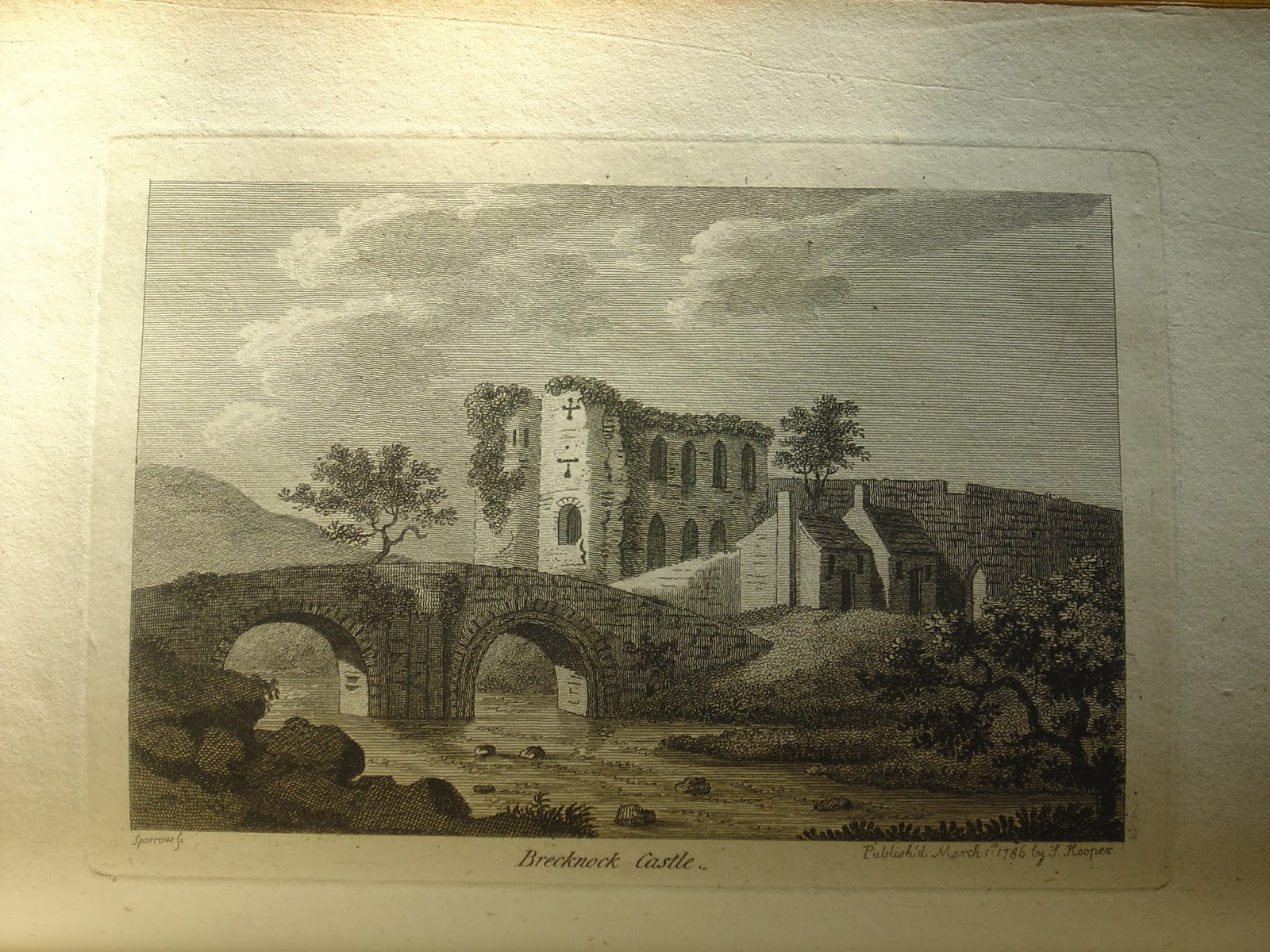
            The largest county in Wales at the time, Brecknockshire, situated to the north of Glamorganshire, was noted for its mountainous landscape. In terms of Brecknockshire’s historical buildings, the most significant is undoubtedly Brecknock Castle, built during the reign of William Rufus, by Barnard de Newmarsh, who had immense lands due to his marriage to the grand-daughter of Gryffyth ap Llewellyn Prince of Wales. In an act of revenge against her son for reproaching her behaviour, she declared him illegitimate, causing him to be disinherited. This resulted in the castle and estate passing to his sister and then through her female descendents to the Mortimer family.

An engraving of Brecknock Castle. By permission of the Dean and Chapter of Worcester Cathedral (UK)
            The county of Radnorshire, north of Brecknockshire, is described as “the most barren county of all Wales and its air is “cold and piercing”. Despite this, the mineral water at Llandrindod was very popular and also the Offa’s Dyke Path, now a popular walking route, originally the boundary running from the mouth of the Wye to the mouth of the Dee, made by Offa, King of Mercia.

            At the time that the book was written, Cardiganshire, modern day Ceredigionshire, had a population of 35,380 inhabitants, and only had four market towns: Aberystwyth, Cardigan, Llanbadernvaur and Tregaron. A site of historical and archaeological importance to this day, the Abbey of Strata Florida, was built in 1164 for Cistercian monks and is thought to be the burial place of many welsh princes. Unfortunately, now nothing more than ruins remain of the abbey.

An engraving of Strata Florida. By permission of the Dean and Chapter of Worcester Cathedral (UK).
            The county of Carmarthenshire, described by Grose as “the most fruitful county in Wales”, was a big producer of wood, corn, cattle, game, sea and river fish, coal and lead. A particularly interesting statement made by the author is that near Carmarthen is a spring which ebbs and flows twice every 24 hours. Although this is now claimed to be myth, it is interesting to consider whether the author noted down a myth he had heard about the spring, or whether at the time he visited, it did in fact ebb and flow. Another interesting site within this county is Kidwelly Castle, built soon after the Norman conquest, and destroyed and rebuilt on a number of occasions, as it passed from the Normans to the Welsh and later from the Royalists to the Roundheads. Despite this, the present day castle still contains remains from 1200 and 1460.

A map of Carmarthenshire. By permission of the Dean and Chapter of Worcester Cathedral (UK).

            Pembrokeshire was and is notable for its multitude of stunning headlands, such as Strumble Head and Cape Stuncuin. This beautiful county however, is also home to a large array of mysterious and unusual sites and artefacts. Firstly, in the vicinity of Newport, there were said to be seven barrows, one of which when opened, contained five urns full of “burnt bones and ashes”, and whose presence was unexplained. Additionally, near St David’s was a stone “one hundred oxen could not move”, called The Rocking Stone, which was apparently rendered immovable by Cromwell’s soldiers. Finally, Buck’s Pool, near Stackpool, was described as a “pit of water that cannot be fathomed”. This dubious comment was probably due to the fact that it was fed from a redundant spring never known to stop in summer or winter.

These two blog posts explored only a small sample of the sites mentioned in Grose’s fascinating book. However, the book and others in the series are available to view by appointment.


Carys Aldous-Hughes

Wednesday, 8 January 2014

Heritage and History of Wales - Part 1: North Wales

Within Worcester Cathedral Library is a captivating and highly intriguing tour of Wales. It can be found in volume VIII of Grose’s Antiquities of England and Wales, published in 1789. This is a contemporary history of a multitude of fascinating sites within the counties of North and South Wales.

The author, Francis Grose was born in 1731 in London. He was the eldest child of Francis Joseph Grose, a Swiss immigrant and jeweller, and his wife Anne Benet. Earlier in his career, Grose had success in the armed forces, but in 1757, he was elected as a member of the Society of Antiquaries. As a result, he travelled to many parts of England, Scotland, Wales and Ireland, in order to collect material for his volumes on antiquary. He died during his final expedition of this type to Ireland, and is buried in Dublin.

This blog focuses upon his discoveries in North Wales, which encompassed the grand castles of Anglesey, ancient druidical monuments of Denbighshire and enormous standing stones found in Montgomeryshire.

This is a map of Wales .By permission of the Dean and Chapter of Worcester Cathedral (UK)

Being one of the smallest counties in Wales at the time, Anglesey’s population numbered only 12,000 inhabitants and despite being “stony and mountainous”, produce from the island included wheat, cattle, sheep and fish, in addition to copper, mill stones and red, yellow and blue ochre. Anglesey’s most impressive site was Beaumaris castle, built in 1295 by Edward I, which, during the English Civil War, was held for the King until 1649, when it was surrendered to General Mitton. It is possible, however, that all the riches were buried in preference to being surrendered to the Roundhead leader, as there have long been suspicions that large amounts of treasure were concealed both within the vault and the vicinity of the castle.

On the Welsh mainland, to the South East of Anglesey was the striking county of Caernarvonshire, surrounded on three sides by the sea, with “fruitful valleys” and perpetual snow covered mountains. It contains a multitude of features from Snowdon Hills to Orme’s Head and Dolwyddelan Castle to Caernarvon Castle. Of particular interest to Grose is Dolwyddelan, built in the year 500, on an ancient road through the mountains called Helen’s Way (aka Sarn Helen). The birthplace of Llewellyn the Great and residence of Gryffydd ap Tudor, the castle was later purchased by Meredydd ap Jevan during the reign of Henry VII. Despite being resided in by outlaws, Meredydd favoured the castle over his former family residence, as it was said that relations with his family were so poor, that it was said to be a case of either “kill or be killed”. At the castle, however, he established a successful garrison, which included “seven score of the tallest and ablest bows men”.
An engraving of Dolwyddelan. By permission of the Dean and Chapter of Worcester Cathedral (UK)

Of significant Roman and Druid heritage, the county of Denbighshire, to the East of Caernarvonshire, has a variety of Druidical monuments and stones, along with the remnants of a Roman fortification said to be the camp of Caractacus and a tomb stone with Roman inscriptions at the Hill of Graves. Additionally, Denbighshire has a Cistercian abbey dedicated to the Blessed Virgin Mary called the Abbey of Valle Cruis, founded in 1200, and is now said to be one of the best preserved in Wales.

Despite being the smallest counties in Wales at the time, Flintshire contained many sites of historical and religious significance. Most notable is St Winifred’s Well, which is thought to be the oldest continually visited pilgrimage site in Great Britain, visited since the 7th Century. James II and his wife Mary were among the many visitors, prompted by Mary’s inability to conceive, and shortly after their pilgrimage Mary became pregnant with a son. More ominous however, is the locally named “Stone of Lamentation”, a sandstone monolith, thought to mark the site of ancient treasure, but apparently with the power to conjure lightning and storms to deter possible treasure hunters.

A map of Denbighshire. By permission of the Dean and Chapter of Worcester Cathedral (UK)
The county of Merionethshire, situated on the Irish Sea, to the South of Denbighshire and Caernarvonshire is described by Grose as “mountainous and unwholesome” and subject to a “livid fire or vapour”, which caused destruction to land and livestock, prominently in the years 1542 and 1584. Of particular interest is Harlech Castle, which was of great military significance for both England and Wales. It was Owain Glydwr’s home and military base from 1404 to 1409, and later was held by the Lancastrian forces for seven years during the Wars of the Roses, before its siege by the Yorkist troops in 1468. It is now classed as a world heritage site and regarded as one of the finest examples of 13th and 14th Century military architecture in Europe.

Grose states that at the time, Montgomeryshire was the home to a very impressive collection of standing stones such as those found at Stonehenge in Wiltshire. They were said to be so large that it would be “hardly possible to move them with 50 yoke of oxen”. A particularly interesting and unusually site is Dolforwyn Castle, due to the legendary origins of its name. Dolforwyn (Meadow of the Maiden) is thought to allude to Sabra of Sabrina, the illegitimate daughter of Locrine (a king of ancient Britain). She was drowned in the River Severn by Gwendolen, Locrine’s wife, following his death, and she is said to be the inspiration for a poem, reproduced in Grose’s book, a sample of which is below:
“She guiltless damsel, flying the mad pursuit,
 Of her enraged stepdame Gwendolen
 Commended her fair innocence to the flood”


            To discover the mysteries of some of South Wales heritage, read next month’s blog. 

Carys Aldous-Hughes

Monday, 23 December 2013

Worcester Cathedral Christmas Services and Concerts in the 1920's and 1930's


At sometime over Christmas many people will visit their local church for a service. But what were the Christmas services of the past like? In the cathedral’s archives are scattered notes of the Christmas services held in the Cathedral in the 1920's and 1930's which offer some interesting reports from a broken musical instrument, the first performance of an Elgar carol, and charitable gifts and concerts.

The cover of the 1920 Carol Service for Worcester Cathedral. Image copyright the Dean and Chapter of Worcester Cathedral (U.K.)


What sort of music and carols were sung?

There are two copies of a carol service that was often used between 1920 and at least 1931. Some of the carols sung may be unfamiliar to you.  A processional hymn Christe Redemptor Omnium, the words of which were written in the sixth century and the melody composed in the eleventh were sung first, followed by the bidding prayer and the hymn O Come all ye Faithful. The carol From Jesse’s stock up-springing followed, which is an ancient melody arranged by M. Praetorius (1571-1621), and the carol In Dulci Jubilo arranged by R. L. De Pearsall (1795-1856), followed by A Carol for Christmas Day from William Byrd’s Song of Sundry Natures dating to 1589.

The Cathedral choir then sang In the bleak Mid Winter by Gustav Holst, words by Christina Rossetti, and then everyone sang The First Noel the angel did say, followed by a 15th century carol from the Processional of the Nuns of Chester - Qui creavit coelum, and then three carols: The Babe in Bethlehem’s manger laid, and Three Kings have come from the eastern land, and A babe is born of maiden pure, with the recessional hymn being While shepherds watch’d their flocks by night.

The 1934 Worcester Cathedral programme for its Christmas Nativity play. Image copyright the Dean and Chapter of Worcester Cathedral (U.K.)


Notable events in the Christmas services

In 1921 the cathedral’s new organ broke down at Evensong on Christmas Eve, whilst the Bishop of Worcester and the Countess of Beauchamp were attending. Thankfully, the services continued smoothly without it.

In 1928, the Cathedral’s Christmas time music was interesting for two reasons. Between 16th and 23rd December the Advent Antiphons, copied down in the Worcester Antiphoner were sung again in the cathedral. The Antiphoner dates to c.1230 but the music is from an earlier time. Boxing Day 1928 also saw the first performance in Worcester of Sir Edward Elgar’s Christmas carol I sing the birth. On Boxing Day 1930 Sir Edward was present in the Cathedral to hear another performance of his carol.

In Christmas 1931 a special music concert organized by Sir Ivor Atkins was held in College Hall to raise money for the building of an extension onto the Worcester Royal Infirmary. At that time, Christmas fundraising concerts were unusual at Worcester Cathedral, and had only happened on two other occasions- once in 1923 to raise funds for the organ and another in 1917 to help the Red Cross Depots in Worcester.

In January 1934, for the first time since the monastic era, a nativity play was performed in the cathedral entitled The Christmas Mystery. This included carols, readings from the Gospels, and tableaux of ‘actors’ in elaborate costumes.

Dean William Moore Ede who urged the congregation to donate to help German refugees. Photograph Copyright the Dean and Chapter of Worcester Cathedral (U.K.)


Collections for Charity and Good Causes

The collection on Christmas Day in the Cathedral in 1920 was for the Save the Children Fund, and in 1931 it was for the St. Lawrence’s home (Church of England’s Waifs and Strays Society). In December 1933 or 1st January 1934 the Dean William Moore Ede made an urgent appeal to the congregation for a collection to help refugees who had escaped to England from Germany.

Have a very Happy Christmas from everyone at Worcester Cathedral Library and archive.

Tuesday, 10 December 2013

A sheepskin manuscript with mysterious, missing artwork

Worcester Cathedral library MS F.9 is a fourteenth century manuscript of Flavius Josephus’ The Jewish War and the Antiquities of the Jews, which is thought to have been professionally made by a team of lay scribes and artists, though the exact location of production is unknown. Unlike many of our manuscripts, the monks of the Cathedral priory had no physical role in the production of F9, and we can provide no evidence for the priory owning the manuscript before the seventeenth century. As to how this MS came to the Cathedral is a mystery. Upon displaying it to visitors this summer we found it was a rather curious manuscript indeed, with a lot of scribal quirks and artistic oddities (such as the one pictured below). This week I explore what makes F9 an unusual item that stands out from the rest of our collection.


F9. A detail from the top line of a page,
the scribe has drawn a small profile head with
a large pointed nose. Photograph
© the Chapter of Worcester Cathedral (U.K.)
The first unusual point about MS F9 is that it is made from 324 leaves of thick sheep skin, rather than vellum (calf skin). This is uncommon for manuscripts of this date. Vellum was the usual choice of skin after the ninth-century, though the Saxons did reserve sheepskin for some special liturgical texts (for example the Echternach Gospels). Sheepskin is greasier than vellum and can often be more translucent, making painting directly onto it more difficult. F9 evidences some of the problems associated with using sheepskin for manuscripts. The hair side of sheepskin parchment yellows overtime and F9 has certain leaves which are severely yellowed.

This manuscript of The Jewish War has an unusually large number of (probably contemporary) repairs also; every few folios you will find a hole which has been sewn or repaired by pasting another bit of parchment on top. There are more holes found in F9 than you would normally find with a vellum manuscript, because the layers of sheepskin are fattier, therefore more prone to separating and allowing holes to develop. Even in cases where small holes are stitched up, it is not uncommon that the hole continues to grow and eventually bursts open the repair.


Yet by far the most puzzling thing about F9 is to be found on folio 229 (see pic below), where we can see that the artist has drawn out the border and square of an illuminated letter but left the space blank. A similar blank space for a decorated initial with a border is left on folio 230.  Illumination is generally accepted as the last stage in manuscript production. Only once the scribe or scribes have written the text block will the quires of parchment be passed on to an artist or a team of artists for decorating. Could it be that the artist simply forgot these pages? Did they make a mistake? Was the illuminated letter stolen from the manuscript at a later date?

Photograph
© the Chapter of Worcester Cathedral (U.K.)
We will never definitively know the answer as to why these two folios remain undecorated. It cannot be because they were considered unimportant, for within the manuscript folio 229 marks the beginning of the prologue by Josephus and folio 230 signals the beginning of the main text of The Jewish War. I also think it’s unlikely that these pages were forgotten, for the artist took the time to draw the title of the section at the top of the page in alternating blue and red. Moreover, the scribes or the artists have continued throughout the book to extend the descenders of letters on the last line of each page and embellish them artistically either with grotesques or frilled designs.
Looking at the manuscript, I’d like to suggest that there is evidence that these two illuminated letters with part borders were done, or at least designed, on a separate piece of parchment which was intended to be pasted onto the main body of the manuscript at the end. This was not an uncommon practice for illustrators working on sheepskin. As early as the ninth-century, according to Bischoff, miniatures were being painted onto separate pieces of calfskin and pasted onto folios of sheepskin, because the rough surface of calfskin proved better suited for coloured painting.[1]

 Looking through F9, you can see instances where the translucency of the sheepskin causes coloured inks to bleed from the verso to the recto, which must surely have been a source of frustration for the artists! Below is a picture of a completed illuminated initial in blue from f. 279. You can see that the sheepskin has been difficult to paint onto, and when the book has been closed, blue ink has bled onto the opposite page as the greasy nature of sheep skin means it struggles to absorb paint. It seems likely that these sizeable spaces have been left, then, with intention of pasting completed artwork onto them so as to avoid the inks running through to the underside of the page or blotting onto the other. If you run your finger over folio 229 (pictured above), the border is definitely raised suggesting that the outline in blue may be pasted down.
F9. an illuminated letter with border, looking to the opposite page there is blue ink which has been transferred. Photograph
© the Chapter of Worcester Cathedral (U.K.)
Perhaps the ultimate question with F9 is not 'why are these two folios missing decoration' but 'why did the stationer or workshop in which the manuscript was made opt for sheep skin in the first place, when it was known to be of lesser quality'? It could be that calf skins were in short supply at that time in the region where the manuscript was made, but we have no way of knowing this because no information or research has been done to shed light on where this manuscript was produced. Though we currently know little about the context of the production of this manuscript, F9 nonetheless provides a useful contrast to the rest of Worcester Cathedral Library's manuscript collection, the majority of which is done on vellum. It also evidences how making manuscripts, even in a professional context, could still have many challenges in the later middle ages and suggests that artists and scribes had to come up with inventive solutions to circumvent the challenges of working on sheepskin.


[1] Bischoff, Latin Palaeography trans. Daibhi O Croinin and David Ganz (Cambridge: Cambridge UP, 1990), p. 10.

Monday, 25 November 2013

Surgery and Medical Treatment by a Royalist Surgeon at the Battle of Worcester 1651

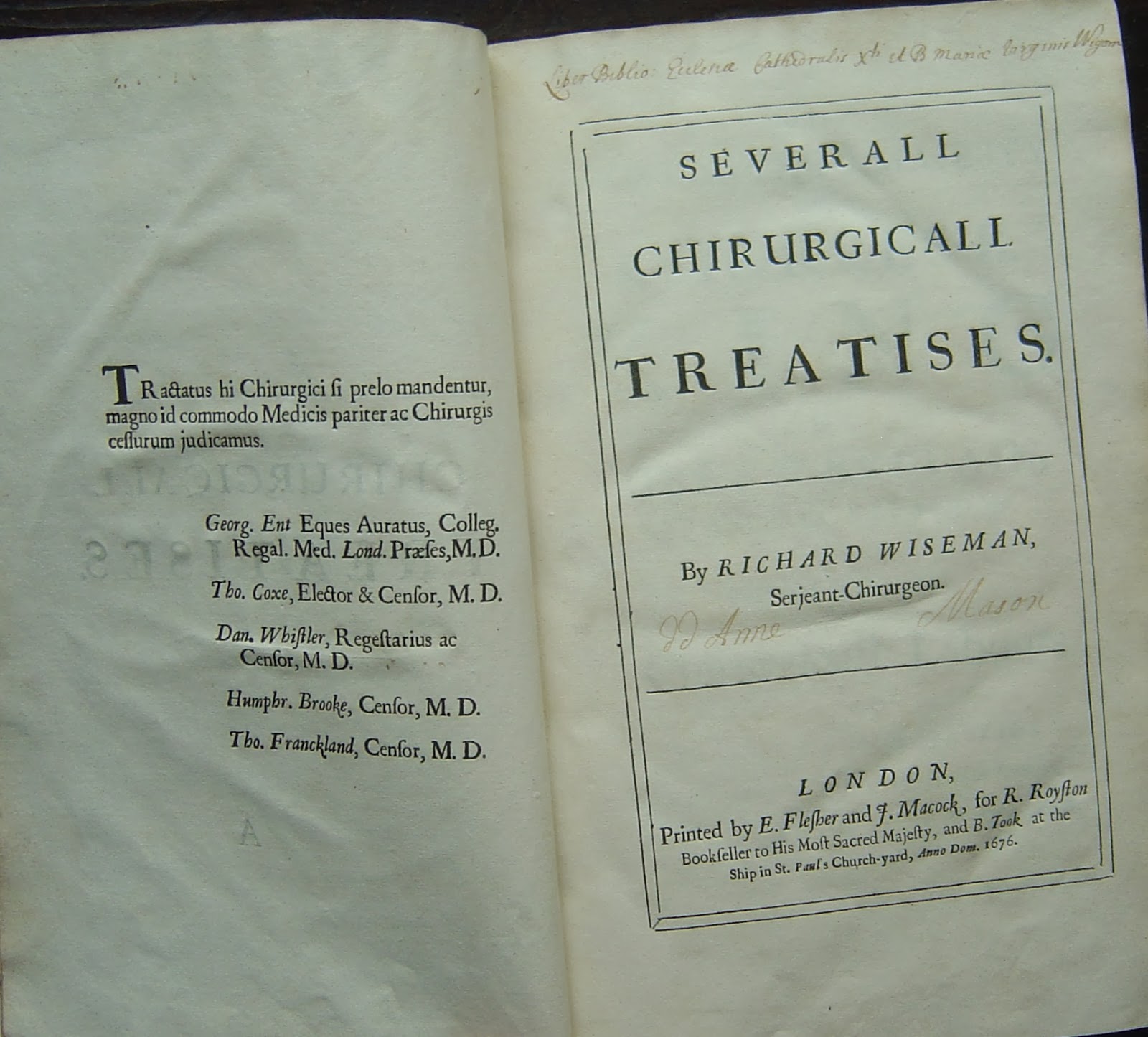
In 1676 Serjeant-Chirurgeon Richard Wiseman published his Severall Chirurgicall Treatises. Richard Wiseman was a surgeon who served in the Royalist army during the English Civil War, then as a Navy surgeon, and after the Restoration, acted as one of Charles II’s surgeons. His book covers such topics as a treatise on tumours, a treatise on ulcers, haemorrhoids, the King’s Evill, a treatise on wounds, gun-shot wounds, fractures, and venereal disease. In this week blog we look at just a few of the cases which he encountered.

The battle of Worcester 1651. Photograph by David Morrison. Reproduced by permission of the Chapter of Worcester Cathedral (U.K.)


Just before the Battle of Worcester, Wiseman was treating soldiers wounded in skirmishes. One man had a musket ball lodged on the right side of his head. Wiseman’s servant assistant William Clarke, whilst dressing the wound, felt the musket ball in the skull. He called over Wiseman who noticed the man could not speak. They made a circular incision, allowing the trapped blood to escape. Having cleaned the wound with a sponge dipped in vinegar they filled the gap with lint. When the bleeding had stopped some time later, they tried unsuccessfully to get the bullet out. Using an instrument called a Trepan; they cut away another hole nearby, which again released more trapped blood. This enabled them to pull out the bullet and the depressed bone fragments. They now saw that there was a large wound in the Dura Mater (one of the outer layers surrounding the brain). Nevertheless they dressed the wounds in the skull and bandaged the head. Whilst they did this, the man suddenly regained consciousness, and asked where he was. He survived the operation, but after the chaos of the ensuing battle Wiseman never saw him again.    


An eighteenth century depiction of the battle of Worcester 1651. Photograph by David Morrison. Reproduced by permission of the Chapter of Worcester Cathedral (U.K.)

During the battle, a royalist garrison held Fort-Royal just outside the city. The next case is of a soldier in the fort, who during the fighting was using his bonnet to carry a fresh supply of gunpowder to his fellows on the ramparts. He was just refilling his bandoliers (ammunition pouches to hold the powder), when a fellow soldier fired his musket too close to him. A spark from the musket ignited the powder and both men were horribly burned. Wiseman and his assistants dressed the wounds as best they could, covering the burns with some sort of oil and egg white mixture. William Clark, managed to cure the first soldier, and the latter was bandaged enough to allow him to escape the city.

In a case of a musket ball entering a soldier through one side of his chest, which passed out between two ribs on the other side of his body, they cleaned the wounds, and kept the hole between the ribs open to allow discharge of any matter. The wound was later cleaned, and the patient attended to after the battle by Wiseman’s assistant William Clarke, who later lived in Bridgenorth. The soldier was concealed in the city until he could make his escape.


Richard Wiseman's book on surgery. Photograph by David Morrison. Reproduced by permission of the Chapter of Worcester Cathedral (U.K.)

During the battle, a soldier came to where Surgeon Wiseman was working. The soldier was still clutching his broken sword and was covered in wounds, particularly around the head. Wiseman saw that the hairy scalp of one side of his head was hanging down his neck, and calling over his colleague William Clarke, they cleaned the wound with a sponge. They noticed many fissures, and some fractures on the head caused by various weapons. They freed the scalp of some bone fragments, and dressed the wound, applying liniment. At this point the Parliamentarians broke into Worcester. Wiseman decided it was time to leave in the middle of treating the soldier. However his young assistant and servant William Clarke remained and carried on treating the wounded even after the fighting was over. He later wrote to Wiseman and told him about the case. Three days after treating him, the soldier seemed in good spirits, but the head wounds were causing discomfort, and Clarke loosened two of the stitches to vent the wounds. He dressed penetrating wounds, and discarded damaged bone fragments. The soldier eventually recovered, traveled to the Indies and then served in the Tower of London.

A 1616 book on anatomy Wiseman might have seen. Photograph by David Morrison. Reproduced by permossion of the Chapter of Worcester Cathedral (U.K.)

Meanwhile, Captain Smith, leading a Company of Dragoons, was pursuing Wiseman and the defeated Royalist soldiers as they fled from the battle.  In the ensuing skirmish Smith was wounded across the right Temporal Muscle (on the side of the head) and was bleeding to death. He was brought to surgeon Wiseman’s quarters. Wiseman stitched his wound and, lacking enough medicines, dressed it with a little wheat-flower and the white of an egg, applying over it a compress which he described as being pressed out of vinegar, and secured with a bandage. Three days later Wiseman took off the bandages and found the wound to be healing. By this time, he had managed to get medical supplies from an Apothecary and sprinkled the lips of the wound with these. Two days afterwards he cut the stitches and applied “epuloticks” and after a couple more sets of fresh dressings the man recovered.

David Morrison

Monday, 18 November 2013

John Calvin's Preface to the Institution of the Christian religion.

How did a book intended for sixteenth century Spanish humanists and Spanish reformers end up in Worcester? Still in its original binding, it is still uncertain who purchased it, or donated it here. 


John Calvin's Insitution of the Christian Religion in Spanish. Photograph by David Morrison by permission of the Dean and Chapter of Worcester (U.K.).

The Cathedral library has a copy of the second edition of John Calvin’s book entitled Institution of the Christian religion, comprising of four parts, each divided into chapters. It was published in 1597 by Ricardo del Campo after being translated into Spanish or the “Castilian tongue” by Cypriano de Valera.

Woodcut of John Calvin, from . Reproduced by the permission of the Dean and Chapter
of Worcester Cathedral (U.K.)
Calvin prefaced his book with two introductions addressed to “All the faithful of the Spanish nation” who desire the advancement of Christ’s Kingdom”. He was in a buoyant mood because his first book had been warmly received in other European countries and he was very optimistic of its success in Spain also. In the second, shorter introduction he is full of thanks to Almighty God for looking favourably on his first book and he believes that he is duly bound to serve Him and all converts to his new doctrine to bring more and more people to Christ with his new improved volume into which he has poured his “meagre god given talents”. He stresses how hard he has worked in God’s service, to the extent that he became seriously ill and almost died from quartan fever one winter, but did not rest until he had got his book into its desired shape. Now, whatever happens to its author, it will stand as testament to the power of God and the rightness of the teaching based on the close study of the text of the Bible and the strict observance in everyday life of its laws. 

He sets out his work as a lawyer might, illustrating his arguments with detailed references from the Old Testaments and the gospels, writing with fervour and convinced that his Protestant ideas on the Reform of the Christian church are the only valid ones; that he is a warrior of Christ combatting the corrupt practices of the Catholic Church with his teaching and preaching.

Calvin saw the Roman Catholic Church as in the power of Satan, and took every opportunity to condemn its way of worshipping Christ. In his Preface he mentioned the Diet of Augsburg, one of the conferences organized by the Catholic Church to promote the Counter Reformation and heaped scorn on the “lies” they published about him. His duty was, with God’s grace, “to so prepare and instruct those who wish to study theology that they might easily learn Holy Scripture, have a clear understanding of what they might read and walk a straight path from which they never depart.” The end of the shorter preface stresses that the book deals so fully and clearly with all matters of religion that every reader who perseveres will be given a very useful tool with which to live a godly life and refute the statements of “the Enemny”. Calvin wanted no praise for his achievement but to be remembered before God by those who found spiritual benefit in the pages of the book.
Like other reformers, Calvin was a product of ideas stemming from the Renaissance. Scholars prized the Greek and Roman civilizations and in their intensive study of Green and Latin discovered new ways of looking at the language and meaning of the Bible in its original tongues, and the enigma of human existence. Such men were called “humanists”. Unfortunately the different ways they interpreted what they found set in motion religious divisions which remain to this day.


Erasmus from a Worcester Cathedral Library book. Photograph by David Morrison, by permission of the Dean and Chapter of Worcester Cathedral (U.K.)


In Spain humanism began to take root in the very early sixteenth century, when Erasmus’ writings began to be read in Spain. Spanish universities began to study and discuss the new religious ideas. The Catholic Church, however, was quick to imprison even moderate thinkers like Luis de León whose statue stands facing the old university building of Salamanca today. By the time Erasmus died in 1536, the Inquisition had pounced upon any attempt at reform and religious humanism was sent underground, though in the plastic arts and in literature the study of Renaissance ideas brought about what is called in Spain “El Siglo de oro” (“The Golden Age”), which spanned two centuries and produced world class artists and authors, reflecting the influence and splendour of the Catholic Church.

Betty Eggby