Thursday, 28 March 2013

Army Chaplains related to Worcester Cathedral


Within the main Cathedral of Worcester is the St. Georges Chapel. This particular chapel was created to honour the men and women of the county, who prior to 1936 had no specific area within the cathedral dedicated to their memories. The chapel was formally consecrated by Bishop Perowne on armistice Sunday 8 November 1936.
Rollo of Honour for original members of the British Expeditionary Force in the Worcestershire Regiment 1914-15 outside the St. George Chapel. Photograph by permission of the Dean and Chapter of Worcester Cathedral (U.K.)

Inside the chapel there are 6 stained glass windows, all of which show either the images of servicemen, regimental flags and badges and religious figures. Around the walls are hung 26 flags and banners, which represent the various regiments, militias, with two others representing the Royal Navy and the Royal Air Force.

The Rolls of Honour outside the George Chapel which people can consult. Photograph by permission of the Dean and Chapter of Worcester Cathedral (U.K.)


Around the walls of the chapel are a number of commemorative plaques, dedicated to either individuals, rolls of fallen comrades and regimental groups. Whilst the bulk off these are specific to the army, namely groups and individuals, there is one that is dedicated to a Capt. Patrick  Hamilton, of the Royal Flying Corps and one in honour of possibly the most famous person connected to the city in the twentieth century, that of Geoffrey Anketell Studdert Kennedy M.C.
The plaque in the St. George's Chapel to Geoffrey Studdert Kennedy or Woodbine Willie. Photograph by permission of the Dean and Chapter of Worcester Cathedral (U.K.)

There are a number of books written about the life and times of this remarkable man, together with the publications of his poems.

In brief, he was born in Leeds on 27th June 1883.He had 5 step brothers and sisters and 8 other brothers and sisters, from his father’s second marriage. He moved to Worcester in June 1914, where he was the vicar of St. Pauls, in the Blockhouse district of the city. He soon gained a reputation as a kind, generous and godly man around the city and was well liked in general. He volunteered to serve at the outbreak of the First World War and in December 1915 was appointed a Chaplain and posted to France. His dedication to duty and his tireless help with the troops earned him widespread respect and admiration, together with the nickname “Woodbine Willy”, this through the offering of cigarettes to injured and dying soldiers. He won the Military Cross for his reckless courage, he would often run into no-man’s-land to help wounded soldiers, either to pray over them or bring them back to safety. He died on 8th March 1929 of pneumonia aged only 45.

Whilst the deeds of Studdert Kennedy are noted and commemorated, there is another whose actions and devotion to duty are not noted within the Chapel area. A minor canon named Thomas Cuthbert de la Hey volunteered to serve during the First World War also. He held numerous offices and positions in the life of the Cathedral. Upon his enlistment he was sent to the front in September 1917 as a Chaplain, appointed to the 55th (Lancashire) Division, with which he served throughout the war.
Cuthbert de la Hey in his army chaplain's uniform. Photograph by permission of the Dean and Chapter of Worcester Cathedral (U.K.)


He also received the Military Cross in April 1918.It was awarded to him for his part played in the defence of Givenchy, fought from 9th  to 16th April 1918, ‘in recognition of personal bravery and devotion to duty’. Like Studdert Kennedy, his abiding aim was the comfort and help of his fellow soldiers. He organised a fund which was used for the purpose of this task and through this he was able to provide, on one occasion, a large case of biscuits, a large case of chocolates and a large case of cigarettes, which was divided amongst the men.

The dangers of the front were no stranger to him. He was home on leave at the end of June and returned on 13th July. The following morning he was wounded in the left arm by a high velocity shell!
Reverend Cuthbert de la Hey in more peaceful times.Photograph by permission of the Dean and Chapter of Worcester Cathedral (U.K.)

He survived the war and returned to clerical life in the city. The actions of this man were almost a mirror image of Studdert Kennedy: both had an unswerving loyalty to their fellow man. To find out more about Woodbine Willie why not have a look at Bob Holman's new book: Woodbine Willie- An Unsung Hero of World War One (Lion books 2013).

By Adrian Skipp.

Thursday, 21 March 2013

PRINCE ARTHUR: 1486-1502


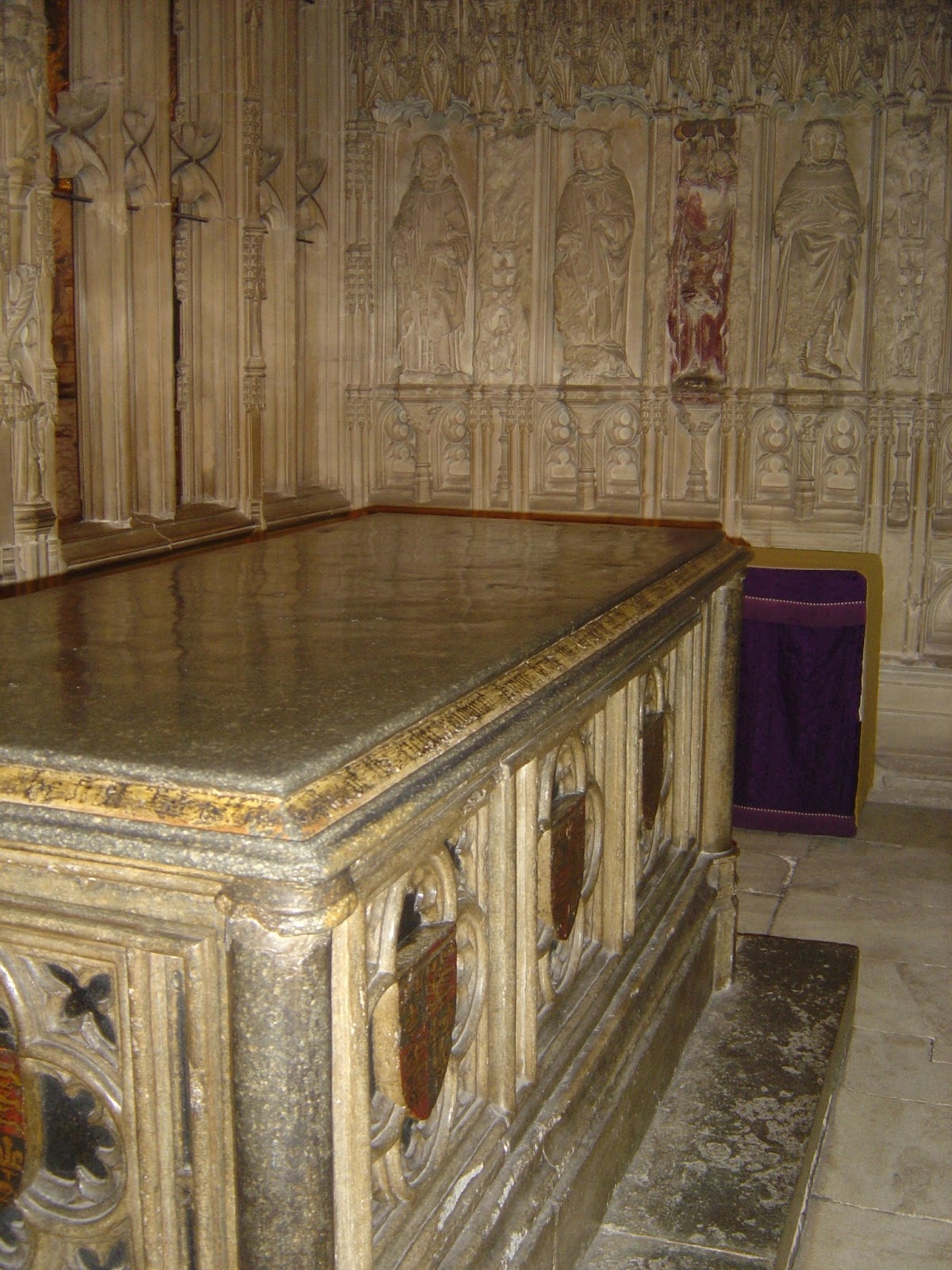
Prince Arthur was the oldest son of Henry VII, the first Tudor king, who erected the tomb to contain his son’s body after his death at the age of only 15. Arthur was married to Catherine of Aragon, daughter of Ferdinand and Isabella of Spain. Catherine was to become Henry VIII’s wife after Arthur’s death.
Prince Arthur's Chantry Chapel. Photograph is reproduced by permission of the Dean and Chapter of Worcester Cathedral (U.K.)

Arthur was born in the castle at Winchester to Elizabeth of York, his father Henry VII being the former Lancastrian claimant to the throne. It was hoped that the birth of Arthur, as son of both factions in the Wars of the Roses, would end the bitter rivalry. As a child, Arthur had many titles and duties thrust upon him and even became Regent while his father was away in France. He was Prince of Wales and Lord of the Marches and with his Council was responsible for keeping the peace in Wales and along the borders. He often went with his parents on visits to the border country and went to Shrewsbury and Worcester, and with his grandmother, Lady Margaret Beaufort, probably visited Malvern. Ludlow Castle became one of his official homes, with his Council.
The tomb of Prince Arthur Tudor. Photograph is reproduced by permission of the Dean and Chapter of Worcester Cathedral (U.K.)

His formal education followed a typical Renaissance classical pattern. He studied Latin and Greek grammar and the great Latin and Greek authors, in between and during his travels and other duties.
A stained glass window of Prince Arthur in the Cathedral near the Chapel. Photograph is reproduced by permission of the Dean and Chapter of Worcester Cathedral (U.K.)

Arthur’s marriage to Catherine was considered to be vital. An alliance between Spain and Britain would bring trade to Britain and also help to diffuse some of France’s dangerous power. Proxy ceremonies of betrothal and marriage were held while the two children were very young. When Catherine arrived in England she was “welcomed by the whole people”.  They were married in St Paul’s Cathedral when both of them were just fifteen. The prince and princess were to spend their honeymoon in Ludlow Castle. However Arthur caught a fever and was too delicate to recover from it. He was dead within five months.  
The Tudor Rose and the Prince of Wales's badge carved on the Chapel. Photograph is reproduced by permission of the Dean and Chapter of Worcester Cathedral (U.K.)

Arthur is said to have been a gentle prince, in total contrast to his younger brother Henry. His tragic death was mourned by all and after lying in state for three weeks at Ludlow Castle, the body was transported to Ludlow Church where masses were sung. Three days later the cortege set out for Worcester where the body was placed on a magnificent bier. The next day a long series of funeral services began   It is said that the corpse was laid in the grave “with weeping and sore lamentation”.  

Henry VII had the beautiful Chantry Chapel built to be Arthur’s final resting place and also to be a place set aside for prayers for Prince Arthur’s soul.
Giving you an idea of the height of the Chapel raised above two medieval tombs. Photograph is reproduced by permission of the Dean and Chapter of Worcester Cathedral (U.K.)

From the death of Arthur came the marriage of Catherine to Henry, the divorce and Henry VIII’s subsequent quarrel with the Pope. The history of England might have been very different had Arthur lived to ascend the throne.

by Mary Somers

Thursday, 28 February 2013

Carrying out Local History Research at Worcester Cathedral's Archive.


By Vanda Bartoszuk
Have you ever wondered about the history of your village, house, church or other building? When was it built? Why was it built? Who owned it? who lived there? Then perhaps we can help you.In the Cathedral Library we maintain not only books but many documents relating to holdings of the medieval Cathedral Priory of Worcester, some dating back to the thirteenth century, and from 1540 onward the archives of the Protestant Dean and Chapter of Worcester Cathedral.
If you are not sure where to start your research, then our Librarian is able to guide your search using our holdings.  Added to which, many of the library volunteers have their own areas of research and are willing to share their expertise to help you.It's a good idea to begin your research from what you know for certain and work back gradually step by step. Maps are a brilliant place to start as Ordnance Survey maps dating back to the nineteenth century are easily available to be searched online or in your local Record Office.


Maps

Once you have established the place you are searching for was around in the nineteenth century then the Tithe and Enclosure maps and associated apportionments are particularly useful to take you a step further back in time.
These photographs are Pre-Enclosure and Post-Enclosure maps of Iccomb showing how the former medieval land management system which consisted of strips of individual holdings around the village were later turned into large single ownership fields.
This photo is copyright of the Dean and Chapter of Worcester Cathedral, UK

This photo is copyright of the Dean and Chapter of Worcester Cathedral, UK


From the sixteenth century onward, some landowners, including the Dean and Chapter, began to employ surveyors and cartographers to make maps of their lands. These maps can provide not only details of the boundaries of the estate but also the houses that were there and sometimes who owned them. They might include information on adjoining manors and parishes. And don't forget to look for early books that have been published covering your area they may include maps.
This photo is copyright of the Dean and Chapter of Worcester Cathedral, UK

Section of map from The History and Antiquities of the City and Suburbs of Worcester by Valentine Green published in 1796
Deeds

Deeds are another source of information.  Owners or holders of property are said to have a 'title' to that property and the term deeds is the collective name for a variety of documents which help to prove that title.   Many deeds can appear complicated but don't be put off as they are formulaic and the information contained within them is easily understood once you grasp the way they are laid out.
Deeds can provide a vital means of tracing the history of a particular piece of land, building or house.   They may even include information on previous owners, previous uses and even previous rights associated with the property.  They can even sometimes contain detailed descriptions of the property at a particular date, if you are lucky perhaps they may even include lists of fixtures and fittings!
This photo is copyright of the Dean and Chapter of Worcester Cathedral, UK

This is a cathedral lease of 1768


Manorial Records


To go even further back in time manorial records can be useful for family history as tenants of the Lord of the Manor appear in many of the court rolls and rentals. The names of the pieces of land they held can survive down the centuries to be still traceable today.  Another avenue to explore may be a manorial rental.  This was a list of the names of all tenants who held land in the manor, together with a description of the land they held and a record of the rent they paid.  
This photo is copyright of the Dean and Chapter of Worcester Cathedral, UK

A rental about Himbleton village from 29th July 1502 in the reign of King Henry VII


The manorial system in England and parts of Wales affected much of the population until well into the seventeenth and eighteenth centuries. In fact some manorial courts operated in a few areas until the early years of the 20th century.


And Last but not Least - Things are not always what they seem:

On maps North is not always at the top!  Always look to see if a Compass Rose or North Arrow is drawn on the map.

The scales vary.  Some of these will be easy to interpret, for example six inches to a mile. Others are more difficult, referring to measurements such as roods and chains and yet others may be represented graphically, using a calibrated bar.

Roads move.  Look out for trackways, some become roads, some disappear, but they lead somewhere, or used to lead somewhere.

Names change.  Clerks sometimes had to choose between various phonetic spellings of local names.

Finally, as with any piece of research, there will be dead ends and disappointments, but don’t give up.  If one line of research comes to a halt, retrace your steps to known facts and start again – every house, church or village will have a different history that requires a unique research path.

Friday, 22 February 2013

A very successful author: Ellen Wood


Ellen Wood is the first woman who, by her own work and abilities, won a place among the great of Worcester who are commemorated within the Cathedral. She was born Ellen Price on 17th January 1814.
Ellen Wood's plaque. Photograph copyright the Dean and Chapter of Worcester Cathedral (U.K.)

She married aged 21 years and had the misfortune of having to leave Worcestershire with her new husband. Ellen Wood, or as she was more commonly known to her readers at the time Mrs. Henry Wood, turned her hand to writing novels after her husband’s business’s failed. It came to be one of the wisest decisions she ever made because her books proved to be extremely successful across the English-speaking world. To say that her novels sold well would be an understatement. Her stories gave a true picture of the life of the people of Worcester, of the King’s School and of the Cathedral. Her depictions of the Worcestershire countryside were fresh and vivid and she wrote in a simple and natural style of early Victorian life. Her ‘Johnny Ludlow’ stories are considered to be her supreme achievement. Many of these tales focus on romance or unhappy love entanglements. Some of her fiction concerns an aspect of rural life, a few are ghost stories or tales of schoolboy pranks and a high proportion are crime stories. She also wrote for periodicals, and found time to be the editor of a monthly magazine.

Her father, Thomas Price, was the chief glove manufacturer in the city and the family lived near the Cathedral. He was a most cultivated man and associated with the deans and canons. Thus the future Mrs. Henry Wood knew the families of the dignitaries and observed their foibles. Her boyfriends were King’s School scholars and she knew all the school gossip from them. Her father’s connection with the glove trade meant that she could draw on her knowledge of the town’s inhabitants when she began writing. For many of her stories, she was able to resurrect her early memories.

Bishop Carr. Photograph copyright the Dean and Chapter of Worcester  (U.K.)

In her novel East Lynne, there is the incident of the body of the heroine’s father Lord Mount Severn being seized before a funeral can take place, due to unpaid debts. The author actually based this on a true event that happened at Worcester. Bishop James Carr (1831-1841), a good friend of King George IV, died in debt due to a lavish lifestyle. As a result his body was seized by debt collectors. His relatives were forced to pay over securities for them to go ahead with the ceremony. Not all of the clergy were so unfortunately remembered by her. Her son later recalled to the cathedral in 1916 that she often used her memories of the handsome Dean Lord George Murray (1828-1845) in her novels. Murray, son of a Scottish Earl, was Dean of Worcester when Ellen was growing up in the city.
Dean Lord George Murray. Photograph copyright the Dean and Chapter of Worcester (U.K.)

Another of the many connections with Worcester is that No. 2 College Green was used in her novel The Channings. She was also good friends with Canon Benson, whose bust is kept in the cathedral library to this day.


Canon Benson. Photograph copyright the Dean and Chapter of Worcester Cathedral (U.K.)


Ellen Wood died 10th February 1887, and in 1916 a plaque commemorating this successful writer was finally unveiled in Worcester Cathedral near the entrance to the tower. Her son also gave a sum of money to the King’s School Worcester to endow a writing competition for the best essay on Worcester, its neighbourhood, or any other subject. The plaque was made by the sculptor Miss D. S. Wise A.R.C.A. The Cathedral library in its modern reference section holds a copy of her novel East Lynne.

Mary Somers
  

Thursday, 14 February 2013

Izaak and Anne Walton: A Staffordshire lady in Worcester Cathedral


Izaak Walton. Photograph copyright the Dean and Chapter of Worcester Cathedral (U.K.)

It’s Valentine’s Day and so the blog this week looks at the story of a couple, which reflects this. In the Lady Chapel at the East end of the cathedral you will find a small white marble monument. The inscription states:

                        
Here lyeth buryed, soe much as
could dye of ANNE,the wife of
IZAAK WALTON
who was
A woman of remarkable prudence
and of the Primitive Piety, her great
and generall knowledge: being adorn’d
with such true Humility, and blest
with soe much Christian meeknesse as
made her worthy of a more memorable
Monument.
She dyed  (Alas that she is dead)
the 17th of Aprill 1662. Aged 52.
Study to be like her

Izaak was born in August 1593 in Stafford. He moved to London, where he lived in the parish where John Donne was vicar. They became friends. In 1626, Izaak married Rachel Flood. They had seven children, who all died by the time they were in their teens, and then Rachel died. However, in the 1640’s Izaak married Anne Ken. His nickname for her was Kenna. They had two children, imaginatively named Izaak and Anne. During the dark days of the civil war, Izaak decided to escape Puritan London and return to his native Stafford. Once safely in the Midlands, the Waltons gave succour to Doctor George Morley, a Royalist clergyman wanted by the Parliamentarians.
Bishop Morley. Photograph copyright the Dean and Chapter of Worcester Cathedral (U.K.)

Morley had stayed with them in Stafford before going into exile in France with King Charles II. Morley had stayed with King Charles I as long as he was allowed and also ministered to Lord Capel, another captured Royalist commander when he was on the scaffold. After the Restoration of the monarchy, when Morley became Bishop of Worcester, he was able to repay their bravery and kindness by appointing Izaak his steward.

Unfortunately, Anne contracted a fatal illness while living at the Deanery with her husband. In the cathedral archives there is a record of two pounds being paid for the choir to sing at Anne's funeral by Izaak.
The Anne Walton monument. Photograph copyright the Dean and Chapter of Worcester Cathedral (U.K.)

Izaak Walton wrote the inscription to his beloved wife originally in his Prayer Book, which has slight differences to what is on the monument. Walton first wrote “of Primitive Piety”. The change is to clarify that her piety was that of the reformed church (i.e. The Church of England). The monument is not the only memorial to his wife. Walton also wrote a ballad in which he refers to ‘my Kenna’ (Anne).

Izaak himself is of course famous in his own right as the author of The Compleat Angler, and author of The Lives of John Donne, Henry Wotton, Richard Hooker, George Herbert, and Robert Sanderson. The cathedral library does not have the Compleat Angler but does have his other works. Izaak Walton died at the age of 90 in 1683 at the home of Doctor Hawkins, a Canon of Winchester Cathedral. Walton had moved to Winchester when Doctor Morley became Bishop of Winchester.


Liz Sydney

Monday, 11 February 2013

The alchemist: Bishop John Thornborough, 1551-1641


The monument at the West end of the cathedral.  Image is copyright the Dean and Chapter of Worcester Cathedral (U.K.) 

In the west end of the cathedral is a large striking monument. It commemorates one of the more unusual bishops of Worcester. Bishop Thornborough wrote a book on alchemy published in 1621. Alchemy was the study of turning base metals into gold and was a term for chemistry from the middle ages to the early modern period. Some of the wording and numbers on his monument often intrigue visitors as it appears to be a code. It is believed one half translates as: “In Him, who is the source, the beginning, the middle, and the end of all existence and perfection, though I breathe no more, yet shall I hope.”  The other part of the inscription is believed to read: “While I live I hope for the perfection of wise men”. The first part was worked out by John Noake in 1856 and published in his Notes and Queries on Worcestershire, and the second part was quoted by Dean Moore Ede in his 1925 book on the cathedral’s monuments.
 The bishop's effigy. Image is copyright the Dean and Chapter of Worcester Cathedral (U.K.)

John Thornborough was born at Salisbury, Wiltshire in 1551 and was educated at Magdalen College Oxford. It was recorded that whilst there, his fastness of living took over from his diligence of study. After university he was ordained in the Church. In 1580 after holding several livings he was appointed one of Queen Elizabeth’s chaplains. In 1589, he was appointed Dean of York, to which was added a Prebend and later two rich Yorkshire livings: all of which he held until arriving at Worcester as bishop in 1617.
A document in the cathedral archives. The Bishop appointed a  keeper of Hartlebury Castle.  Image is copyright the Dean and Chapter of Worcester Cathedral (U.K.) 

In 1593, Thornborough was appointed Bishop of Limerick where as an active supporter of the crown he made his next move in 1602 as Bishop of Bristol: but still was Dean of York. At this time James I became King of England and the Bishop showed his loyalty by publishing two books praising the king’s wisdom in visiting the kingdoms of England and Scotland.
Another document in which the Bishop appointed a keeper of Hartlebury Park. Image is copyright the Dean and Chapter of Worcester Cathedral (U.K.)


January 1617 saw Thornborough elected Bishop of Worcester and whatever traits of his early character had surfaced prior to this appointment; he now fully displayed them until his death in 1641. He decided to appoint to the two best benefices in his diocese Hartlebury and Upton-upon-Severn his son-in-law and chaplain; but the king wished to appoint two friends and therefore the Bishop was forced to withdraw his nominations.

Thornborough’s twenty-five years in office was a period when a breach developed between the people and the Crown. There was popular sympathy with the ideas of the Puritans on theology and on church ceremonies. The bishop was much in sympathy with the popular view, but the Dean Dr. Mainwaring was strongly in support of the arbitrary power of the king. Perhaps this is one reason why the cathedral library does not have a copy of Thornborough's book or any books belonging to him. 

In 1626 the forty year lease on the Carnary Chapel to the Chapter Clerk expired and Bishop Thornborough took this over at the same rent 6/8d per annum and used the chapel as a hay barn. In 1635, Dean Mainwaring was ordered by the Archbishop to restore the Carnary Chapel to its proper use. A new Dean Christopher Potter was appointed in 1636 and decided, faced with an expanding library, to move it to the schoolhouse (Refectory) and move the school into the chapel. The bishop complained to the archbishop that whilst he had complied with his instruction to remove his hay and restore the chapel, it was now to be used by schoolboys. This would create noise and in his opinion this would be worse than filling the chapel with hay as the school boys would swear and lie! The furious mayor and leading citizens, whose relatives were educated there, lodged a complaint with the Archbishop of Canterbury over the location of the school. In 1637 Thornborough had the tomb of a noble lady translated from the chapel to the north aisle of the Lady Chapel. The school remained in the Carnary chapel for five years until 1643, returning to the College Hall.
Heraldry on the Thornborough monument. Image is copyright the Dean and Chapter of Worcester Cathedral (U.K.)

Bishop Thornborough had a very determined attitude to life for a man in his eighties. He had lost a son unable to cope with debts, who committed suicide. Another son was forced to marry an heiress, with whom he was living, but he spent her fortune and she was left penniless to beg from her father-in-law. The Bishop gave her a very small allowance to live on. He died at Hartlebury Castle in July 1641. To read more about this time in Worcester's past, read Pat Hughes and Annette Leech’s The Story of Worcester, Logaston Press 2011 or William Moore Ede's Worcester Cathedral, Its Monuments and their stories, (Worcester, 1925).

Ian Clargo                                 

Thursday, 31 January 2013

Worcestershire's "Institutor of Infirmaries": Isaac Maddox 1743-1759

What would you do if you realized that your local hospital or charity needed to raise funds urgently? The answer in the eighteenth century was call in one of the country’s most gifted preachers and exponents of improved medical care: Isaac Maddox.


Hartlebury Castle where Maddox and his family lived. Maddox restored the Chapel, which is the structure with the largest window. Reproduced by permission of the Dean and Chapter of Worcester Cathedral (U.K.)

In Worcester Cathedral is a monument to a one of the most important Bishops of Worcester, who helped to found Worcester’s first public infirmary. Isaac Maddox’s story is fascinating. Orphaned, he was possibly brought up his aunt. After time as an apprentice pastry cook he was tutored by a local parish clergyman, and gained an exhibition to Edinburgh University. He spent a short time at Oxford, then gained the well paid job of Clerk of the Closet to Queen Caroline, rose through the ranks of the clergy, and at the University of Cambridge, he was awarded the degree of Doctor of Divinity. He then married a wealthy niece of his patron the Bishop of Chichester. He wrote a book “A Vindication of the Government, Doctrine, and worship of the Church of England established in the reign of Queen Elizabeth” in 1733. A copy of this book is kept in the cathedral library. Maddox was made a Bishop in 1736. He was a brilliant and successful preacher of charity sermons, for example in support of the hospitals of Westminster and London. In 1743 he was promoted to the Bishopric of Worcester, where he was  conscientious, and kept an eye on the Cathedral and the Diocesan administration. In 1746 he was made President of the Small Pox Hospital, and pointed out the importance of inoculation against the disease in a successful pamphlet.

The Monument to Bishop Isaac Maddox in Worcester Cathedral.  Reproduced by permission of the Dean and Chapter of Worcester Cathedral (U.K.)

In 1745 he urged, together with others, the establishment of a Worcester infirmary in Silver Street which would serve the whole county. This proved such a success that a larger hospital on a new site was built in 1770. He not only encouraged others to contribute but also gave a generous regular payment, which his widow continued. Maddox drove home the importance of providing good quality health care, particularly for the poor, including the establishment of local infirmaries, where schools of medicine would facilitate improved standards.

The first page of Maddox's successful book on the Church of England. Reproduced by permission of the Dean and Chapter of Worcester Cathedral (U.K.)
Maddox’s good work did not stop there. He preached against the dangers of excessive alcohol consumption, and established a special fund to help the poorly paid clergy of the diocese. He was on good terms with the Nonconformist Protestants of the locality. Tragedy struck Maddox’s family when his eldest daughter died aged 11 in 1747 and his son died aged 17 in 1757. They were both buried behind the Quire of the Cathedral. Bishop Maddox died in 1759. Thankfully one daughter, called Mary, survived him.

The title page of Maddox's successful book vindicating the Church of England. Reproduced by permission of the Dean and Chapter of Worcester Cathedral (U.K.)

On Isaac Maddox's monument is a depiction of the Good Samaritan- one of Jesus’ parables in the Gospel of Saint Luke. This story of an injured man helped by someone who was completely different from himself exemplifies the Christian values that Maddox put into practice in his ministry. Thanks to the establishment of Worcester infirmary, treatment of diseases would be offered regardless of who the sick were. Maddox's portrait is at Hartlebury Castle, the chapel of which he restored. He is also mentioned in the chaplaincy section of the new medical museum at the Infirmary.  As part of his epitaph states, he was: “A Guardian of the poor, he abounded in private charities and encouraged every public one. Long may the sick and impotent bless the patron and those of this county the institutor of infirmaries!”
To find out more about Bishop Maddox, the history of health care or Hartlebury Castle why not look at these:

The infirmary’s webpage is www.facebook.com/theinfirmaryworcester
The Hurd Library blog is at http://thehurdlibrary.tumblr.com/
William Moore Ede's Worcester Cathedral Its Monuments and their Stories, Worcester 1925
William Henry McMenemey, A History of the Worcester Royal Infirmary, London 1947