Thursday, 26 January 2012

‘Worcester Never Looked Better’: Cathedral and Town in the Nineteenth Century


Thanks to the efforts of numerous people the Library’s first major exhibition of the year is up and running in the Cathedral.  We’ve had great fun plundering the Victorian archives for stories and pictures, and have turned up some real gems along the way.  Did you know that Canon Melville was a graceful ice skater, or that the Cathedral helped finance a floating chapel on the River Severn?

For those of you unable to get to Worcester to see the exhibition in person we have uploaded some images in order for you to get a flavour of what is on offer.  The Victorians were enthusiastic preservers of our ecclesiastical heritage, and during the nineteenth century every medieval cathedral in England was repaired or restored in some way.  More money was spent at Worcester than anywhere else, which is not surprising given the very dim view of the building held by commentators at the time.  One journalist wrote that no other Cathedral presented ‘so little to admire, and so much to deplore’.


The Restoration of the Tower

The restoration led to something of a renaissance in other areas of Cathedral life.  It acquired some greatly respected clergy in the second half of the nineteenth century, including Mandell Creighton who later became bishop of London.  One of the lay clerks wrote some extraordinary reminiscences of the Victorian clergy, including a description of Canon Fortescue’s appalling dress sense.  Fortescue’s oversized black gloves and starchy collars were a favourite of the choristers during his time here.  Of course, music played an extremely important part in the life of the Cathedral, from its involvement in the Three Choirs Festival to its acquisition of a daring new piece of technology – an electric organ!  One of the most interesting pictures on show is of the enormous ‘Patent Kinetic Blower’ used to drive the organ’s motors.


During the nineteenth century, the idea of visiting a cathedral as a tourist or day-tripper really took off.  The Tower visitor book of 1890 reveals that the future Prime Minister, Stanley Baldwin, was one of the first to brave the heights in that year.  Victorian Worcester had its fair share of notable people, including the founder of the British Medical Association, Charles Hastings, and the authoresses Mary Martha Sherwood and Mrs Henry Wood.  It’s been great fun and extremely rewarding doing the research for this exhibition; we hope you can get along to enjoy it too!

‘Worcester Never Looked Better’ will run until the 10th February in the Dean’s Chapel.

Friday, 13 January 2012

The First Post of 2012


A happy new year to you all from Worcester Cathedral Library!  The first two weeks of the year have proved especially hectic, so I have been unable to update the blog until now.  But what better way to repel those Friday 13th blues than to catch up with the Library news.  The volunteers and I have been beavering away creating a new exhibition for the Cathedral, which will run between 23rd January and 10th February in the Dean’s Chapel.  Entitled ‘Worcester Never Looked Better: Cathedral and Town in the Nineteenth Century’, it will use archive documents and photographs to give a flavour of the vibrancy and personality of the Victorian Cathedral.  We’ve come across such an array of fascinating material tucked away in draws, boxes, trunks and cupboards that it’s proving difficult to trim it down for the exhibition.  For those who are unable to get to the Cathedral to see the finished product, you will certainly not miss out.  Once everything is up and running I will post some of the highlights on the blog, so watch this space!
Today’s date got me thinking how often research comes down to luck, no matter how methodical one thinks one is.  In the Library we very often rely on the knowledge or instincts of our volunteers to lead us to the material we need, rather than on the catalogues and databases.  Computers have yet to achieve the sort of ‘joined-up thinking’ that people are good at!  So we would like to take this opportunity to thank all of our volunteers for the hard work that they put in over the course of last year, which was accomplished with great skill and wit and enthusiasm.

Personally I have a very busy year to look forward to.  I will be working towards my Postgraduate Certificate in Heritage Management at the University of Birmingham/Ironbridge Institute, as well as contributing a paper to the International Medieval Congress at Leeds in July.  Hopefully I will be able to persuade a few of the medievalists back to Worcester Cathedral Library over the summer!  It’s going to be a good year.

Friday, 16 December 2011

A Medieval Mass for Christmas Day and the Carol of the Three Kings

There is a festive theme to this week’s Library blog post, which will be the final instalment of the year!  The first document I’ve selected relates to the celebration of Christmas Day in the twelfth century.  It is a fragment from a missal (or mass-book), which contains part of the third of three masses for Christmas Day along with masses for St Stephen (26th December) and St John the Evangelist (27th December).  This manuscript would have been very beautiful when it was complete; the colours of the initial letters are still striking today.


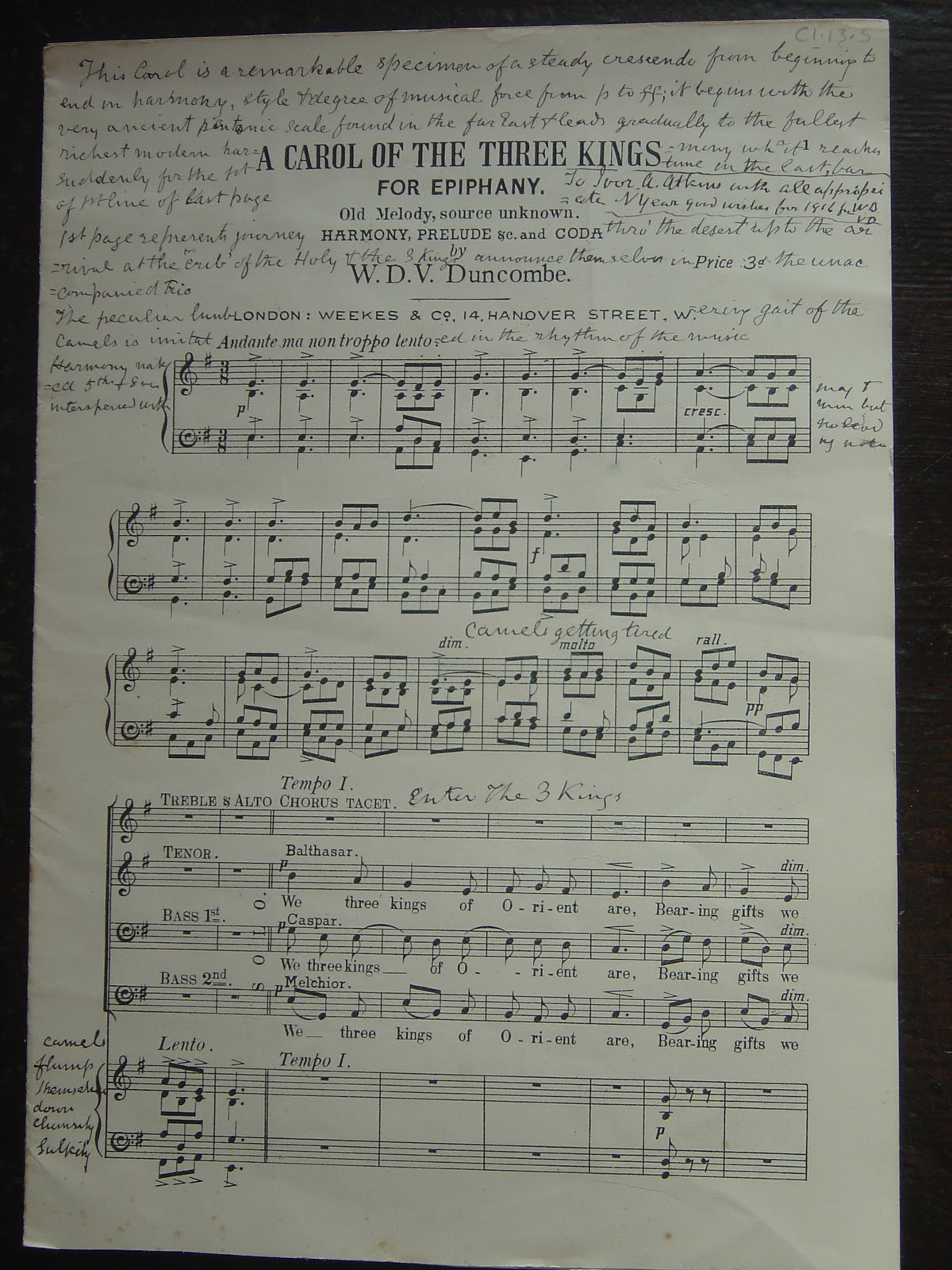
The second document is a copy of ‘A Carol of the Three Kings’ from Christmas 1915.  W. D. V. Duncombe, who wrote the ‘Three Kings’, sent this charmingly annotated version of his latest work to Ivor Atkins, the organist and choirmaster at Worcester between 1897 and 1950.

Duncombe declares on the first page that ‘The peculiar lumbering gait of the camel is imitated in the rhythm of the music’.  The camel theme is further pursued in the subsequent marginal notes, which include references to ‘camels getting tired’, and ‘camels flump themselves down clumsily, sulkily’.  So next time you sing ‘We Three Kings’, spare a thought for the plight of those grumpy camels!


 Camels

Monday, 5 December 2011

Book of the Week (5th December 2011)


MS. F. 173, a Sacramentary of Old Minster, Winchester

This week’s book is of personal interest to your blogger, who has dabbled in the history of the liturgy in late Anglo-Saxon England!  MS. F. 173 is a sacramentary, a book containing the words to the various Masses performed throughout the Church year.  Sacramentaries were often made for monastic users, and this one is no exception.  It was made for the monks of the Old Minster, Winchester, during the first quarter of the eleventh century.  We know this because the prayers (‘collects’) appended to two Masses invoke Saints Birinus, Ethelwold, Grimbald and (perhaps most famously) Swithun, all of whom were connected with – and venerated at – Winchester.  The book must have been brought to the Cathedral before the Reformation because it is inscribed with the name of Worcester monk, John More.

The image below (folios 3v – 4) includes a special Mass for sailors (‘Missa pro navigantibus’).  It seeks God’s protection against adversities and asks that he provides a safe haven for those on board.


Monday, 28 November 2011

Conservation at the Cathedral Library and Book of the Week, 28th November 2011


Last Friday saw the return of one of the Library’s copies of John Foxe’s ‘Acts and Monuments’ (popularly known as ‘Foxe’s Book of Martyrs’), earlier taken away for repair.  It was decided that the book, which was discovered in a cupboard in something of a parlous state, should be restored and re-shelved.  Bookbinder Glenn Bartley was drafted in to replace the missing front board, put in new endpapers and headbands, strengthen the spine and give it a new title label in gold leaf.  This book raised an interesting issue about the ‘authenticity’ of modern repairs, because while Glenn deliberately ‘aged’ the tooled title label to match the rest of the spine, he opted not to distress the front cover in order to match the back.  Personally I think the book looks great, and it is terrific that it can be seen, used and enjoyed again rather than languishing in a cupboard!  Below you can see the new cover, detail from the repaired spine, and Glenn's handiwork on the title label.


Glenn also brought along ten new boxes for our manuscripts.  It is important for the preservation of medieval books that they are stored in these bespoke boxes, made from acid-free board, which also help protect the contents from dust and buy us time in the event of fire and flood.  The Library runs an ‘Adopt-a-Book’ scheme, so if someone sponsors a manuscript a new box can be made.  Lately the Library has been able to press ahead with two conservation projects, thanks to the generosity of a charitable trust and the Friends of the Cathedral.  Their donations have enabled Oxford University conservators to carry out minor repairs to a selection of Worcester manuscripts and start the process of conserving a series of medieval and post-medieval monastic registers.

Naturally our Book of Week is the newly-repaired edition of Foxe’s ‘Acts and Monuments’ printed in 1684.  John Foxe (1516/7-1587) was a Protestant scholar and minister, acknowledged as one of England’s first literary celebrities.  His reputation is chiefly down to his ‘Book of Martyrs’, a history of the Church from the time of John Wycliffe (the first person to translate the Bible into English in the last quarter of the fourteenth century) to the reign of Elizabeth I, and a record of the many Protestant ‘martyrs’ persecuted or put to death under both Henry VIII and Mary I.  The first edition was published in 1563.  The second edition was in preparation as early as 1566 owing to the success of its predecessor.  This appeared in 1570, and was followed by a third edition in 1576 and a fourth in 1583.  The real martyr to ‘Acts and Monuments’ was Foxe himself; having spent over twenty years of his life devoted to the book and its various editions, he neglected his own health and eventually died in 1587.

Monday, 21 November 2011

Book of the Week (21st November 2011)


The 1875 ‘Mock Festival’ and the Tale of a Drunk Man’s Tail

In addition to its fine medieval manuscript and printed book collection, the Cathedral Library holds around 20,000 archive documents relating to the Dean and Chapter.  These documents range from early monastic registers to the latest Chapter minutes.  Among the more interesting and unique archives are the ‘scrap books’ which contain newspaper cuttings, poems and other ephemera connected to momentous events in the Cathedral’s history.  Today’s ‘Book of the Week’, compiled by the Lay Clerk, James G. Smith, in 1906, is one such example.

Now part of our music library, Smith’s book (A.1.10) records the controversy which arose prior to the 1875 Three Choirs Festival, an annual event organised by the Cathedrals of Gloucester, Hereford and Worcester.  Following the extensive restoration of Worcester Cathedral during the 1860s and 70s, Dean Yorke and a number of his Chapter considered that it was no longer appropriate to stage secular music festivals in the nave.  This decision caused widespread consternation, both within the Cathedral itself and in the town and surrounding area more generally; the Festival was one of the highlights of the civic calendar.  Smith’s scrap book charts the escalation of the argument, including clippings from both the national and local press, and a satirical poem published in Punch magazine.  It also includes personal responses to the event, such as the wonderfully acerbic epitaph ‘In Memory of the Worcester Musical Festival, Died September 1875’.  Such was the ill-feeling in Worcester that effigies of Dean Yorke and Canon Barry, another vocal opponent of the Three Choirs Festival, were burned on Pitchcroft.  Although a Festival was staged in 1875, its programme was limited to sacred works, which critics were quick to dub the ‘Mock Festival’ or the ‘Sham Festival’.  Smith’s book even contains a copy of a satirical poster advertising the event (see image below).  The ‘Mock Festival’ remains one of the most colourful episodes in the history of the Three Choirs event, and this little scrap book is a fascinating document of contemporary accounts and attitudes.

‘Never before Suspected’:  Alongside the cuttings relating to the Mock Festival and the activities of Dean Yorke and Canon Barry, James Smith also included a couple of yarns which neatly reflect the Victorian taste for the absurd.  One of them relates the story of a drunken man knocked over by a 60lb dog with a milk-pan attached to its tail.  On impact the dog lost both the pan and a portion of its tail.  The inebriated man, sore from landing on his backside, noticed the piece of tail lying in the road and assumed that it had once belonged to him.  Bemoaning his failure to fully capitalise on his tail before he lost it, the man set off in search of his next drink!  One must certainly learn to expect the unexpected in a Cathedral Library archive...