Wednesday, 26 February 2014

A Danish Ambassador’s journey from Russia to Peking in 1692.

As part of the library’s current exhibition on maps, one of our volunteers studied two maps by English cartographer Emanuel Bowen (active c. 1714-67) that illustrate a Danish Ambassador’s journey from Russia to Peking in 1692. Although we didn't have room for them in the exhibition the story is very interesting. The first map, pictured below, is “A new and accurate map of the whole Russian empire as contain’d both in Europe and Asia Drawn from authentic Journals, Surveys and most approved modern maps”. This map shows territory from St. Petersburg (located to the extreme West of the map) eastwards to Kamtchatka and the Arctic Circle. It also shows the North of the Empire of China and depicts the Great Wall of China in miniature.


Emanuel Bowen, “A new and accurate map of the whole Russian empire as contain’d both in Europe and Asia Drawn from authentic Journals, Surveys and most approved modern maps” in Harris' Complete Collection of Voyages and Travels, Vol. II (1748). Image copyright of the Chapter of Worcester Cathedral U.K., 2014.


This edition of Bowen’s map of the Russian Empire was printed in Volume II of John Harris’ Complete Collection of Voyages and Travels (1748). It accompanies the account of the travels of Everard Ysbrants Ides. Ides travel account gives us early observations on what the author refers to as the Ostyaks (the indigenous peoples of Siberia that today include the Khanty people, Ket people and Selkup people). Certain parts of Ides travels can seem preposterous to the modern reader, but they are thought to be more far more accurate than an account of the same voyage published by Adam Brand in 1699.


Brand accompanied the Danish ambassador as “one of his domesticks” but the editor of Ides’ travels noted that Brand’s work contained “a Multitude of Things equally Inconsistent with Probability and Truth; not withstanding which, it gained Credit for a Time, and passed current for a true Relation of this celebrated embassy”. (1) Today, experts on historic voyages and travel narratives still recognize the accuracy with which Ides described the places he visited. Yet, as your blogger found, Ides journey can be extremely difficult to plot on Bowen’s map as the spellings of many of the Russian place names he uses differ from those used by the cartographer.
Ides’  travels
Ides set out from Moscow on the 14th March 1692 with a retinue of personal staff, porters, a baggage train hauled by horses and oxen, and an escort of soldiers. His journey north eastwards to Siberia was initially difficult due to melting snow and moving ice on the rivers. If we look closely at Bowen’s map, this portion of his journey is relatively simple to follow- Ides travelled eastwards from Moscow to Wologda and from there to Kaigorod before crossing the Werchaturia mountains. Due to bad weather Ides was forced to stay in the city of Kaigorod for several weeks until the river Kama was open again to boats. Kaigorod was said to be “an indifferent city” and Ides stated that he felt uncomfortable staying there because during the course of his stay the city had been raided and set ablaze by “a rabble of runaway servants”(2). After Kaigorod Ides travelled to the Siberian city of Tobolsk (referred to as Toboleski), and his observations on this city give us a great insight into the demography of the area, its trade and the cultural practices of the various peoples that lived in the surrounding area.
The city of Tobolsk, artist and engraver unknown, from Harris' Complete Collection of Voyages and Travels (1748). Image copyright the Chapter of Worcester Cathedral U.K., 2014 
The people that live in the lands surrounding the city of Tobolsk were said to be Tartars who worshipped Islam, and Ides visited their mosque and gave a detailed description of its interior. North of the River Oby (now called the river Ob) were said to be “Russian Jemskicks, who are in the Pay of his Czarish Majesty, for which they supply the Waywodes that are ordered [that] way, and all other Persons who travel on the Czar’s Affairs in Siberia, with free carriages and men to work […] These people keep great numbers of dogs, which they make use of to travel with in winter, for it is utterly impossible to pass this country with horse sleds” (3).

Engravings of the Ostyak peoples who lived near to Toblosk, from Harris' Complete Collection of Voyages and Travels (1748). Image copyright of the Chaper of Worcester Cathedral U.K., 2014.

A series of fine engravings illustrate these pages and give artistic interpretations of what the city and peoples of Tobolsk looked like in the late seventeenth century. The artist and engraver that produced the accompanying illustrations to Ides “A description of the North-East, Parts of Asia and the Empire of China” is not named. It could well have been John George Weltsel, a painter from Sleswick who Ides describes as one of his retinue. Weltsel unfortunately died whilst travelling with Ides after suffering for a fortnight from a fever. They buried his body on a hill near to “the village of Makofskoi” (4) There are illustrations, however, that accompany Harris’ edition of Ides account that could not have been produced by Weltsel because he was deceased by that portion of the journey, for example the landscape illustration showing Ides and his retinue passing through the Great Wall of China.
In addition to engravings and Bowen’s maps, there are a number of humorous, interesting incidents that help break up Ides’ lengthy narrative. I was particularly amused by a brief digression on woolly mammoths. Ides described how along the rivers Yenisei, Tunguska [?]  and Lena “mammuts [mammoths’] tongues and legs are found” (5). What is most striking to the modern reader is that neither Ides nor any of the Ostyaks described were aware of their prehistoric origin and certain communities of Ostyaks were described as believing that mammoths existed underground in the seventeenth century. The Siberian Russians on the other hand were recounted as believing that mammoths drowned during the Biblical great flood, before which the climate of Siberia was warmer. Here is a section from Ides discussion on woolly mammoths:
“ I had a person with me who had annually gone out in search of these bones; he told it to me as Real Truth, that he and his companions found the head of one of these [mammoths], which was discovered by the fall of […]  a frozen piece of earth.  As soon as he opened it, he found the greatest part of the flesh rotten, but it was not without difficulty that they broke out his teeth, which were placed in the fore part of his mouth, as those of Elephants are [.] Concerning this animal there are very different reports. The Heathens of Jakuti, Tungusi, and Ostiaki say that they continually, or at least by reason of the very hard frost, mostly live under ground, where they go backwards and forwards. […] They further believe that if this animal comes so near to the surface of the frozen earth as to smell the air, he immediately dies, which they say is the reason that several of them are found dead on the high banks of the river” (6)
  In addition to the discussion of mammoths there is a humorous, bizarre incident whereby Ides was visited by a Tunguskian prince who he says had “prodigious long hair” (7). Ides was curious as to the exact length of this prince’s locks. Convinced he must measure it, Ides decided his best bet was to ply the prince with brandy and persuade him to unravel his hair. After Ides obtained the permission of an intoxicated prince, he carefully measured the hair with an ell. He found it was four Dutch ells long (about two and a half metres!)
"Tunguzian Prince whose Hair was Four Dutch Ells long and his Son's near an Ell long", engraving in Harris' Complete Collection of Voyages and Travels (1748). Image copyright the Chapter of Worcester Cathedral, 2014.
  Much of the Ide’s narration on his journey through Siberia and Tartar lands contains similar anthropological observations which, though interesting and enjoyable, can often be extremely critical of the religions and customs of the Ostyak peoples. Finally on 3rd August 1693 the Chinese frontier was reached, where Ides was met by a Captain of the Imperial city and ten soldiers to escort the convoy to Peking. Travelling through Tartar country they were warned to keep to the roads and avoid moving by night because of the number of tigers in the surrounding country side. Following their arrival in Peking, Ides first audience and meal with the Emperor was on 16th of November. He was invited to meet the Jesuit Missionaries and attend the Annual Festival. He departed Peking to return to Moscow on 19th February 1694 and again after many adventures arrived at the court of the Czar on the 1st January 1695. This journey had taken two years and ten months and his record of it a remarkable geographic and anthropological achievement.


Endnotes
1) John Harris, A Complete Collection of Voyages and Travels consisting of above six hundred of the most Authentic Writers, Vol. II, (1748), p. 919. 
2) Ibid., 919-20.
3) Ibid., 922
4)Ibid., 927
5) Ibid., 927
6)Ibid., 928
7) Ibid., 932


by Ian Clargo and Deirdre McKeown


Thursday, 13 February 2014

What to eat when stranded in Greenland: advice from 1630.

Films like Gravity (2013), Castaway (2000) and The Beach (2000) have captivated audiences by exploring what it would be like to be stranded in a remote place, be it a desert island or in outer space. How would you survive, what dangerous creatures or people would you encounter and how would entertain yourself to pass the time? This week your blogger stumbled across a gripping account of how eight Englishmen survived being stranded in Greenland for nine months in 1630. Spoiler alert- their story involves eating whale fritters and roasted walrus!

"The miraculous preservation and deliverance of eight english-men left by mischance in Greenland" was written by one of the eight stranded men, Edward Pellham, and published in A Collection of voyages and travels (1745). The account of the men’s struggle for survival is illustrated with a map of Greenland, pictured below. You can currently see a photograph of this map in the Dean’s Chapel of Worcester Cathedral as part of the library’s “Seeing and Mapping our World” exhibition.  The cartographer is unknown but if you know anything about this map, please get in touch.
Map of Greenland, A Collection of Voyages and Travels (1745), p. 743.
What were  eight Englishmen doing in Greenland in 1630?
Edward Pellham travelled to Greenland in May 1630 as part of the company of Muscovy merchants, who frequently carried out whaling expeditions around Spitsbergen in the seventeenth century. Pellham says that three ships were sent to “make voyage upon whales or sea horse[s] for the advantage of the merchants and the good of the common-wealth”.

The purpose of the Muscovy merchants' whaling expeditions was to use the blubber from whale carcasses to create train oil. Despite its smell, oil manufactured from whales’ blubber was used for lighting oil lamps until the end of nineteenth century in England. It was also used in the manufacture of soap and industrial cleaners until the invention of hydrogenation in the early twentieth century.

Whaling was cruel indeed; just take a look at the illustrative border that surrounds the map of Greenland (shown below) that depicts men trapping and harpooning whales and walruses close to shore. It is a bit of a mystery as to why trading companies would have been killing walruses, which are for some reason described in the period as “sea horses” or “seamorce”. Presumably their blubber was also used in the production of oil.

Stranded with “not so much as book amongst us”.

Like a great many castaway narratives, the eight men of the Muscovy company became separated from their party by a series of misfortunes. They were instructed by their captain to sail from Foreland to Bell Sound to take some casks of train oil from another ship that was carrying too  large a quantity of oil. Pellham and eight men were ordered from this group of twenty to hunt venison en route to Bell Sound. When they returned in their small sailing boat to their ship at the bay of Green Harbour after two days hunting, they found the rest of their group of twenty men had departed without them, leaving them with nothing but their small boat, the clothes on their back and 14 venison carcasses!
In the pages that follow the men dump the venison into the sea in an attempt to lighten their boat and make haste. They try desperately to travel to Bell Sound so that they might join with Captain William Goodler, who was commanding the three Muscovy merchant ships, in time for their company’s departure back to London. Yet a series of storms combined with the fact that the men had “never a compass to direct our course by, nor any of our company […] sufficient to know land when he saw it” meant they reached Bell Sound too late and the Muscovy merchants left them behind. Pellham's is particularly critical of a member of his party called William Fakely, a seaman "though no skilfull mariner", and blames him for persuading them to go in the wrong direction.


Struggling to survive
The rest of the account of the men’s time in Greenland is preoccupied with the details of how they survived. Bulleted below are some of the highlights from the account:
 

·         Telling inappropriate stories- as soon as the men get stranded they somewhat unwisely decide to discuss what happened to men before them stranded in Greenland. Pellam cheerfully tells a story of “nine good and able men, left in the same place […] by the same master [the Muscovy merchants] [that] all died miserably upon the place, being cruelly disfigured by bears and hungry foxes, which are not only the civilest but also the only inhabitants of that comfortless country”. Talk about lightening the mood!

·         Sampling the local cuisine- The men survived for nine months off a horrifying array of animals native to Greenland. A month after they were stranded, the men come across a group of walruses sleeping on a piece of ice close to the shore that they harpoon, chop to pieces and roast. This, Pellham seems to say, was one of the more pleasant animals to eat, although he comments that they are very difficult to harpoon unless asleep. Pellham also describes how his group of men are forced to eat whale frittars, “a most loathsome meat” made from “the scraps of the fat of the whale, which are flung away after the oil is gotten out of it”. A particularly nasty incident is recounted by Pellham whereby after eating the liver of a bear the group found that “our very skins fell off”. This could be a dramatic addition to the story, or so your blogger hopes. The skin problems the men were suffering from could well have resulted from scurvy caused by their poor diet.

·         A man’s best friend- one of the strangest aspects to this account is that the eight men are stranded for nine months with two bull mastiff dogs. The dogs were brought on the Muscovy merchants’ expedition to help the men hunt for food whilst ashore. It is curious Pellham and his men did not kill the dogs for food, given that for three months they ate one meal a day due to their lack of provisions. It is likely, however, that the mastiffs were too important in helping the men hunt to be killed. On 16th March 1631, Pellham says that one of the mastiffs ran away and was never seen again. When spring arrives the men see a buck and wish to kill it but the remaining bull dog is described as having “grown so fat and lazy” that he cannot bring the buck down. The men are forced to forget the buck and hunt fowl instead!
Pellham and his men were saved on 25th May 1631 when a ship from Hull landed within sight of the area where the men had built their tent. All eight of the men miraculously survived and departed back to London after fourteen days of rest aboard captain Goodler’s ship. Pellham does not describe the men who he was stranded with in any detail but we can nonetheless glean from his account that, because the men were whalers, seamen, and coopers, they were extremely resourceful and good at adapting materials for various purposes. For example, they create needles from whales’ bones to mend clothing. They were also devoted to their faith, and kept holy the Sabbath Day, although Pellham says they had no Bible with them to read. All-in-all Pellham's account is a remarkable read and from it we can glimpse much about the seasonal changes in Greenland and the behaviour of local wildlife. Next week we will be posting another blog about a travel book that contains a map, so be sure to watch this space.  


Wednesday, 22 January 2014

Henry Philpott Bishop of Worcester 1860 to 1890


If you visit Worcester Cathedral you might see the fine sculpture by Sir Thomas Brock of Henry Philpott, who was Bishop of Worcester between 1860 and 1890. The statue was originally positioned in the south Transept. Today, many visitors may not realize why a statue was made in his honour, and paid for by the public. This would surprise our Victorian ancestors who knew him as a great mathematician, an able administrator, and a man deeply committed to charity.

Bishop Henry Philpott of Worcester. Photography by permission of the Dean and Chapter of Worcester Cathedral (U.K.)


Henry Philpott, born in Chichester, was from an early age a gifted mathematician and classicist. As an undergraduate he was awarded the position of Senior Wrangler at Cambridge University, and was Smith’s Prizeman. His exam answers were kept for many years by the University because of their quality. He became a Fellow of St. Catherine’s College, and later went on to be the Master of the College from 1845 to 1860, and was Vice-Chancellor of Cambridge University on three occasions. He did this job so well that he impressed Prince Albert, who made him his Chaplain.


Autographed picture of Bishop Henry Philpott. Photograph by permission of the Dean and Chapter of Worcester Cathedral (U.K.)
Yet it was his actions as Bishop which made him beloved of his Diocese. He was a hard working man, who realised that debates are often pointless and that he could achieve far more in life by avoiding the House of Lords, meetings, congresses, Lambeth Conferences, and Convocations whenever possible. As a moderate Evangelical he devoted himself to his Diocese and to charitable work. He helped local churches in need of repair, offering sums of money from his own pocket. For example, he gave an acre of land to Lower Mitton when it needed an additional churchyard, and £1,250 to All Saints, Worcester. He also helped poor clergy. He had a substantial private income, and was frequently able to give away most of his official income to charities and charitable causes, both private and public. He also extended this charity to fellow Protestants in non-conformist churches in Worcester and Stourbridge. He founded scholarships, for example at Malvern Proprietary College in the 1860’s, and served as chairman of the Trustees at Bromsgrove school, where a stained glass window was erected in the school’s chapel in 1891. He was also interested in health matters and was a Governor of Worcester Infirmary, and was a patron of the Worcester Ophthalmic Hospital. He also attended meeting of Philanthropic societies in his Diocese.

Bishop Philpott was not a great public speaker. He only had three addresses for confirmation ceremonies. However, he was conscientious in replying to all correspondence and never relied upon a secretary. In 1881, he escaped being killed in his own library at Hartlebury Castle, when a large stone monument to Bishop Hurd above the door fell down only moments after he had been there.

In 1846 Philpott married Mary Jane, the daughter of the Marchese di Spineto. In 1878 the Bishop’s wife went blind. When he came home each evening Bishop Philpott would read to her. Despite her blindness she also enjoyed walks around the Castle’s gardens with her husband. The Bishop resigned the Bishopric in August 1890, and retired to his much-loved Cambridge, where he died. On his retirement money raised was put towards the gift of a silver ink stand, but the majority of the money established the ‘Philpott fund’ for the Pensions of the Clergy in the Diocese. This was because the poverty of the clergy at the time was an issue that Philpott was only too aware of. He is now buried at the Church of St. Mary at Bishop’s Wood in Hartlebury, which he built.


One volume of Dr. Samuel Johnson's works donated by Bishop Philpott to the Cathedral. Photograph by permission of the Dean and Chapter of Worcester Cathedral (U.K.)

Bishop Philpott generously donated many books from his own collection to the Cathedral Library. The cathedral’s archive also shows that the Bishop was involved in the administrative side of the Victorian restoration of the Cathedral, and provided the new Bishop’s throne. He died leaving a large sum of money, including generous legacies to the Church Pastoral Aid Society, and the Church Missionary Society.


The catalogue of books Henry Philpott gave to Worcester Cathedral. Photograph by permission of the Dean and Chapter of Worcester (U.K.)


When visiting Worcestershire, why not also look at Hartlebury Castle and its excellent Hurd Library. Their link is as follows: http://www.hurdlibrary.co.uk/


David Morrison, with thanks to Mr. David Everett for research.

Wednesday, 15 January 2014

Heritage and History of Wales - Part 2: South Wales

In a continuation of last month’s blog about Grose’s book of Welsh antiquary, with a focus upon North Wales, this month’s blog delves into the history and myth of the counties of South Wales, which Grose discovered on his travels in the late 18th Century.

A map of Wales 1696. By permission of the Dean and Chapter of Worcester Cathedral (UK).

            The county of Glamorganshire, located in the far south of Wales, encompassing Swansea and Cardiff, was notable in 1789 due to it being “fruitful, pleasant and populous”, to the extent that it was often called the “Garden of Wales”. Additionally, being home to over 25 castles and a number of abbeys and priories, demonstrates this county’s historical, strategic and religious significance. Of the multitude of sites, Cardiff Castle Tower probably can lay claim to the most intriguing story associated with it, as it was the building in which Robert Duke of Normandy, brother of William Rufus and Henry I, was confined to for over 26 years.  Following his escape and recapture during this period, he was blinded when his optic nerve was destroyed by a hot brass baton close to his face. Following a further incident with his brother, the Duke of Normandy refused nourishment and starved himself to death.

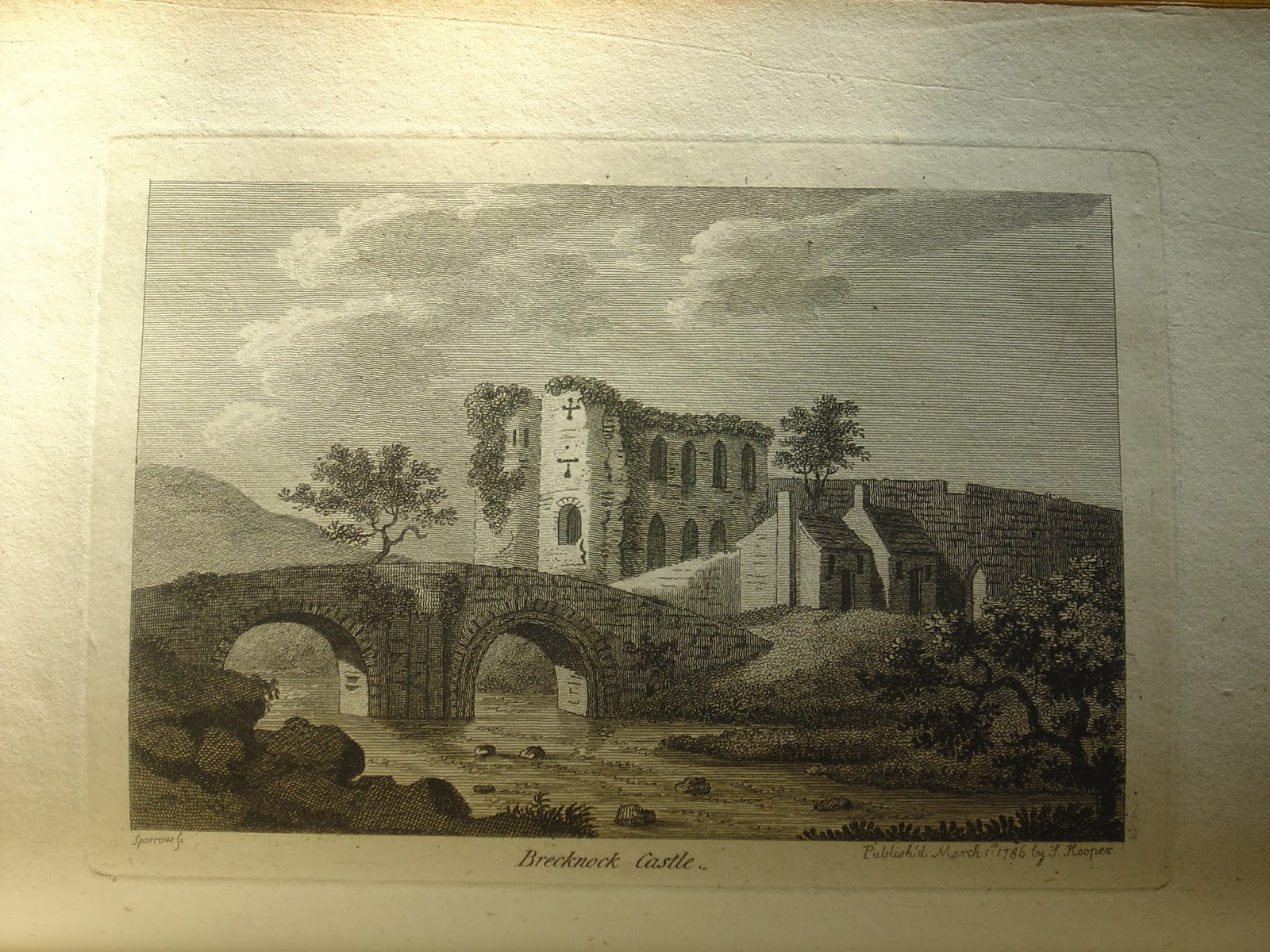
            The largest county in Wales at the time, Brecknockshire, situated to the north of Glamorganshire, was noted for its mountainous landscape. In terms of Brecknockshire’s historical buildings, the most significant is undoubtedly Brecknock Castle, built during the reign of William Rufus, by Barnard de Newmarsh, who had immense lands due to his marriage to the grand-daughter of Gryffyth ap Llewellyn Prince of Wales. In an act of revenge against her son for reproaching her behaviour, she declared him illegitimate, causing him to be disinherited. This resulted in the castle and estate passing to his sister and then through her female descendents to the Mortimer family.

An engraving of Brecknock Castle. By permission of the Dean and Chapter of Worcester Cathedral (UK)
            The county of Radnorshire, north of Brecknockshire, is described as “the most barren county of all Wales and its air is “cold and piercing”. Despite this, the mineral water at Llandrindod was very popular and also the Offa’s Dyke Path, now a popular walking route, originally the boundary running from the mouth of the Wye to the mouth of the Dee, made by Offa, King of Mercia.

            At the time that the book was written, Cardiganshire, modern day Ceredigionshire, had a population of 35,380 inhabitants, and only had four market towns: Aberystwyth, Cardigan, Llanbadernvaur and Tregaron. A site of historical and archaeological importance to this day, the Abbey of Strata Florida, was built in 1164 for Cistercian monks and is thought to be the burial place of many welsh princes. Unfortunately, now nothing more than ruins remain of the abbey.

An engraving of Strata Florida. By permission of the Dean and Chapter of Worcester Cathedral (UK).
            The county of Carmarthenshire, described by Grose as “the most fruitful county in Wales”, was a big producer of wood, corn, cattle, game, sea and river fish, coal and lead. A particularly interesting statement made by the author is that near Carmarthen is a spring which ebbs and flows twice every 24 hours. Although this is now claimed to be myth, it is interesting to consider whether the author noted down a myth he had heard about the spring, or whether at the time he visited, it did in fact ebb and flow. Another interesting site within this county is Kidwelly Castle, built soon after the Norman conquest, and destroyed and rebuilt on a number of occasions, as it passed from the Normans to the Welsh and later from the Royalists to the Roundheads. Despite this, the present day castle still contains remains from 1200 and 1460.

A map of Carmarthenshire. By permission of the Dean and Chapter of Worcester Cathedral (UK).

            Pembrokeshire was and is notable for its multitude of stunning headlands, such as Strumble Head and Cape Stuncuin. This beautiful county however, is also home to a large array of mysterious and unusual sites and artefacts. Firstly, in the vicinity of Newport, there were said to be seven barrows, one of which when opened, contained five urns full of “burnt bones and ashes”, and whose presence was unexplained. Additionally, near St David’s was a stone “one hundred oxen could not move”, called The Rocking Stone, which was apparently rendered immovable by Cromwell’s soldiers. Finally, Buck’s Pool, near Stackpool, was described as a “pit of water that cannot be fathomed”. This dubious comment was probably due to the fact that it was fed from a redundant spring never known to stop in summer or winter.

These two blog posts explored only a small sample of the sites mentioned in Grose’s fascinating book. However, the book and others in the series are available to view by appointment.


Carys Aldous-Hughes

Wednesday, 8 January 2014

Heritage and History of Wales - Part 1: North Wales

Within Worcester Cathedral Library is a captivating and highly intriguing tour of Wales. It can be found in volume VIII of Grose’s Antiquities of England and Wales, published in 1789. This is a contemporary history of a multitude of fascinating sites within the counties of North and South Wales.

The author, Francis Grose was born in 1731 in London. He was the eldest child of Francis Joseph Grose, a Swiss immigrant and jeweller, and his wife Anne Benet. Earlier in his career, Grose had success in the armed forces, but in 1757, he was elected as a member of the Society of Antiquaries. As a result, he travelled to many parts of England, Scotland, Wales and Ireland, in order to collect material for his volumes on antiquary. He died during his final expedition of this type to Ireland, and is buried in Dublin.

This blog focuses upon his discoveries in North Wales, which encompassed the grand castles of Anglesey, ancient druidical monuments of Denbighshire and enormous standing stones found in Montgomeryshire.

This is a map of Wales .By permission of the Dean and Chapter of Worcester Cathedral (UK)

Being one of the smallest counties in Wales at the time, Anglesey’s population numbered only 12,000 inhabitants and despite being “stony and mountainous”, produce from the island included wheat, cattle, sheep and fish, in addition to copper, mill stones and red, yellow and blue ochre. Anglesey’s most impressive site was Beaumaris castle, built in 1295 by Edward I, which, during the English Civil War, was held for the King until 1649, when it was surrendered to General Mitton. It is possible, however, that all the riches were buried in preference to being surrendered to the Roundhead leader, as there have long been suspicions that large amounts of treasure were concealed both within the vault and the vicinity of the castle.

On the Welsh mainland, to the South East of Anglesey was the striking county of Caernarvonshire, surrounded on three sides by the sea, with “fruitful valleys” and perpetual snow covered mountains. It contains a multitude of features from Snowdon Hills to Orme’s Head and Dolwyddelan Castle to Caernarvon Castle. Of particular interest to Grose is Dolwyddelan, built in the year 500, on an ancient road through the mountains called Helen’s Way (aka Sarn Helen). The birthplace of Llewellyn the Great and residence of Gryffydd ap Tudor, the castle was later purchased by Meredydd ap Jevan during the reign of Henry VII. Despite being resided in by outlaws, Meredydd favoured the castle over his former family residence, as it was said that relations with his family were so poor, that it was said to be a case of either “kill or be killed”. At the castle, however, he established a successful garrison, which included “seven score of the tallest and ablest bows men”.
An engraving of Dolwyddelan. By permission of the Dean and Chapter of Worcester Cathedral (UK)

Of significant Roman and Druid heritage, the county of Denbighshire, to the East of Caernarvonshire, has a variety of Druidical monuments and stones, along with the remnants of a Roman fortification said to be the camp of Caractacus and a tomb stone with Roman inscriptions at the Hill of Graves. Additionally, Denbighshire has a Cistercian abbey dedicated to the Blessed Virgin Mary called the Abbey of Valle Cruis, founded in 1200, and is now said to be one of the best preserved in Wales.

Despite being the smallest counties in Wales at the time, Flintshire contained many sites of historical and religious significance. Most notable is St Winifred’s Well, which is thought to be the oldest continually visited pilgrimage site in Great Britain, visited since the 7th Century. James II and his wife Mary were among the many visitors, prompted by Mary’s inability to conceive, and shortly after their pilgrimage Mary became pregnant with a son. More ominous however, is the locally named “Stone of Lamentation”, a sandstone monolith, thought to mark the site of ancient treasure, but apparently with the power to conjure lightning and storms to deter possible treasure hunters.

A map of Denbighshire. By permission of the Dean and Chapter of Worcester Cathedral (UK)
The county of Merionethshire, situated on the Irish Sea, to the South of Denbighshire and Caernarvonshire is described by Grose as “mountainous and unwholesome” and subject to a “livid fire or vapour”, which caused destruction to land and livestock, prominently in the years 1542 and 1584. Of particular interest is Harlech Castle, which was of great military significance for both England and Wales. It was Owain Glydwr’s home and military base from 1404 to 1409, and later was held by the Lancastrian forces for seven years during the Wars of the Roses, before its siege by the Yorkist troops in 1468. It is now classed as a world heritage site and regarded as one of the finest examples of 13th and 14th Century military architecture in Europe.

Grose states that at the time, Montgomeryshire was the home to a very impressive collection of standing stones such as those found at Stonehenge in Wiltshire. They were said to be so large that it would be “hardly possible to move them with 50 yoke of oxen”. A particularly interesting and unusually site is Dolforwyn Castle, due to the legendary origins of its name. Dolforwyn (Meadow of the Maiden) is thought to allude to Sabra of Sabrina, the illegitimate daughter of Locrine (a king of ancient Britain). She was drowned in the River Severn by Gwendolen, Locrine’s wife, following his death, and she is said to be the inspiration for a poem, reproduced in Grose’s book, a sample of which is below:
“She guiltless damsel, flying the mad pursuit,
 Of her enraged stepdame Gwendolen
 Commended her fair innocence to the flood”


            To discover the mysteries of some of South Wales heritage, read next month’s blog. 

Carys Aldous-Hughes

Monday, 23 December 2013

Worcester Cathedral Christmas Services and Concerts in the 1920's and 1930's


At sometime over Christmas many people will visit their local church for a service. But what were the Christmas services of the past like? In the cathedral’s archives are scattered notes of the Christmas services held in the Cathedral in the 1920's and 1930's which offer some interesting reports from a broken musical instrument, the first performance of an Elgar carol, and charitable gifts and concerts.

The cover of the 1920 Carol Service for Worcester Cathedral. Image copyright the Dean and Chapter of Worcester Cathedral (U.K.)


What sort of music and carols were sung?

There are two copies of a carol service that was often used between 1920 and at least 1931. Some of the carols sung may be unfamiliar to you.  A processional hymn Christe Redemptor Omnium, the words of which were written in the sixth century and the melody composed in the eleventh were sung first, followed by the bidding prayer and the hymn O Come all ye Faithful. The carol From Jesse’s stock up-springing followed, which is an ancient melody arranged by M. Praetorius (1571-1621), and the carol In Dulci Jubilo arranged by R. L. De Pearsall (1795-1856), followed by A Carol for Christmas Day from William Byrd’s Song of Sundry Natures dating to 1589.

The Cathedral choir then sang In the bleak Mid Winter by Gustav Holst, words by Christina Rossetti, and then everyone sang The First Noel the angel did say, followed by a 15th century carol from the Processional of the Nuns of Chester - Qui creavit coelum, and then three carols: The Babe in Bethlehem’s manger laid, and Three Kings have come from the eastern land, and A babe is born of maiden pure, with the recessional hymn being While shepherds watch’d their flocks by night.

The 1934 Worcester Cathedral programme for its Christmas Nativity play. Image copyright the Dean and Chapter of Worcester Cathedral (U.K.)


Notable events in the Christmas services

In 1921 the cathedral’s new organ broke down at Evensong on Christmas Eve, whilst the Bishop of Worcester and the Countess of Beauchamp were attending. Thankfully, the services continued smoothly without it.

In 1928, the Cathedral’s Christmas time music was interesting for two reasons. Between 16th and 23rd December the Advent Antiphons, copied down in the Worcester Antiphoner were sung again in the cathedral. The Antiphoner dates to c.1230 but the music is from an earlier time. Boxing Day 1928 also saw the first performance in Worcester of Sir Edward Elgar’s Christmas carol I sing the birth. On Boxing Day 1930 Sir Edward was present in the Cathedral to hear another performance of his carol.

In Christmas 1931 a special music concert organized by Sir Ivor Atkins was held in College Hall to raise money for the building of an extension onto the Worcester Royal Infirmary. At that time, Christmas fundraising concerts were unusual at Worcester Cathedral, and had only happened on two other occasions- once in 1923 to raise funds for the organ and another in 1917 to help the Red Cross Depots in Worcester.

In January 1934, for the first time since the monastic era, a nativity play was performed in the cathedral entitled The Christmas Mystery. This included carols, readings from the Gospels, and tableaux of ‘actors’ in elaborate costumes.

Dean William Moore Ede who urged the congregation to donate to help German refugees. Photograph Copyright the Dean and Chapter of Worcester Cathedral (U.K.)


Collections for Charity and Good Causes

The collection on Christmas Day in the Cathedral in 1920 was for the Save the Children Fund, and in 1931 it was for the St. Lawrence’s home (Church of England’s Waifs and Strays Society). In December 1933 or 1st January 1934 the Dean William Moore Ede made an urgent appeal to the congregation for a collection to help refugees who had escaped to England from Germany.

Have a very Happy Christmas from everyone at Worcester Cathedral Library and archive.

Tuesday, 10 December 2013

A sheepskin manuscript with mysterious, missing artwork

Worcester Cathedral library MS F.9 is a fourteenth century manuscript of Flavius Josephus’ The Jewish War and the Antiquities of the Jews, which is thought to have been professionally made by a team of lay scribes and artists, though the exact location of production is unknown. Unlike many of our manuscripts, the monks of the Cathedral priory had no physical role in the production of F9, and we can provide no evidence for the priory owning the manuscript before the seventeenth century. As to how this MS came to the Cathedral is a mystery. Upon displaying it to visitors this summer we found it was a rather curious manuscript indeed, with a lot of scribal quirks and artistic oddities (such as the one pictured below). This week I explore what makes F9 an unusual item that stands out from the rest of our collection.


F9. A detail from the top line of a page,
the scribe has drawn a small profile head with
a large pointed nose. Photograph
© the Chapter of Worcester Cathedral (U.K.)
The first unusual point about MS F9 is that it is made from 324 leaves of thick sheep skin, rather than vellum (calf skin). This is uncommon for manuscripts of this date. Vellum was the usual choice of skin after the ninth-century, though the Saxons did reserve sheepskin for some special liturgical texts (for example the Echternach Gospels). Sheepskin is greasier than vellum and can often be more translucent, making painting directly onto it more difficult. F9 evidences some of the problems associated with using sheepskin for manuscripts. The hair side of sheepskin parchment yellows overtime and F9 has certain leaves which are severely yellowed.

This manuscript of The Jewish War has an unusually large number of (probably contemporary) repairs also; every few folios you will find a hole which has been sewn or repaired by pasting another bit of parchment on top. There are more holes found in F9 than you would normally find with a vellum manuscript, because the layers of sheepskin are fattier, therefore more prone to separating and allowing holes to develop. Even in cases where small holes are stitched up, it is not uncommon that the hole continues to grow and eventually bursts open the repair.


Yet by far the most puzzling thing about F9 is to be found on folio 229 (see pic below), where we can see that the artist has drawn out the border and square of an illuminated letter but left the space blank. A similar blank space for a decorated initial with a border is left on folio 230.  Illumination is generally accepted as the last stage in manuscript production. Only once the scribe or scribes have written the text block will the quires of parchment be passed on to an artist or a team of artists for decorating. Could it be that the artist simply forgot these pages? Did they make a mistake? Was the illuminated letter stolen from the manuscript at a later date?

Photograph
© the Chapter of Worcester Cathedral (U.K.)
We will never definitively know the answer as to why these two folios remain undecorated. It cannot be because they were considered unimportant, for within the manuscript folio 229 marks the beginning of the prologue by Josephus and folio 230 signals the beginning of the main text of The Jewish War. I also think it’s unlikely that these pages were forgotten, for the artist took the time to draw the title of the section at the top of the page in alternating blue and red. Moreover, the scribes or the artists have continued throughout the book to extend the descenders of letters on the last line of each page and embellish them artistically either with grotesques or frilled designs.
Looking at the manuscript, I’d like to suggest that there is evidence that these two illuminated letters with part borders were done, or at least designed, on a separate piece of parchment which was intended to be pasted onto the main body of the manuscript at the end. This was not an uncommon practice for illustrators working on sheepskin. As early as the ninth-century, according to Bischoff, miniatures were being painted onto separate pieces of calfskin and pasted onto folios of sheepskin, because the rough surface of calfskin proved better suited for coloured painting.[1]

 Looking through F9, you can see instances where the translucency of the sheepskin causes coloured inks to bleed from the verso to the recto, which must surely have been a source of frustration for the artists! Below is a picture of a completed illuminated initial in blue from f. 279. You can see that the sheepskin has been difficult to paint onto, and when the book has been closed, blue ink has bled onto the opposite page as the greasy nature of sheep skin means it struggles to absorb paint. It seems likely that these sizeable spaces have been left, then, with intention of pasting completed artwork onto them so as to avoid the inks running through to the underside of the page or blotting onto the other. If you run your finger over folio 229 (pictured above), the border is definitely raised suggesting that the outline in blue may be pasted down.
F9. an illuminated letter with border, looking to the opposite page there is blue ink which has been transferred. Photograph
© the Chapter of Worcester Cathedral (U.K.)
Perhaps the ultimate question with F9 is not 'why are these two folios missing decoration' but 'why did the stationer or workshop in which the manuscript was made opt for sheep skin in the first place, when it was known to be of lesser quality'? It could be that calf skins were in short supply at that time in the region where the manuscript was made, but we have no way of knowing this because no information or research has been done to shed light on where this manuscript was produced. Though we currently know little about the context of the production of this manuscript, F9 nonetheless provides a useful contrast to the rest of Worcester Cathedral Library's manuscript collection, the majority of which is done on vellum. It also evidences how making manuscripts, even in a professional context, could still have many challenges in the later middle ages and suggests that artists and scribes had to come up with inventive solutions to circumvent the challenges of working on sheepskin.


[1] Bischoff, Latin Palaeography trans. Daibhi O Croinin and David Ganz (Cambridge: Cambridge UP, 1990), p. 10.