Wednesday, 7 August 2013

Bell foundry and bell thievery in Worcester

Notable bell founders.

The oldest bell displayed in the cloister is dedicated to St Wulfstan and was cast by William Burford, a London bell-founder.  William Burford worked between 1371 and 1392, and only twenty two of his bells are known to exist. The inscription on the bell in Worcester Cathedral, "IN HONORE SCI WOLSTANI EPI", when translated reads, "In honour of St. Wulfstan, Bishop”. This dedication of a bell to St. Wulfstan is unique to Worcester Cathedral

Next to this bell is the oldest dated bell cast in the county of Worcestershire, which was cast at Worcester in 1480. Although it is not known for sure who cast this bell, the city of Worcester has had a long tradition of bell-founding from medieval times through to the mid-1690s.  


One of the most prominent bell-founders in the Cathedral Library records is a Richard le Belyeter, who on four occasions occupied the office of Bailiff. Le Belyeter occurs as a witness on many documents, from 1300 to 1322.  He held land in Sidbury in his own right. In 1976, when an archaeological dig took place of three medieval craftsmen's tenements in Sidbury, bell-founding waste was found in the medieval layers.  For those familiar with Worcester, look for the florists shop in Sidbury. This is the site that may have been Le Belyeter’s house and work-yard.


A lease of lands from Richard le Belyeter to Richard le Mercer, complete with a bell-founder's seal. Photograph reproduced by permission of the Chapter of Worcester Cathedral (U.K.) 


 A particularly rare document pertaining to bells in Worcester Cathedral Library is one in which Le Belyeter is leasing lands in Timberdine to Richard le Mercer. The document has affixed to it an exquisite specimen of his seal, a wide-mouthed bell, with the legend "Sigillum Ricardi le Belyeter".  This seal is one of only a handful of bell-founder seals surviving in the country.

Bell thievery in Worcester

Can you imagine churches without their bells? Here at Worcester Cathedral, on the east side of the cloister, are displayed some of the medieval bells of the cathedral which were decommissioned in the second half of the 1800s as part of the major Victorian restoration of the cathedral.

The "New Bells for Worcester Cathedral" manufactured by John Taylor and Co. as part of the Victorian programme of restoration. Photograph reproduced by the permission of the Chapter of Worcester Cathedral (U.K.)

Initially, there had been no plans for the replacing of these bells, but in May of 1863, when work on the great Victorian restoration of the cathedral was in progress, it was discovered that one of the bells had been stolen. Curiously, it seems that at the time of the theft no-one noticed a giant bell being stolen! No trace of the bell was ever found. It was the theft of this bell which led to the replacement of the remaining medieval bells by a new ring of twelve bells.

The Victorian theft was not the first time that a bell was stolen from the Cathedral. Legend has it that during an invasion of the city by the Danes one of the raiders attempted to steal the Sanctus bell but the townspeople caught him. He was punished by being flayed alive and his skin pinned to the Cathedral door. The less squeamish of you can view what is reputed to be a piece of this skin, displayed in a cabinet in the Cathedral Library, it is next to King John's thumb bone.
 
Bells in Worcester Cathedral today

The Cathedral’s tower now contains a ring of 15 bells, with a total weight of 16 tonnes, the fifth heaviest ring in the world and also generally acknowledged to be one of the finest rings in the country. These bells were cast in 1928 by John Taylor & Co. of Loughborough, from the metal of the previous bells cast for the Victorian restoration.  The non-swinging bourdon bell, which on its own weighs nearly a tonne, was cast in 1868, and is used by the clock to strike the hours.

by Vanda Bartoszuk


Monday, 29 July 2013

Conserving medieval registers

This week your blogger caught up with Katerina, our free-lance conservator here at Worcester Cathedral Library. Currently, Katerina is working on a project funded by a charitable trust to repair twenty medieval registers, and some post-medieval registers.  The purpose in repairing the registers is to make them more usable for researchers.

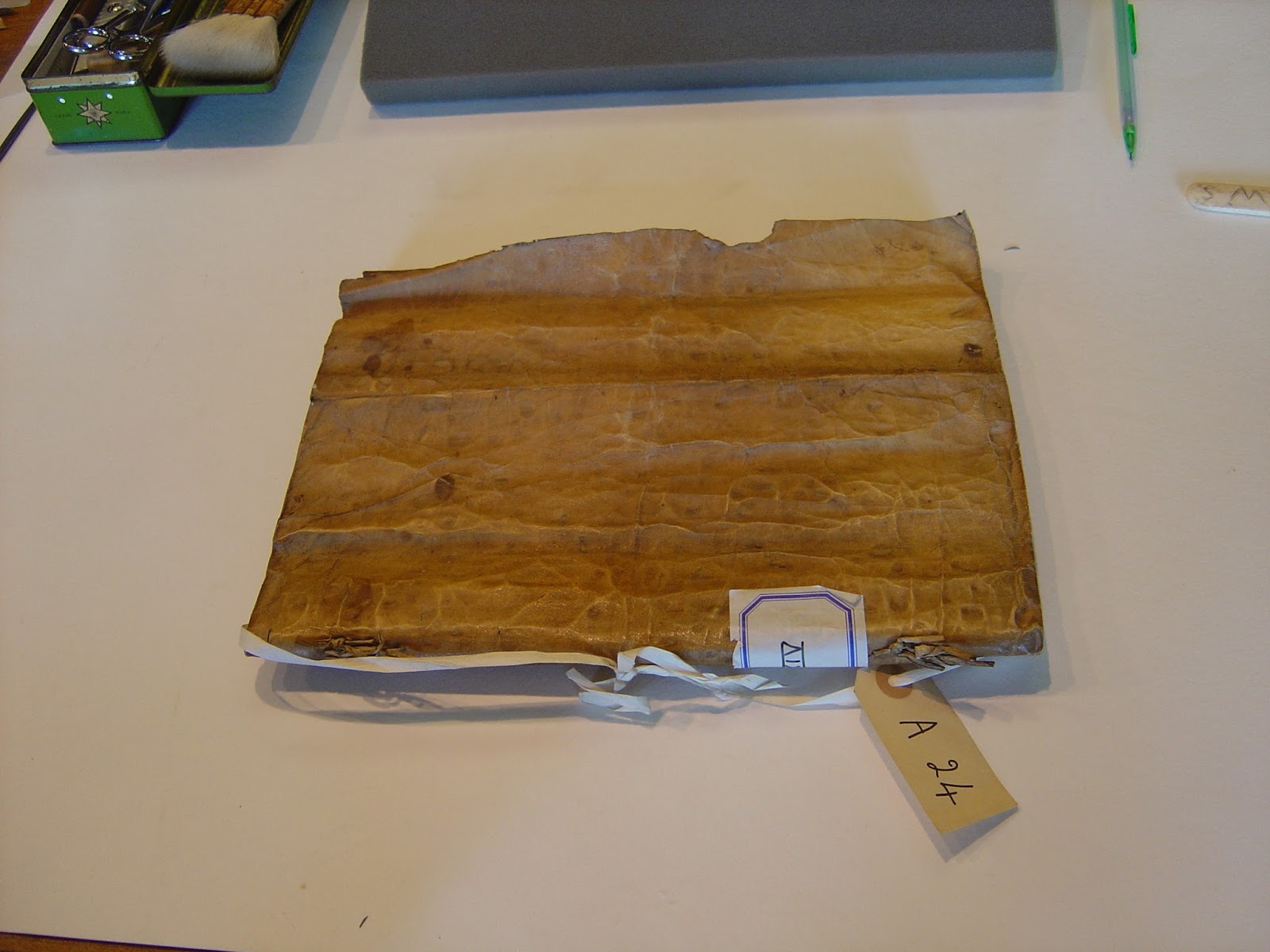
On Friday, Katerina was working on A. 24, a register from 1501-1510. A.24 is a register of leases and tithe payments, relating exclusively to land in Devon. There is a bit of a mystery  behind this register. The Cathedral priory, to our knowledge, never held any land in Devon, so we are all a bit stumped as to how or why this register which solely pertains to Devonshire properties has ended up at Worcester!

Nonetheless, I was interested to learn more about the construction of this register, and find out how Katerina will go about repairing it. Here’s what I found out.
Photograph, A.24. You can see the limp vellum cover and along the bottom of two tackets made of twilled parchment. These bind the quires to the cover. Photograph by K. Powell, conservator. Reproduced by the permission of the Chapter of Worcester Cathedral (U.K.)
 A.24 is a register is made up of two thick paper quires, tacketed or bound to a limp vellum cover, pictured above. The lower page has a flap on its outer edge. This flap would have originally wrapped around the register, and probably have been tied with an alum tawed skin tie, to offer additional protection. The vellum cover appears to have been re-used, and evidence of an earlier binding can be seen in holes on the front and back covers. This re-used vellum cover even has some earlier writing on it, which I have not attempted to decipher (yet.)


Photograph, A.24. You can see the severe curling of the edge of the leaves, and imagine the difficulty Caterina must have trying to unfold them all. Photograph by K. Powell, conservator. Reproduced by the permission of the Chapter of Worcester Cathedral (U.K.)

The binding was not done by a professional but more likely in house, perhaps at Worcester. It is an early type of stationary binding, a very basic construction. The tackets (the bits that hold the pages to its cover) are made from twirled parchment and run through two layers of parchment stays.
What I found interesting about A.24 is that, although the cover and the binding are made from parchment, the text-block or quires are all made of paper. This is probably because late medieval writers clung to using parchment as a binding material, often believing it to be far stronger than paper.

There is a large amount of surface dirt on both the binding and the text-block. Therefore, the first stage of conservation is cleaning. As a substantial portion of the text-block has edges that are severely curled, Katerina has to painstakingly uncurl the edges before she can begin the cleaning process with a smoke sponge. The cleaning process for A.24 will take Katerina one day.
Photograph, an earlier conservation project. Manuscript being undergoing treatment with gortex. Photograph by K. Powell, conservator. Reproduced by the permission of the Chapter of Worcester Cathedral (U.K.)
The next stage after cleaning is humidifying the paper. The pages will be humidified in a Gore-Tex and capillary matting sandwich. The matting is a polyester wadding like material which holds the moisture, Gore-Tex lets a small amount of the moisture through and gently humidifies the paper. Two pages can be humidified at the same time. The pages are then pressed between blotting papers until dry. This will flatten the curled edges.
The second issue needing attention is the tears that have resulted from the severe curling of the edges of the pages. These will be repaired by Katerina using Japanese paper and wheat starch paste. Japanese paper is especially useful in conservation because of its long fibres, which make it very strong and well suited to repair work.
Broadly speaking, Katerina uses Japanese paper along the grain on the tears because it shrinks less when used this way. For larger repairs to the text-block she often uses Japanese paper across the grain because this maximizes the strength of the repair.
A.24 will be completed over the next month, leaving around ten more registers to conserve. We are very grateful to Katerina and her colleagues for their continuing help and hard work. The medieval registers are one of a number of conservation projects we are currently involved in. The link below provides information on some of our other conservation work. If you feel that you would like to support the ongoing conservation work at Worcester Cathedral Library, click this link to find out how:
http://worcestercathedral.co.uk/index.php?pr=Library_Conservation


Friday, 19 July 2013

Richard III: The Tyrant King?


Researched and edited by Joshua S. Baker-Cox and Henry H. Partridge.
For the full names of authors mentioned, and their books used, see the bibliography.


Photograph reproduced by the permission of the Dean and Chapter
of Worcester Cathedral (UK).
This depiction of Richard is taken from Raymond's History of England

Richard III is frequently portrayed as this vilified, even dehumanized manner. However, is this really the case?
A great deal of our modern vision of this last Plantagenet king is due to anti-Plantagenet propaganda under the Tudor monarchs. Rous, a historian contemporaneous with both Richard III and Henry VII is a prime example of this Tudor-propagated image, having written of Richard that he was ‘a great man’ during his reign, and then later adopting the Tudor view of the corrupted monster who ‘disgraced’ the English throne. Another fine instance of Tudor propaganda that has affected the popular view of Richard III was the tampering of both contemporary and Tudor-era paintings to over exaggerate his physical deformities such as his crooked spine and withered arm. Given the anti-Ricardian bias presented by Shakespeare and historians since the Battle of Bosworth, it is easy to see why this image has crept into popular imagination. But, setting aside historical aspersions on his character and physical appearance, is this truly the real Richard III?
Photograph reproduced by the permission of the Dean and Chapter of Worcester Cathedral (UK).
This depiction, also taken from Raymond, shows Richard III with his 'withered arm'. 

Evidence that supports the Tudor-endorsed view includes Richard’s threat to decapitate Lord Stanley’s son (whom he was given as a hostage) prior to the Battle of Bosworth due to his father’s reluctance to fight loyally for his king outright, and Richard’s only being prevented from this action by the pleas of councillors and the sentiment that he could potentially deal with opposition after the battle, as well as the multiple rebellions, social unrest, and executions of rival nobility like the Duke of Buckingham, beheaded without trial, that marked his reign. Of course, the most notable and infamous decision of Richard’s life is perceived to be his possible involvement in the deaths of his two princely nephews in the Tower. While it is implied in several letters (Raymond and Rapin both make reference to these letters) that Richard may have enquired into the possibility of removing potential threats to his rule such as the princes, this has never been proved for certain and was definitely emphasized by Tudor-era propaganda. Finally, popular opinion was against Richard even in his lifetime, as shown when, after his wife Anne died, he was accused of poisoning her for his own advantage, meaning that his unpopularity was rife even before the over exaggerations of the Tudor era took hold.

Photograph reproduced by the permission of the Dean and Chapter of Worcester Cathedral (UK). This is a monastic account roll from Worcester Cathedral priory belonging to William Dene, Master of the Chapel, 1483-1484, years 1-2 of Richard III 
However, despite Raymond’s depiction as a ‘tyrant’ and ‘usurper’, the emphasis placed on Richard’s darker qualities by Tudor historians cannot be relied upon for factual evidence. He was greatly loved in the north and particularly by the people of York. His attempts to engage Henry Tudor’s forces before their numbers could grown with additional support shows a strategic brilliance and excellent military command, whilst his laws to protect the poor and uphold the permanence of the law in England show a passion for justice. Much of the propaganda levied against him is unproven, and therefore choosing to go upon this view to construct any decision would not do the last English king true justice. At the end of Rapin’s ‘History of England’ (in the cathedral library) the writer shows a considerably modern approach to historical Ricardianism, stating that these aforementioned points would have perhaps led to a better kingship had he possessed a tighter grip on the throne and on popular opinion. All accounts of Richard’s death in battle agree on the point that he showed ‘uncommon valour’ and courage in the face of opposition, even unto the moment of his last breath. ‘Thus fell Richard of York, king of England, in the thirty-fourth year of his life’.’(Rapin).
Photograph reproduced by the permission of the Dean and Chapter of Worcester Cathedral (UK). This is a property document between three citizens of Worcester, John Broke, Richard Petur and his wife Alice, on the 28th of January, 1484, the first year of Richard III's reign. This is in the Worcester Cathedral Archives.

Bibliography:

Rubin, Miri: The Hollow Crown.
Penguin Books 2006.
ISBN: 13 978-0—140-14825—1.

Raymond, George Frederick: A New, Universal and Impartial History of England, from the earliest authentic records, and most genuine historical evidence, to the summer of the year 1785.

De Thoyras, Rapin: A History of England, written in French, translated into English with additional notes by N. Tindal, N. A. Vicar of Great Walton in Essex. 2nd Edition, Volume I.

Richard III to Henry VII. Correspondences from the one to the other through letters written in Richard’s last year of rule.


Monday, 1 July 2013

Sir John Moore's Campaign in Spain


The book ‘Moore’s Campaign in Spain’, which is held by Worcester Cathedral Library, is an account of Sir John Moore’s actions in the Peninsular War of 1808-1809, in which Britain was allied to Spain and Portugal against Napoleon’s forces. The book’s author, James Moore, uses letters written to and by his brother to refute “ungenerous attacks and dark insinuations” that followed Moore’s death, regarding his military decisions during the campaign.
Photograph of Sir John Moore from Moore's Campaign in Spain. Photograph reproduced by permission of the Chapter of Worcester Cathedral (U.K.)
Excluding his retreat and defence of Coruna, where he died, Moore is probably most famous for his role within army reform, as he introduced light infantry regiments such as the Rifles. Despite considerable criticism of his military decisions at the time of his death, Sir John Moore is now remembered for his valiant leadership in the Peninsular War, and throughout his military career. His bravery and courage were recognised, surprisingly by Marshal Soult, his French counterpart, who ordered a monument to be erected to his fallen enemy in respect and remembrance for a man whose campaign had been steeped in adversity.

Whereas modern warfare is largely governed by tactics, with military operations being decided based upon the likelihood of victory or expected casualties, early 19th Century warfare was predominantly governed by the availability of food and the conditions of transport routes, as demonstrated by Moore’s campaign.

The massive consumption of the British Army, exemplified by the prediction that in three months of warfare, “all the oxen would be consumed and very few hogs would remain in the country”, meant that the military convoy was forced to travel through the north of Portugal, where food supplies were more plentiful. Additionally, the need for rapid transport of weaponry to the front lines across the rugged Spanish and Portuguese landscape  limited transport to the main routes across the mountains, making them vulnerable to attack.

These decisions resulted in the massive loss of life, including that of Sir John Moore himself, at the battle of Coruna. It is therefore easy to see how the necessity of obtaining sufficient supplies determined the outcome of wars during this period.
Photograph of an engraving of Cornua. The caption reads "A view of the British and  French position". Photograph reproduced by the permission of the Chapter of Worcester Cathedral (U.K.)

Although the content and intentions of this book are obviously serious, the descriptions of the Spanish do, in retrospect, prove amusing. James Moore says that “the disposition to exaggerate in Spain is such that it is difficult even now to ascertain what was the number of its army”, which contained “few officers who deserved the name”. Despite their shortcomings, when the British Army was forced to roll trunks containing £25,000 over a precipice as it was too heavy to transport when travelling quickly to try to outpace the French, it was apparently the Spanish peasantry who stumbled upon the money.

Why this book is held in the Cathedral’s Library still remains a mystery. The only significant link to Worcester is that Moore’s daughter married into the Dancy family, who have lived in and near to Worcester for many generations, so it is possible this book was donated to the Library by one of his descendents.

By Carys Aldous-Hughes.

Monday, 24 June 2013

A fourteenth-century lawyer's handbook

Your blogger’s favourite item from Worcester Cathedral Library’s law collection is a fourteenth-century lawyer’s handbook. Unlike the law textbooks studied by the monks at Worcester Cathedral priory, this handbook was in day-to-day use in the courtroom. The manuscript, as a result, displays signs of heavy usage. Most eye-catching are the “medieval sticky notes” protruding from the pages. These are called parchment place-markers. The parchment place-markers are pictured below. They are very dark in colour, probably because the vellum has absorbed a lot of dirt from being touched.


Photograph, Statuta Anglie. Photograph reproduced by the permission of the Chapter of Worcester Cathedral (U.K.)

It seems probable that it was the lawyer himself who made these sticky notes. Upon inspection they appear to be small, rectangular pieces of vellum, folded in half vertically. Whereas modern day sticky notes have adhesive on one side, these parchment place-markers are doubly glued. That is to say, the left hand side of parchment-marker is pasted to the recto and the right-hand side is pasted to the verso. As a result a tiny loop is created that protrudes from the page, and it is this that the user touches to find certain sections. That the parchment place-markers are glued to both recto and verso may well be why they are, quite literally, hanging on almost six hundred years after they were made.

These parchment place-markers are, moreover, significant in so far as they reflect a different way of highlighting sections of a manuscript to what we usually encounter with monks’ textbooks. Tamsin Rowe, predecessor to your blogger, in her exhibition on Worcester’s manuscripts discussed the way in which monks used marginal illustrations and drolleries to highlight and refer back to important sections of texts, during their hours of private study. Here is a good example of a way in which a monk would highlight a section of a text. This little pointing hand is found in a fourteenth-century textbook, Averroes' commentary on Aristotle's physics, used at Oxford:


Photograph, Averroes, Commentum magnum on Aristotle, Physica. Photograph reproduced by the permission of the Chapter of Worcester Cathedral (U.K.)

By comparison, the parchment place-makers in the Statuta Anglie serve as more of a physical marker which would allow the medieval lawyer to quickly flick to the right law when in the courtroom. Unlike the Benedictine monks, the medieval lawyer who owned the handbook probably did not have time to casually browse to find the section he was looking for. The Statuta Anglie contains 37 different law texts, the first being the Magna Carta, the second being the Charter of the Forest. With such a large number of texts in a relatively small book (210 mm x 145 mm), finding a page could well have gotten you in a tizzy in the medieval courtroom.
Another aspect of this manuscript that I enjoy are the humorous illustrations that decorate its pages.  For instance, on  f.156 there is evidence that the lawyer may well have had a dull day in the courtroom, for he draws little pictures of sausage dogs in the margins and, what appears to be, an imp-like man who is either pointing at himself or on the cusp of picking his nose!


Photograph, Statuta Anglie (f. 156). Photograph reproduced by the permission of the Chapter of Worcester Cathedral (U.K.)

 
Equally intriguing is how this fourteenth-century handbook found its way to Worcester. In the catalogue of Worcester Cathedral’s manuscripts, it is noted that the handbook was probably “used in the Hereford diocese, coming to Worcester after the reformation.”  The first few folios are dated at Bosbury in 1334. On f.286 v the name “Rocheford” appears written in a formal hand, and the signature has been dated to 1400.

Photograph, Statuta Anglie (f. 286). Photograph reproduced by the permission of the Chapter of Worcester Cathedral (U.K.).


The next information on the manuscript’s ownership is not until the seventeenth century; on f,.7 r in a seventeenth-century hand is written the name “Fransisci Harewell armigeri” of Birlingham. Birlingham is parish located roughly twenty minutes away from Worcester. The name Sir Francis Harwell appears on another book at Worcester Cathedral Library, a sixteenth-century printed law book.
Both books are thought to be donated by Sir Francis Harewell in 1676. A Thomas Harewell, possibly the son of Francis, is known to have donated books to the library in the 1690s. We know very little about either of the Harewell’s mentioned. An interesting area for research  would certainly be the Harewell family; an exploration of who they were, how they obtained this medieval law book, and whether they had any particular affiliation with practicing law (given that both books they donated to the Cathedral relate to practicing law). The pursuit of answers to these questions could possibly yield some interesting results.
If you enjoyed this week’s blog and would like to see the lawyer’s handbook up close then might enjoy taking a tour of the library. From 5th-31st of August, we will be running two tours daily. The cost is £5.00 per person (£2.50 for under 16s).
See the August 2013 events section for more details.

Monday, 17 June 2013

Medieval productions of Robin Hood

One of the treasures of Worcester Cathedral Library is the Journal of Prior William More.  This is a handwritten weekly account book for the years 1517 to 1535 kept by William More, who was the penultimate Prior of Worcester before the dissolution of the Monastery.  Surprisingly, for an account book, it offers a unique insight into a more light hearted side of Monastic life, and provides an uncommon amount of detail on monastic feasts and entertainment.

Photograph, Avi , Monastic Register. Close-up of a decorated letter ('R') depicts a number of figures including a lute player or possibly minstrel. Photograph by permission of the Chapter of Worcester Cathedral, (U.K.)

The religious year was laid out as a series of festivals, saints' feast days and holy days so there was always an excuse for a celebration.  For instance the Prior celebrated St Thomas's Day[6th July] in 1529 with a bonfire at Crowle and to help the party go with a bang he spent threepence on 'kakes' and to wash those down there was a 'potell [four pints] and a quarte [two pints] of red wyne' and a 'potell of sacke'.  This was in no way unusual as he celebrated Christmas dinner 1520 with a 'quarte of mawmesey', a 'potell of rumney' and a 'potell of osey' and the meal was accompanied by carols and William the 'Lewter' playing for guests.

Entertainment played a large part in late medieval celebrations and the accounts list over two hundred payments or donations to entertainers that include among others; jugglers, bearwards, tumblers, minstrels, players, singers and dancers. 

While some are donations made to support parish groups others are payments made to entertainers who were brought to the Priory or one of the Prior's houses to entertain him and his guests.  For one day's entertainment alone at Battanhall he lists, rewards to “singers on ye dedicacion day in ye morenyng” and for later on that day, “William slye & his compeny beyng the quenes pleyers” and also the “Dewke of suffolke[s] mynstrell” and let us not forget the payment for “wyne”.

Robin Hood seems to have been one of Prior Moore’s favourites. He contributed a substantive forty pence to the town of Tewksbury to support their Robin Hood event. He also paid the villagers of Cleeve six shillings and eight pence “in rewardes” for travelling to his house at Crowle and “pleying with Robyn Whot Mayde Marion”.  Another entry lists twelve pence to “certen yong men of seynt Elyns that pleyd Robyn whod”.  Although I leave you to decide if the twelve pence to “Robyn Whod & little John of Ombursley” are players or the real people.

Saturday, 8 June 2013

A manuscript without glitz or glamour

Conservative. Inexpensive. Modestly decorated. These are three terms that pop-up frequently in discussions of the late Saxon and Anglo-Norman manuscripts produced at Worcester.  This week your blogger considers how we read and understand a medieval manuscript that is sparsely illuminated or even undecorated.

If you enjoy the glitz and the glamour of a beautiful illuminated manuscript then it’s true, Worcester was producing some plain looking manuscripts from the late tenth-century to the middle of the twelfth-century. Let's take as an example the Expositio libri comitis: a manuscript which contains writings by Smaragdus (a Benedictine monk from the Diocese of Verdun).


Photograph, Exposito libri comitis. Photograph by Mr Christopher Guy, Worcester Cathedral Archaeologist. Reproduced by permission of the Chapter of Worcester Cathedral (U.K.)

The scribe’s name has been identified from another Worcester book , now held at the British Library, as Sistan. Sistan exemplifies a typical scribe employed by Worcester at the end of the tenth-century. The script he uses is called Caroline miniscule. This script developed from the earlier Saxon Insular miniscule, and retained some if its features (such as wedge shaped ascenders). Sistan’s script is quite easy to read, this is because it is quite bold or heavy handed. Yet the quality of Sistan’s work is far from perfect, and there is a great deal of variation in the quality of his hand between manuscripts and even within the same manuscript.

In the Exposito libri comitis, for example, Sistan appears to have ruled lines but occasionally gone a bit wonky when copying; there are even instances within this manuscript where he seems to have written across the lines rather than on them. In the close-up below, you can see that he’s gone over the line ruled in the right-hand margin.
Photograph, Exposito Libri Comitis. Photograph by permission of the Chapter of Worcester Cathedral (U.K.)
Sistan aside, the Exposito libri comitis fails to leave onlookers gobsmacked primarily because it is undecorated. Academics and medieval enthusiasts alike emphasize decoration as an important aspect to medieval book production. Rightly so, manuscripts should always be considered the product of a collaborative project between patrons, scribes, decorators and binders. The sheer cost of manuscript decoration alone in the middle ages seems evidence enough that patrons considered visual appearance (letters, colours, pictures) as important as the text itself.

In the case of an undecorated text, like the Exposito libri comitis, should we therefore assume that the text was considered unimportant or was cheaply produced?

That the Exposito libri comitis is undecorated actually tells us some important information about the contact Worcester had with other centres of manuscript production (English and continental) during this period. Richard Gameson, who writes an excellent chapter on Worcester’s book production in St. Oswald of Worcester: Life and Influence (London: Leicester University Press, 1996), stresses that during the episcopate of St. Oswald (961-92) Fleury was probably Worcester’s main source for exemplars (“standard” versions of the texts that the scribe copied from). Gameson describes Fleury as “a centre of reform and scholarship” and “an important potential source of text and script models”. Fleury was not, however, renowned for its illumination and this might explain the blandness or sparseness of decoration in late Saxon and early Norman manuscripts produced at Worcester, such as the Exposito libri comitis.
The Exposito libri comitis being devoid of any artistic stamp is, however, an extreme example of the late Saxon manuscripts produced at Worcester. Many other Worcester manuscripts were illuminated, particularly as we move towards the Anglo-Norman period. Illumination in Worcester manuscripts was nevertheless sparse in comparison to texts decorated in the scriptoriums of Canterbury and Winchester.
To end, I'd like to talk briefly on some of the decoration of Anglo-Norman manuscripts at Worcester. A psalter with commentary, which dates from around 1200, is a good example of Anglo-Norman decoration at Worcester. The psalter was decorated in two stages. Stage one was undertaken at the time of the psalter’s writing, and it involved the adding of initials in red, green and blue (see below).
Photograph, Psalter (1200). Photograph by permission of the Chapter of Worcester Cathedral (U.K.)
It was not until thirty years later, however, that stage two of decoration began. In the second stage of decorationthe ‘Beatus’ initial, which marks the beginning of the text, was added as well two other initials (‘X’ and ‘H’) gilded in gold. The second stage would have been far more costly than the first given the large size of these initials and the price of the precious metal. Both stages are beautiful in their own right but all-in-all the psalter presents the reader with a hodge-podge of decorated initials. The two very distinct decorative styles do not visually gel well together.
Photograph, Psalter (1200). Photograph by permission of the Chapter of Worcester Cathedral (U.K.)
One interesting decorative feature of the psalter and other manuscripts produced at Worcester in this period, are these decorated initials (like the 'M' pictured below) with curious little foliate tails. Some are very plain whilst others include intricate lattice work.
Photograph, Psalter (1200). Photograph by permission of the Chapter of Worcester Cathedral (U.K.)
Next Friday, I’ll talk a little more about these and ask whether one or more Worcester artist was employed them, and explore whether they present a unique Worcester style of decoration.