Friday, 10 May 2013

Some Natural Catastrophies and Others Befalling the City

Over the centuries there have occurred numerous natural disasters and events, which have shaped the lives of the citizens of Worcester. Some of these occurrences are noted in a book titled ‘Forgotten Worcester’ and from it’s pages are noted some of these events, spanning a 600 year period.

On December 31st 1210, there was such a severe frost that the river Severn was frozen as far down to the outskirts of Gloucester. It lasted until mid February and it was further reported that it was possible for a man to cross the river on horseback.

In January 1285, a heavy fall of snow caused great damage to property and claimed many lives. The  weight of the snow was so great that it broke many bridges throughout the county.

During 1342, a fatal plague broke out in the city, claiming many lives.

In 1349 the Black Death or what was termed as a ‘severe pestilence’ erupted and killed many of the population. So great was the fear of contamination that it was ‘deemed unsafe’ to bury the bodies within the Cathedral churchyard and so they were interred at St.Oswalds.

Earthquakes have been felt in the county and city, one of which was mentioned in 1534.

What was referred to as ‘the sweating sickness’ raged through the city during the year 1558.Then almost 80 years later, as happened in many towns and cities across Europe, almost a quarter of the city’s population died from the plague.

The flooding of the river Severn has always been a major problem to the city and no more so than in 1672.When this occurred it was reported that this was the highest ‘then on record’. Then in 1770 this level was exceeded by 10 inches, a level that was matched in 1795.

In the year 1811 the city was hit by a tremendous storm, it ravaged much of the surrounding land as well as causing huge damage to both property and forestry. Huge pieces of ice 5” to 6” in diameter were hurled around in a hurricane force wind, accompanied by vivid lightning and rolling thunder.

During 1813, for a period of 9 days the city was engulfed in a ‘remarkable’ fog.

Epidemics were not uncommon in the city and that of Cholera was no stranger. Outbreaks occurring in 1831,1832 and 1849,claiming 43 lives.

On reading this list, it should be noted that a celebrated antiquarian – Lambarde wrote the following, ”that never had he met a place that had so great experience, in the calamities of the intestine broils of the kingdom, and other casual disasters, as the city of Worcester”.

Over the centuries the city has suffered, on numerous occasions, severe damage to properties and loss of life through fire. Of course a main aid to this was that the bulk of the city was timber built and through either accident or design this was an inevitable problem. As far back as 1114, July 19th, there was an unusually immense fire that caused huge damage, including the destruction of the Cathedral, together with many of the cities churches and the castle was destroyed.

Adrian Skipp


Friday, 3 May 2013

The Worcester Medieval Music Fragments


Tumultuous periods in history are equated with the destruction and damage of culturally valuable materially. This week’s blog puts that theory to the test!


Worcester Medieval Music Fragments. Photograph by permission of the Chapter of Worcester Cathedral (U.K).
 
Many of the medieval music fragments at Worcester, like those pictured above, have suffered over the course of history considerable damage from fire, exposure to smoke or have deteriorated as a result of being used as fly leaves in later fifteenth-century manuscripts and ledgers. We commonly assume that the Reformation and Civil War, two of the most volatile periods in English history, are entirely accountable for the poor condition of the Worcester fragments.
 

The Worcester music fragments are thought to have originally formed three volumes of music from the thirteenth and fourteenth centuries, which were made up of roughly five parts harmonised music to one part plainsong. These volumes were re-used by the monks in the fifteenth-century, their pages being torn out, recycled as wrappers and used fly leaves in later manuscripts. Though there was burning of sacred music in 1549 on the College Green, the fragments managed to escape the burnings because they had not been discovered.
 
The Civil War is the second historical event which impacted upon the Worcester fragments’ condition, and this week we stumbled across an interesting note from the 1660s written at the bottom of one of the medieval music fragments. The note is by Stephen Richardson, Chapter Clerk in the years immediately following the Civil War. The note is pictured below.


A Note by Stephen Richardson. Photograph by permission of the Chapter of Worcester Cathedral (U.K.)
 

It reads:
“Memorandum that Eighteene leaves were taken out of this booke and lost when itt was in the hands of th[e] Com[m]ittee and before itt was regained by Mr Barnabas Oley to the Church, so itt conteineth now but 48 leaves
Stephn’ Richardson”
When Worcester surrendered to the Parliamentarians in July 1646 the Committee of Sequestrations took possession of all Cathedral property and, during the period of the Commonwealth, many of the Cathedral’s ledgers and documents were sent to London for safe keeping by instruction of the County Committee. Indeed, this was the case with the ledger that contained the medieval music fragment pictured above. The note from Richardson tells us that the period in which the fragments were in London led to further destruction, with “eighteen leaves” being “taken out of this book lost when it was in the hands of the committee”. We cannot be certain whether the “eighteen leaves” refers to leaves from the ledgers / accounts or eighteen leaves of medieval music specifically.
 
Richardson states that the particular fragment pictured, and the book in which it was originally bound, was “regained by Barnabas Oley to the church”. Barnabas Oley was Canon during the restoration of the Cathedral. Oley was greatly concerned by the loss of manuscripts and archival holdings that the Cathedral had sustained during the Civil War. From 1661-1666 Oley travelled to London and reclaimed several boxes of registers and ledgers connected with the office of the Treasurer and Receiver General, and returned them to Worcester.
By the time Richardson was writing in the late 1660s the medieval music fragments had been torn apart, recycled, and transported to London where, under the County Committee, pages had been lost. Yet it is curious that Richardson records that, in spite of such tumultuous historic events, the book contains “48 leaves”. Is he suggesting there were, in the 1660s, 48 leaves of this particular music book? If this is what he is suggesting than we are faced with the possibility that many more fragments were lost in the post-Civil War than we have hitherto assumed. We have little knowledge of how the fragments were treated and stored in Worcester Cathedral Library in the three centuries prior to their rediscovery by Canon Wilson in the early years of the twentieth century. Unfortunately, there are no more helpful little notes by clerks like Richardson to provide us with nuggets of information! Perhaps by turning our gaze to more recent history, than consistently focussing on the Reformation and the Civil War, we could discover new information on the state of the fragments over the course of history.


Friday, 26 April 2013

John Dee: Mathematician and Crystal Ball Gazer!


John Dee, astronomer, pictured here with his "shew stone". Photograph by permission of the Chapter of Worcester Cathedral (U.K.).


This week’s Cathedral Library blog is about an Elizabethan scientific mastermind who coined the term “Brittania” and in later life took up crystal ball gazing! He also visited Worcester Cathedral Library and got to keep one of our precious manuscripts!
John Dee (1527-c. 1609) was an influential astronomer and mathematician of the Elizabethan era. Described by John Bale in his Index of British and Other Writers as an “astronomus pertissimus”  (an expert astronomer), Dee was originally known for the accuracy and quality of his astrological birth charts, and went on to draw up birth charts for Queen Elizabeth I and Sir Philip Sidney.  The work for which he is most renowned is The Mathematicall Praeface; an introduction to Henry Billingsley’s translation of Euclid that argues mathematics should be used as a basis for the study of the universe, and other scientific disciplines.
In his early life Dee was educated as an undergraduate at St. John’s College, Cambridge, and later became a fellow of Trinity College, Cambridge. Straddling a period of educational reform at Cambridge, Dee’s studies focused on Greek philosophy and Arabic arithmetic, and incorporated the learning of geometry, arithmetic, harmonics, and astronomy.
Dee travelled from the middle of the 1540s to the 1550s through the Low Countries, where he encountered some of Europe’s leading minds (Gemma Frissius, Gerard Mercator, Pedro Nuñez). Dee’s reputation had grown by the time he returned home from the continent c.  1551 and, aided by his former Cambridge tutor (Robert Ascham), he was introduced to the court of Edward VI. He presented to the boy-King two astronomical books he had written whilst in Louvain.  By 1551, Dee was in service as a tutor to the Earl of Pembroke’s sons and the following year was requested to join the Duke of Northumberland’s household. So renowned was Dee that by the time he came to visit Worcester Cathedral in February 1565 the then Dean (John Pedder) willingly gave him a rare Anglo-Saxon manuscript- the ‘Cosmographia’ of Ethicus. Dee was a keen collector of antiquated scientific texts and, at the peak of his financial success, is thought to have owned around three thousand printed texts and a sizeable number of manuscripts.
In 1555, during the reign of Queen Mary, Dee was accused and arrested for attempting to endanger the lives of the Queen and her sister through conjuring. When Elizabeth ascended to the throne, Dee recovered his reputation for a time. Appointed as a scientific advisor and natural philosopher within the Elizabethan court, Dee had the honour of selecting the date of Elizabeth’s coronation. Throughout the 1570s Dee served as a scientific and technical advisor on England’s voyages of discovery. By applying Euclidean geometry to navigation, he greatly influenced cartography. It was during this period that he coined the term "Brittania".
 Edward Kelly, medium to Dee in later life. Photograph by permission of the Chapter of Worcester Cathedral (U.K.).


Whilst Dee was highly regarded as a mathematician and astrologer, his reputation was increasingly dogged in later life by his association with the occult. Worcester Cathedral Library contains a copy of A True & Faithful relation of what passed for many Years Between Dr. John Dee and Some Spirits, a book which reflects Dee’s growing preoccupation with the spirit world. In the 1580s, Dee befriended and employed a mystic, Edward Kelly, in a bid to commune with spirits so that he could be further enlightened, and better understand the forces at play in the universe. A True & Faithful relation of what passed for many Years Between Dr. John Dee and Some Spirits charts the period from 1583 to 1607 (two years before Dee’s death) in which the pair took to crystal-gazing or ‘skrying’ in a bid to commune with spirits and angels. There are numerous references throughout the text to a “shew-stone” (pictured with Dee above), to which Kelly and Dee gazed into and, from which they claimed, spirits appeared out of. Written in the form of a dialogue between Dee, Kelly and the various spirits, each encounter is given a date. Dee records detailed descriptions, moreover, of the forms that these spirits took: “Suddenly here seemed to come out of my Oratory a Spirituall creature, like a pretty girle of 7 or 9 years of age, attired on her head with her hair rowled up”.
The third volume of The Biographia Britannia, available also to study in Worcester Cathedral Library, demonstrates the extent to which these otherworldly visions would, for centuries to come, tarnish Dee’s reputation as one of the most influential and forward-thinking Elizabethan mathematicians. The Biographia Britannia describes him as “famous for his extensive learning […] but withal extremely credulous, extravagantly vain and a most deluded enthusiast. […] He suffered himself to be deluded into a firm opinion that, by certain invocations, an intercourse or communication with the spirits might be obtained”. So discredited and reclusive was Dee in later life that he had to sell off his once vast library so as to avoid imminent poverty. He died in Mortlake c. 1609, though no gravestone marks his resting place.


Friday, 19 April 2013

Fragments of "The Reeves Tale", printed by William Caxton

           
“Incunabula” is the name given to fifteenth-century books printed by moveable type. The library of Worcester Cathedral is fortunate to have a collection of forty five such early printed books. One of the rarest items in the incunabula collection is fragments of “The Reeve’s Tale” from William Caxton’s first edition of The Canterbury Tales. These fragments were printed in Caxton’s Westminster workshop in 1478. The fragments exist today in the form of two folios, and are accompanied and bound with a letter from the donor in 1917, Mr M. Tomkinson of Franche Hall, Kidderminster. 

Photograph by permission of the Chapter of Worcester Cathedral (U.K.)
 
 
The work of Chaucer was already popular by the time Caxton came to set up shop in Westminster, and was available in numerous manuscript editions. That Caxton chose to print the work of a well-established English author evidences his entrepreneurial skills. Confident that The Canterbury Tales had enough of an audience, Caxton printed around three hundred copies of his first edition. Other books Caxton published in English (The History of Reynart the Foxe, Troilus and Criseyde and Mallory’s Morte D’Arthur) further suggest that his printed texts catered to the established literary tastes of late medieval Londoners.
 

Photograph by permission of the Chapter of Worcester Cathedral (U.K.)


Although the technology Caxton used to produce books was revolutionary, the picture of the fragments above demonstrates how the appearances of Caxton’s incunabula were still greatly influenced by, and reminiscent of, the manuscript tradition.

That is to say, throughout his career as a printer Caxton used only gothic typefaces because they closest resembled the scribal hands most commonly used in late medieval manuscripts. As a printer in London, Caxton would have been in direct competition with the market for manuscripts. Therefore it is likely that he consciously used typefaces that would have been familiar to his target audience, so as to maximize shop sales. For example, the typeface he uses in the fragments of “The Reeve’s Tale” above is called lettre bâtarde, and is based upon a Burgundian script. Edmund Childs notes that despite Caxton’s enterprising nature, he might be considered a less imaginative printer than some of his European counterparts because there is little variation between, and development of, the typefaces he used from 1474-91 (William Caxton: A portrait in the background, London: Northwood Publications, 1976, p. 131). This picture of the fragments also shows initials that were drawn later by hand in red ink, after the main body of the text had been printed by moveable type. The use of red ink is again a nod towards the manuscript tradition, in which scribes most frequently use red ink to make textual additions and corrections.
If you wish to learn more about Caxton and his influence upon English book production and the English language you may well enjoy listening to this BBC Radio 4 episode of “In Our Time”. Click on the link below.


Thursday, 11 April 2013

Three Medieval Bishops of Worcester

In the thirteenth century the Diocese of Worcester had three very different Bishops, who in their own ways made their mark. So to learn about the man who organised the construction of the Cathedral's Lady Chapel, the Bishop who supported the famous Simon de Montfort, and the Bishop who loved his status and got involved in expensive lawsuits read on....
                                                         
Bishop William de Blois in the Lady Chapel. This image is copyright the Dean and Chapter of Worcester Cathedral (U.K.)

                                                             WILLIAM DE BLOIS
                                                   Bishop of Worcester 1218-1236

 Although the monks of Worcester normally elected one of their number to be bishop, William was the papal nominee, their choice having been rejected by the Pope’s official. In spite of this possibly inopportune start, the new bishop proved to be a strong disciplinarian who worked towards raising the standard of clerical life. Bishop Blois is mainly remembered for beginning the erection of the Lady Chapel. The money raised from the pilgrims’ visits to the shrine of Saint Wulfstan was divided between the monks and the bishop. It would seem that the bishop used this as well as some of his own income to pay for the work. The adoration of the Virgin Mary was becoming a very popular form of worship in Bishop Blois’ time, and most cathedrals were adding a chapel in honour of the Virgin. The bishop was determined that Worcester’s Lady Chapel would be a fittingly beautiful construction. The old Norman choir was taken down and architects designed plans for the new choir and the Lady Chapel. We owe to the initiative and generosity of Bishop Blois the exquisite Lady Chapel and the design of the choir. He also enriched the diocese in other ways, for he purchased lands out of his own pocket for the endowment of the bishopric.

Bishop Walter de Cantelupe in the Lady Chapel. This image is copyright the Dean and Chapter of Worcester Cathedral (U.K.)

                                                  WALTER de CANTELUPE
                                                Bishop of Worcester 1237-1265  

Bishop Cantelupe was a true patriot and considered to be one of the greatest bishops of the time. The monks requested permission of the Pope to elect him and when he was enthroned as bishop, the king and many dignitaries were present. The time following the death of King John when the boy king Henry III was on the throne, was a bad time for this country. The nobles surrounding the weak king were evil and grasping. England suffered both from the lawless acts of the king and from papal tyranny. Bishop Cantelupe, together with the great Bishop Grosseteste of Lincoln realised that the only way forward was to resist the demands of both the Pope and the King. The barons appointed a committee to draw up terms for the reform of the state and Bishop Cantelupe was among their number. In the ensuing civil war, our bishop fought with Simon de Montfort for the maintenance of law and order in the country. Bishop Cantelupe is remembered as a patriot but equally as much as an excellent bishop of this diocese. The building of the Lady Chapel and the new choir continued; the Charnel House was extended, with four chaplains in attendance, whose duties included teaching in the Schools, and he founded the nunnery of White Ladies in Worcester. It is said that: “he would have merited canonisation, but for his adherence to Simon de Montfort.”

Bishop Giffard's effigy. This image is copyright the Dean and Chapter of Worcester Cathedral (U.K.)

                                                      GODFREY GIFFARD
                                                 Bishop of Worcester 1267-1301

Godfrey Giffard was selected to be bishop because he was believed to be a strong man who would enforce obedience to the Crown, which he did as a committed Royalist. As successor to Bishop Cantelupe, his actions were quite the reverse of his predecessor, whose patriotic work in opposing the tyranny of both the Pope and the King was exemplary. Bishop Giffard was one of the bishops sent to the Holy Land to meet Edward I on his return. He was a man who enjoyed pomp and state occasions and was adept at entertaining royalty. Edward I visited Worcester eight times during Bishop Giffard’s episcopacy.

He spent much of his time as bishop involved in lawsuits with the monks after years of disagreements. These were hugely expensive as going to law with a bishop meant an appeal to the law courts in Rome.       
                                 
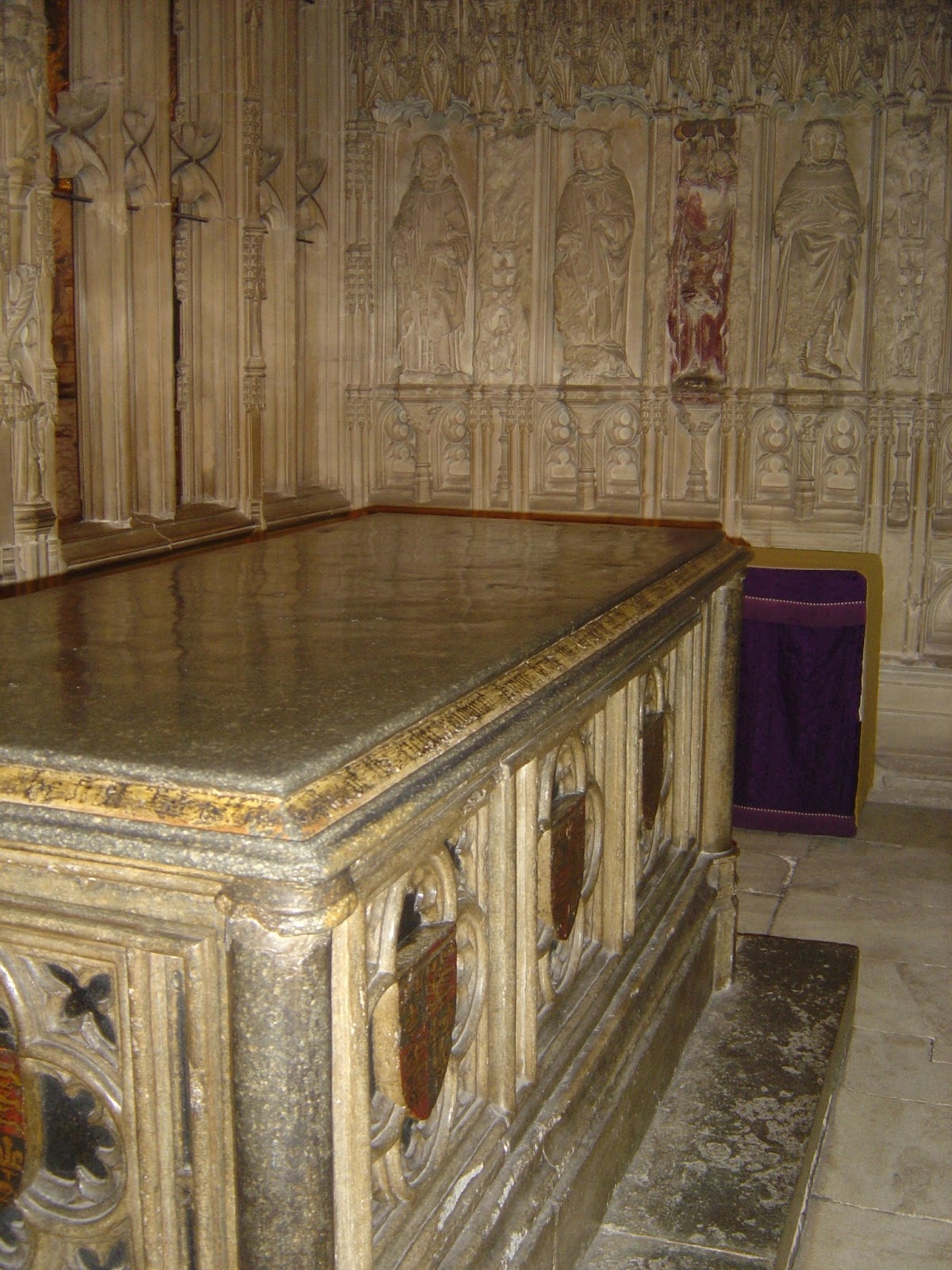
In 1221 the Franciscan Friars came to England and a small group of friars came to Worcester, settling in Friar Street, which was then a swamp. In contrast to the monks, who at the time did little to help the needy, the friars lived among the poor and tended the sick in the medieval slums. It is to the credit of Bishop Giffard that he helped the Franciscans in many ways. As bishop of this diocese for thirty years, it seems that he was very keen to punish clerical offenders and to support institutions which were designed to do good deeds. However, he was also proud and self-important and was buried in the magnificent tomb prepared for his body during his lifetime next to the high altar.   In the following year his body was moved and the tomb taken down as it was obstructing the high altar; perhaps a fitting act in Biblical terms for someone who wished to exalt himself too readily.

Bishop Giffard's tomb underneath Prince Arthur's Chantry Chapel. This image is copyright the Dean and Chapter of Worcester Cathedral (U.K.)

Bishop Giffard also left his mark, because his family coat of arms - ten red torteaux- formed the basis of the coat of arms of Worcester Cathedral and the Diocese of Worcester. On the cathedral's coat of arms, however, the first torteaux in the top left hand corner is hidden by an image of the Virgin Mary holding the Christ child.

Mary Somers

Thursday, 28 March 2013

Army Chaplains related to Worcester Cathedral


Within the main Cathedral of Worcester is the St. Georges Chapel. This particular chapel was created to honour the men and women of the county, who prior to 1936 had no specific area within the cathedral dedicated to their memories. The chapel was formally consecrated by Bishop Perowne on armistice Sunday 8 November 1936.
Rollo of Honour for original members of the British Expeditionary Force in the Worcestershire Regiment 1914-15 outside the St. George Chapel. Photograph by permission of the Dean and Chapter of Worcester Cathedral (U.K.)

Inside the chapel there are 6 stained glass windows, all of which show either the images of servicemen, regimental flags and badges and religious figures. Around the walls are hung 26 flags and banners, which represent the various regiments, militias, with two others representing the Royal Navy and the Royal Air Force.

The Rolls of Honour outside the George Chapel which people can consult. Photograph by permission of the Dean and Chapter of Worcester Cathedral (U.K.)


Around the walls of the chapel are a number of commemorative plaques, dedicated to either individuals, rolls of fallen comrades and regimental groups. Whilst the bulk off these are specific to the army, namely groups and individuals, there is one that is dedicated to a Capt. Patrick  Hamilton, of the Royal Flying Corps and one in honour of possibly the most famous person connected to the city in the twentieth century, that of Geoffrey Anketell Studdert Kennedy M.C.
The plaque in the St. George's Chapel to Geoffrey Studdert Kennedy or Woodbine Willie. Photograph by permission of the Dean and Chapter of Worcester Cathedral (U.K.)

There are a number of books written about the life and times of this remarkable man, together with the publications of his poems.

In brief, he was born in Leeds on 27th June 1883.He had 5 step brothers and sisters and 8 other brothers and sisters, from his father’s second marriage. He moved to Worcester in June 1914, where he was the vicar of St. Pauls, in the Blockhouse district of the city. He soon gained a reputation as a kind, generous and godly man around the city and was well liked in general. He volunteered to serve at the outbreak of the First World War and in December 1915 was appointed a Chaplain and posted to France. His dedication to duty and his tireless help with the troops earned him widespread respect and admiration, together with the nickname “Woodbine Willy”, this through the offering of cigarettes to injured and dying soldiers. He won the Military Cross for his reckless courage, he would often run into no-man’s-land to help wounded soldiers, either to pray over them or bring them back to safety. He died on 8th March 1929 of pneumonia aged only 45.

Whilst the deeds of Studdert Kennedy are noted and commemorated, there is another whose actions and devotion to duty are not noted within the Chapel area. A minor canon named Thomas Cuthbert de la Hey volunteered to serve during the First World War also. He held numerous offices and positions in the life of the Cathedral. Upon his enlistment he was sent to the front in September 1917 as a Chaplain, appointed to the 55th (Lancashire) Division, with which he served throughout the war.
Cuthbert de la Hey in his army chaplain's uniform. Photograph by permission of the Dean and Chapter of Worcester Cathedral (U.K.)


He also received the Military Cross in April 1918.It was awarded to him for his part played in the defence of Givenchy, fought from 9th  to 16th April 1918, ‘in recognition of personal bravery and devotion to duty’. Like Studdert Kennedy, his abiding aim was the comfort and help of his fellow soldiers. He organised a fund which was used for the purpose of this task and through this he was able to provide, on one occasion, a large case of biscuits, a large case of chocolates and a large case of cigarettes, which was divided amongst the men.

The dangers of the front were no stranger to him. He was home on leave at the end of June and returned on 13th July. The following morning he was wounded in the left arm by a high velocity shell!
Reverend Cuthbert de la Hey in more peaceful times.Photograph by permission of the Dean and Chapter of Worcester Cathedral (U.K.)

He survived the war and returned to clerical life in the city. The actions of this man were almost a mirror image of Studdert Kennedy: both had an unswerving loyalty to their fellow man. To find out more about Woodbine Willie why not have a look at Bob Holman's new book: Woodbine Willie- An Unsung Hero of World War One (Lion books 2013).

By Adrian Skipp.

Thursday, 21 March 2013

PRINCE ARTHUR: 1486-1502


Prince Arthur was the oldest son of Henry VII, the first Tudor king, who erected the tomb to contain his son’s body after his death at the age of only 15. Arthur was married to Catherine of Aragon, daughter of Ferdinand and Isabella of Spain. Catherine was to become Henry VIII’s wife after Arthur’s death.
Prince Arthur's Chantry Chapel. Photograph is reproduced by permission of the Dean and Chapter of Worcester Cathedral (U.K.)

Arthur was born in the castle at Winchester to Elizabeth of York, his father Henry VII being the former Lancastrian claimant to the throne. It was hoped that the birth of Arthur, as son of both factions in the Wars of the Roses, would end the bitter rivalry. As a child, Arthur had many titles and duties thrust upon him and even became Regent while his father was away in France. He was Prince of Wales and Lord of the Marches and with his Council was responsible for keeping the peace in Wales and along the borders. He often went with his parents on visits to the border country and went to Shrewsbury and Worcester, and with his grandmother, Lady Margaret Beaufort, probably visited Malvern. Ludlow Castle became one of his official homes, with his Council.
The tomb of Prince Arthur Tudor. Photograph is reproduced by permission of the Dean and Chapter of Worcester Cathedral (U.K.)

His formal education followed a typical Renaissance classical pattern. He studied Latin and Greek grammar and the great Latin and Greek authors, in between and during his travels and other duties.
A stained glass window of Prince Arthur in the Cathedral near the Chapel. Photograph is reproduced by permission of the Dean and Chapter of Worcester Cathedral (U.K.)

Arthur’s marriage to Catherine was considered to be vital. An alliance between Spain and Britain would bring trade to Britain and also help to diffuse some of France’s dangerous power. Proxy ceremonies of betrothal and marriage were held while the two children were very young. When Catherine arrived in England she was “welcomed by the whole people”.  They were married in St Paul’s Cathedral when both of them were just fifteen. The prince and princess were to spend their honeymoon in Ludlow Castle. However Arthur caught a fever and was too delicate to recover from it. He was dead within five months.  
The Tudor Rose and the Prince of Wales's badge carved on the Chapel. Photograph is reproduced by permission of the Dean and Chapter of Worcester Cathedral (U.K.)

Arthur is said to have been a gentle prince, in total contrast to his younger brother Henry. His tragic death was mourned by all and after lying in state for three weeks at Ludlow Castle, the body was transported to Ludlow Church where masses were sung. Three days later the cortege set out for Worcester where the body was placed on a magnificent bier. The next day a long series of funeral services began   It is said that the corpse was laid in the grave “with weeping and sore lamentation”.  

Henry VII had the beautiful Chantry Chapel built to be Arthur’s final resting place and also to be a place set aside for prayers for Prince Arthur’s soul.
Giving you an idea of the height of the Chapel raised above two medieval tombs. Photograph is reproduced by permission of the Dean and Chapter of Worcester Cathedral (U.K.)

From the death of Arthur came the marriage of Catherine to Henry, the divorce and Henry VIII’s subsequent quarrel with the Pope. The history of England might have been very different had Arthur lived to ascend the throne.

by Mary Somers