Wednesday, 7 November 2012

Worcester Cathedral and the home front

No city in England managed to fully escape the impacts of the Second World War, however, Worcester and its Cathedral experienced these to a lesser extent, as it was bombed only a handful of times during the war, resulting in several casualties, but very little destruction. However, it was affected in many other ways which are often overlooked when considering life on the home front.

            As a wartime inhabitant of Worcester, if you happened to be walking past the cathedral on 6th June 1940, you would have been confronted with the sight of the Cathedral’s wrought-iron railings being removed to fuel the country’s war machine. Although the removal of gates, railings and other sources of scrap metal was a common occurrence up and down the country, it was nevertheless a controversial decision to sell the railings (for £44 9s 0d) which had originally surrounded the Old St Michaels graveyard.
5th January 1943: The colours being laid up at Worcester Cathedral. Note the War Memorial and lack of railings in the background. 

            As with all cities and towns across the country, there was the urgent necessity to prepare for the real possibility of German bombing. One preparation was the decision on the location for an air-raid shelter - The crypt was at first proposed; however this was soon disregarded as the potential problem of those sheltering being crushed by falling masonry presented a substantial drawback. The site for the shelter was eventually decided to be under College Hall.

            Further preparations were made to preserve the Cathedral and its collections. This included £25 to be spent on protecting the Cathedral’s manuscripts, and new insurance was taken out for objects such as the organ, bells and furniture. Additionally, particular stained glass windows were removed and stored for safe keeping, and on 8th September 1941, blackout coverings were fixed to the outside of the windows of St John’s Chapel and the Chapter house, which were the main places used for Holy Communion during the war.

Rogation Day 1941: Blackout precautions were needed for services during the war.
            Although the Cathedral itself remained undamaged, due to a combination of precautions and luck, it was by no means left unchanged by the war. The tower, for example, which for centuries has formed part of Worcester’s unique skyline, had its fair share of alterations. It was decided upon as Worcester’s primary observation post to be used to sight and shoot down German bombers, approaching the city. The tower was also the site of Worcester’s air raid siren, to warn civilians of an impending attack.

However, despite the disruption caused by the war to civilians in big ways and also in smaller ways, the stoical attitude of the British during the Second World War was true of Worcester and it’s Cathedral. At Worcester, as in many years previous, an illuminated Christmas tree was placed in the north transept. In December 1941, it was asked that any gifts or donations for the Worcester branch of Soldiers, Sailors and Airmen’s Families Association be placed below the tree. 


by Carys Aldous-Hughes

Friday, 2 November 2012

A great English theologian called John Wyclif

In the last few weeks the cathedral blog has taken you to eighteenth century Berlin with an English traveller, visited the medieval monastic infirmary and looked at medieval doctors' contracts, and told the story of some beautiful choral music from the reign of Charles I.

This week, we include a guest post from work experience student Matthias Hans all about John Wyclif who was a forefather in the eventual development of Protestant Christianity. This was Matthias Hans' final project  for the cathedral library over the summer. If you want to read his study about John Wyclif follow this link.


This photograph shows the bones of John Wyclif being dug up, burnt, and the ashes thrown into the river by the Church authorities who disagreed with what Wyclif wrote! The image is from one of the Cathedral's copies of Foxe's Book of Martyrs. This work is the story of Protestant Christianity upto the reign of Queen Elizabeth I, and about those men and women who died in the struggle for their beliefs.

Tuesday, 23 October 2012

Choicest Master Pieces of Choral Music


If you have been fortunate enough to attend a service or concert at Worcester Cathedral, you will remember the beautiful sound and the atmosphere that is possible in such an ancient building. In this week’s blog we delve into the cathedral library’s music collection to look at two seventeenth century music books.
(Robert Parsons' music from an early part book. The photograph is copyright the Dean and Chapter of Worcester Cathedral)

The first is one of the handwritten Worcester choral part books. This was compiled over many years. One section was copied down at some point between the years 1620 and 1640. The second section dates to between 1670- 1700. There are 115 items by eighteen composers in the manuscript. To pick one of the earlier composers as an example, there are the Venite, Te Deum, Benedictus, Kyrie, Creed, Magnificat, Nunc Dimittis, and an offertory by Robert Parsons (1530 -1572). 

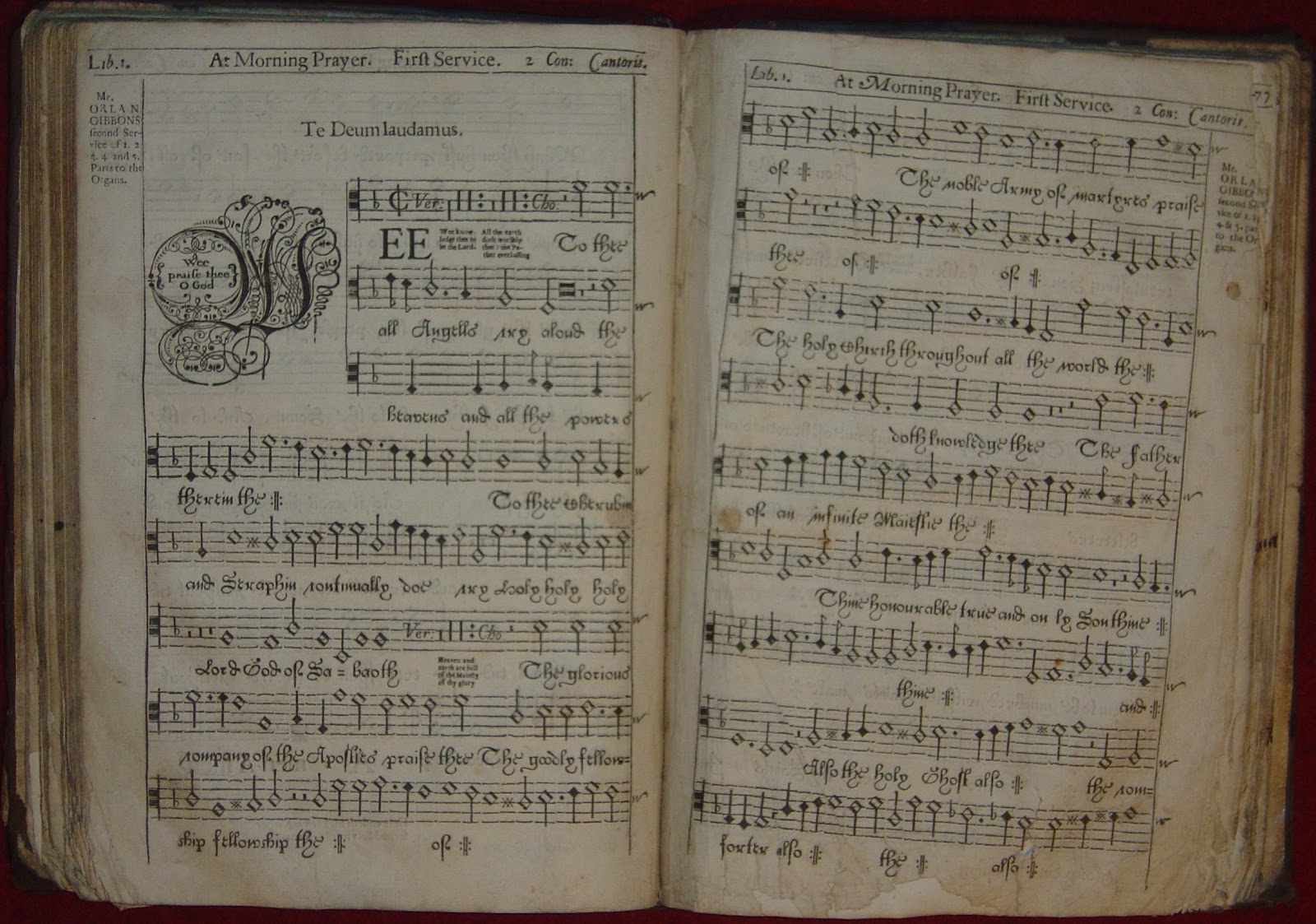
The second book is a printed music book. John Barnard was a minor Canon of Saint Paul’s Cathedral in the mid-seventeenth century. In Worcester Cathedral Library are copies of his famous music book ‘The First Book of selected Church Musick’. Barnard collected together and had published various approved composers works. The book was printed by Edward Griffin in 1641. Griffin was not experienced in printing music, but the finished product must have pleased both himself and the author. It contains a series of intricate opening letters for many of the pieces, and an unusual typeface for the words that give the books a degree of unexpected elegance.

(Barnard's First Book of Church Music 1641. The photograph is copyright the Dean and Chapter of Worcester Cathedral)

Barnard dedicated the book to King Charles I. In his dedication Barnard spoke of the long tradition of English choral music from Anglo-Saxon times. However, he wished to publish what he described as the “choycest Master-peeces, left us in Hymnes, Anthems, and Services” of famous composers’ works from the reign of Queen Elizabeth I onwards. Barnard was not simply bringing his favourite tunes to a wider audience. As he wrote, he was keeping them from the “danger of perishing, or corrupting in erroneous and manuscript obscurity”.

The book consists of service music by Tallis, Strogers, Bevins, Bird, Gibbons, Mundys, Parsons, Morlys, Giles, Ward, and Woodsons. There then follows six composers’ work suitable for the Psalms and Litany, and then fifty-four Anthems again by a range of composers.

(Barnard's First Book of Church Music 1641. The photograph is copyright the Dean and Chapter of Worcester Cathedral)


The last word should go to John Barnard who ended the book’s preface with this sentence: “So wishing to all those that shall use these books, cleere voices, true measure, and chiefly affections ray’sd to the devout height of these ditties, I take leave.”  

David Morrison, Cathedral Library and Archive.

Tuesday, 16 October 2012

Medical Care in a medieval monastery Part 2


Part 2: Medieval Doctors and Medical texts

                                                A copy of Galen's Tegni, 13th Century.
               (This image is copyright the Dean and Chapter of Worcester cathedral U.K.)

Have you ever dreamed of a job where you were paid a salary but you also received free food and a gallon of ale every time you showed up for work? Today’s blog deals with medieval medical textbooks, investigates doctors’ contracts and asks how they paid for medicines and care in the priory?

Just as a major modern hospital has a medical library for the benefit of staff and patients, so the monastic infirmarer also had access to a number of important medical texts from the cathedral library which would have allowed him and his deputy monk assistants to improve their knowledge. These texts included twelfth and thirteenth century translations of Arabic and Jewish doctors, such as Haly Ibn Abbas and Isaac, as well as translations of classical physicians such as Galen, or Hippocrates. There were also contemporary Christian authorities such as Gilbertus Anglicus’s fourteenth century compendium of medical knowledge. Several of the texts show evidence of having been annotated.  


                                             A doctor from a German woodcut of 1475
                    (This image is copyright the Dean and Chapter of Worcester cathedral U.K.)

The infirmarer also worked alongside a local physician. One monastic register reveals the details of a doctor’s contract that was drawn up by the monks with Master Henry Hampton. He became the physician to the monastic infirmary on 6th September 1320. His annual fee was forty shillings. When he visited the infirmary he was also guaranteed a monk’s loaf, a ‘gustatam’ (or gallon to a gallon and a half) of the best ale, a dish of food, stabling for his horse, and a livery robe. The quantity of ale required was normal because water was unsafe to drink and the ale was weaker than modern beer. In 1329 another such medical contract survives for Master John de Bosco. De Bosco was required by the monks to maintain confidentiality, warn them of anyone plotting evil deeds, and promise to give medical advice and assistance when called upon. He too was paid an annual fee, and also received food, the best ale of the monastery, and a place to stay if having to tend the sick overnight. There was also food and lodging for his servant and horse.

A Worcester document showing the income used to pay for medical care in Henry IV's reign.    (This image is copyright the Dean and Chapter of Worcester cathedral U.K.)

Sick monks did not have to pay the doctor themselves because the financial burden was shouldered by the monastery. The infirmarer was allowed to collect the rents from a portion of the monastery’s lands for this purpose. He also received payments towards treating the sick from nine local parish churches, such as Bromsgrove, Himbleton, Tibberton, Knightwick, Saint Andrew’s Pershore, and Saint Swithun’s Worcester. While the head of the monastery could afford to pay for his own medical advice and medicines, he occasionally would intervene to help pay for the cost of medicines of a sick monk as Prior William More did for brother William Fordam in 1531.

David Morrison, Cathedral Library and archives.           

Tuesday, 9 October 2012

Medical Care in a medieval monastery- Part 1


Part 1: The infirmary, nursing and diet


Reading immediately after supper, or drunkenness were just two of the things to be avoided if you did not want to damage your health according to advice in one of the cathedral’s late medieval monastic registers. These archive registers have a huge amount of information about life in the middle ages. They are currently being conserved. In this week’s blog- the first in a two part series- I will use these registers to look at the duties of an infirmarer, aspects of late medieval nursing care, and dietary advice at Worcester Cathedral’s Benedictine priory.

The monk in charge of medical care at Worcester was called the infirmarer. Together with his monastic brothers and lay assistants- the infirmary clerk, the washerwoman, and the groom of the infirmary, the infirmarer would have provided the daily nursing care and general administration of the infirmary, which was located on the west side of the cathedral. He also had to find money in his budget to maintain the fabric of the building, for example repairing the infirmary chapel windows in 1378-79. There was also an infirmary garden both for the benefit of the patients and for growing medicinal herbs.  

The nursing care provided is not recorded in detail but it is known that very sick monks often stayed for weeks at a time in the infirmary. For example, in 1531-32, Brother John Crowle and Brother William Fordham required care for nineteen weeks and nine weeks respectively. 


                                             (A medieval feast from a woodcut of c.1517)

This monastic nursing care probably also included basic dietary advice. One of the Worcester Cathedral monastic archive registers gives details of certain food and drinks to have, and those to avoid.

Things that were good for you included bread that used pure flour and was not stale or old, the newly laid eggs of pheasants, hens, or partridges, fresh milk sometimes with sugar or mint leaves added to it for taste, poultry, venison, beef or pork, fish, figs, lettuces, grapes, parsley, mint, moderate amounts of good wine, and ‘clean brewed’ (i.e. good quality) ale or beer.

Things that were bad for you included unripe fruit, old meat, shellfish, immoderate amounts of onions, and sour wine. They also believed that sweet wines and sweet meats hurt the teeth, and thought that overly salted meat, garlic and onions, as well as thick and sweet wines hurt the eyes.

David Morrison, Cathedral Library and archives.

Wednesday, 3 October 2012

Travelling round Berlin and Potsdam


The theatre at Berlin according to Jonas Hanway. 
(The image is copyright the Dean and Chapter of Worcester Cathedral.) 


In this week’s cathedral library blog, travel back to the year 1753, so don your tricorn, pack your clay pipe and pair of extra large riding breeches, and join Jonas Hanway (1712-1786), English merchant and journal writer. Hanway later became a well known essayist, philanthropist, and apparently even was an early exponent of the umbrella in England. Some of his published views would not be accepted today. However, his travel writing is still of interest. He travelled on a trade route to Persia and back to England via Russia, Germany and Holland and recorded his experiences in detail.

Amongst his many adventures, in Volume 2 Chapter 31, Hanway arrived in Berlin, the entrance to which he described as: “airy and elegant; the streets are regular and clean, and the houses uniform.”

Hanway gave detailed descriptions of the court of the King of Prussia, his palaces, army, and society. After being shown around the royal palace he visited the library “which would be deemed a mean apartment for a common school.”  However, he was impressed by the treasures kept on the shelves including a Bible formerly belonging to King Charles I, which had been used at the King’s execution. It was given to the Elector of Brandenburg as a relic by Archbishop William Juxon. He also saw a copy of the first ever Bible printed in America, a medieval German Bible, and several manuscripts that had once belonged to Cardinal Mazarin.

After describing the beautiful Berlin Opera House, Hanway notes a night time court masque at which the participants dressed in various classical costumes and staged a mock battle at which the wind blew out most of the lamps lighting the show and a local prince managed to injure himself with his own sword. Hanway was much more impressed with a magnificent mock battle staged by the Prussian army outside the city, to which all the citizens had come to watch.  

Hanway noticed that Berlin was greatly influenced by Paris, with French widely spoken by the citizens. He liked how the Prussian capital had elegant structures and regular streets and was reckoned one third larger than London, and yet surprisingly had only one eighth of the inhabitants. Hanway also noted the exchange rate for future fellow travellers reading his book. At this time it was possible to get 6 Prussian dollars for 1 English Guinea. We can only wonder at what he would have made of travel in present day Europe.


The Arsenal at Berlin at the time of Hanway's visit.
(The image is copyright the Dean and Chapter of Worcester Cathedral)


A mile from Berlin he was shown around the Charlottenburg Palace, and then went just beyond Potsdam to see the palace of Sans Souci. He was impressed with the interiors of both places. However the gardener at San Souci would not allow him to wander the grounds with his sword, commenting that even the Prussian king would not do this. The modern tourist undoubtedly no longer has such a problem.


Friday, 21 September 2012

Reformation Monarchy


Our work experience student, Matthias Hans, produced three mini articles on the reigns of Henry VIII, Mary Tudor and Elizabeth I.  Please click on the links below to view the PDFs.

The images of monarchs are taken from a copy of Gilbert Burnet’s three-volume History of the Reformation published between 1679 and 1714.  Burnet was a renowned Protestant theologian who went on to become Bishop of Salisbury.  His History was conceived as a refutation of the work of Catholic writer, Nicholas Sanders.  Burnet was exiled during the reign of James II, who was a Catholic, but returned to England after the ‘Glorious Revolution’.  He preached at the Coronation of William and Mary in 1689.


Henry VIII.  Click here to read more about Henry.


Mary I.  Click here to read more about Mary.


Elizabeth I.  Click here to read more about Elizabeth.