Friday, 2 November 2012

A great English theologian called John Wyclif

In the last few weeks the cathedral blog has taken you to eighteenth century Berlin with an English traveller, visited the medieval monastic infirmary and looked at medieval doctors' contracts, and told the story of some beautiful choral music from the reign of Charles I.

This week, we include a guest post from work experience student Matthias Hans all about John Wyclif who was a forefather in the eventual development of Protestant Christianity. This was Matthias Hans' final project  for the cathedral library over the summer. If you want to read his study about John Wyclif follow this link.


This photograph shows the bones of John Wyclif being dug up, burnt, and the ashes thrown into the river by the Church authorities who disagreed with what Wyclif wrote! The image is from one of the Cathedral's copies of Foxe's Book of Martyrs. This work is the story of Protestant Christianity upto the reign of Queen Elizabeth I, and about those men and women who died in the struggle for their beliefs.

Tuesday, 23 October 2012

Choicest Master Pieces of Choral Music


If you have been fortunate enough to attend a service or concert at Worcester Cathedral, you will remember the beautiful sound and the atmosphere that is possible in such an ancient building. In this week’s blog we delve into the cathedral library’s music collection to look at two seventeenth century music books.
(Robert Parsons' music from an early part book. The photograph is copyright the Dean and Chapter of Worcester Cathedral)

The first is one of the handwritten Worcester choral part books. This was compiled over many years. One section was copied down at some point between the years 1620 and 1640. The second section dates to between 1670- 1700. There are 115 items by eighteen composers in the manuscript. To pick one of the earlier composers as an example, there are the Venite, Te Deum, Benedictus, Kyrie, Creed, Magnificat, Nunc Dimittis, and an offertory by Robert Parsons (1530 -1572). 

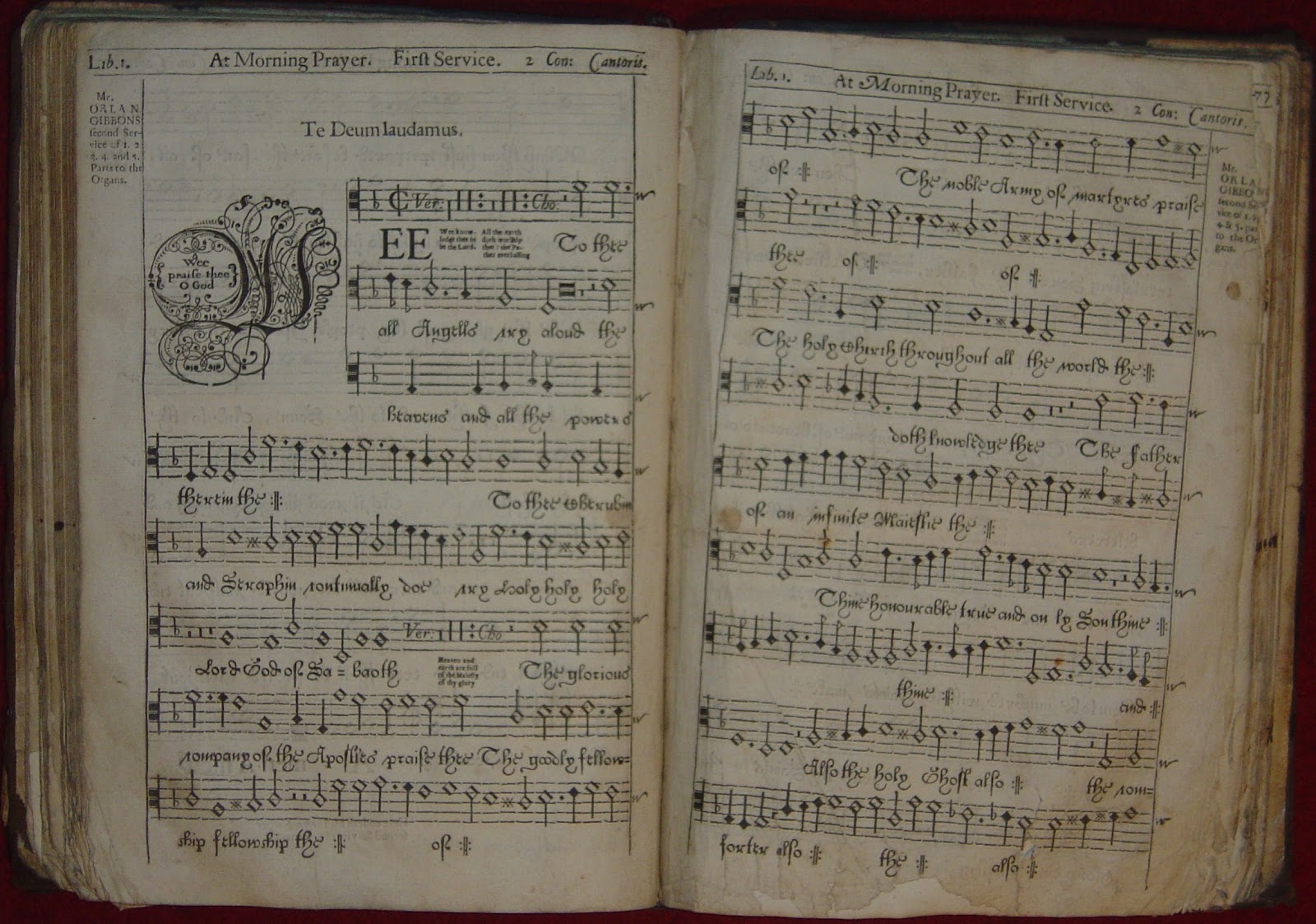
The second book is a printed music book. John Barnard was a minor Canon of Saint Paul’s Cathedral in the mid-seventeenth century. In Worcester Cathedral Library are copies of his famous music book ‘The First Book of selected Church Musick’. Barnard collected together and had published various approved composers works. The book was printed by Edward Griffin in 1641. Griffin was not experienced in printing music, but the finished product must have pleased both himself and the author. It contains a series of intricate opening letters for many of the pieces, and an unusual typeface for the words that give the books a degree of unexpected elegance.

(Barnard's First Book of Church Music 1641. The photograph is copyright the Dean and Chapter of Worcester Cathedral)

Barnard dedicated the book to King Charles I. In his dedication Barnard spoke of the long tradition of English choral music from Anglo-Saxon times. However, he wished to publish what he described as the “choycest Master-peeces, left us in Hymnes, Anthems, and Services” of famous composers’ works from the reign of Queen Elizabeth I onwards. Barnard was not simply bringing his favourite tunes to a wider audience. As he wrote, he was keeping them from the “danger of perishing, or corrupting in erroneous and manuscript obscurity”.

The book consists of service music by Tallis, Strogers, Bevins, Bird, Gibbons, Mundys, Parsons, Morlys, Giles, Ward, and Woodsons. There then follows six composers’ work suitable for the Psalms and Litany, and then fifty-four Anthems again by a range of composers.

(Barnard's First Book of Church Music 1641. The photograph is copyright the Dean and Chapter of Worcester Cathedral)


The last word should go to John Barnard who ended the book’s preface with this sentence: “So wishing to all those that shall use these books, cleere voices, true measure, and chiefly affections ray’sd to the devout height of these ditties, I take leave.”  

David Morrison, Cathedral Library and Archive.

Tuesday, 16 October 2012

Medical Care in a medieval monastery Part 2


Part 2: Medieval Doctors and Medical texts

                                                A copy of Galen's Tegni, 13th Century.
               (This image is copyright the Dean and Chapter of Worcester cathedral U.K.)

Have you ever dreamed of a job where you were paid a salary but you also received free food and a gallon of ale every time you showed up for work? Today’s blog deals with medieval medical textbooks, investigates doctors’ contracts and asks how they paid for medicines and care in the priory?

Just as a major modern hospital has a medical library for the benefit of staff and patients, so the monastic infirmarer also had access to a number of important medical texts from the cathedral library which would have allowed him and his deputy monk assistants to improve their knowledge. These texts included twelfth and thirteenth century translations of Arabic and Jewish doctors, such as Haly Ibn Abbas and Isaac, as well as translations of classical physicians such as Galen, or Hippocrates. There were also contemporary Christian authorities such as Gilbertus Anglicus’s fourteenth century compendium of medical knowledge. Several of the texts show evidence of having been annotated.  


                                             A doctor from a German woodcut of 1475
                    (This image is copyright the Dean and Chapter of Worcester cathedral U.K.)

The infirmarer also worked alongside a local physician. One monastic register reveals the details of a doctor’s contract that was drawn up by the monks with Master Henry Hampton. He became the physician to the monastic infirmary on 6th September 1320. His annual fee was forty shillings. When he visited the infirmary he was also guaranteed a monk’s loaf, a ‘gustatam’ (or gallon to a gallon and a half) of the best ale, a dish of food, stabling for his horse, and a livery robe. The quantity of ale required was normal because water was unsafe to drink and the ale was weaker than modern beer. In 1329 another such medical contract survives for Master John de Bosco. De Bosco was required by the monks to maintain confidentiality, warn them of anyone plotting evil deeds, and promise to give medical advice and assistance when called upon. He too was paid an annual fee, and also received food, the best ale of the monastery, and a place to stay if having to tend the sick overnight. There was also food and lodging for his servant and horse.

A Worcester document showing the income used to pay for medical care in Henry IV's reign.    (This image is copyright the Dean and Chapter of Worcester cathedral U.K.)

Sick monks did not have to pay the doctor themselves because the financial burden was shouldered by the monastery. The infirmarer was allowed to collect the rents from a portion of the monastery’s lands for this purpose. He also received payments towards treating the sick from nine local parish churches, such as Bromsgrove, Himbleton, Tibberton, Knightwick, Saint Andrew’s Pershore, and Saint Swithun’s Worcester. While the head of the monastery could afford to pay for his own medical advice and medicines, he occasionally would intervene to help pay for the cost of medicines of a sick monk as Prior William More did for brother William Fordam in 1531.

David Morrison, Cathedral Library and archives.           

Tuesday, 9 October 2012

Medical Care in a medieval monastery- Part 1


Part 1: The infirmary, nursing and diet


Reading immediately after supper, or drunkenness were just two of the things to be avoided if you did not want to damage your health according to advice in one of the cathedral’s late medieval monastic registers. These archive registers have a huge amount of information about life in the middle ages. They are currently being conserved. In this week’s blog- the first in a two part series- I will use these registers to look at the duties of an infirmarer, aspects of late medieval nursing care, and dietary advice at Worcester Cathedral’s Benedictine priory.

The monk in charge of medical care at Worcester was called the infirmarer. Together with his monastic brothers and lay assistants- the infirmary clerk, the washerwoman, and the groom of the infirmary, the infirmarer would have provided the daily nursing care and general administration of the infirmary, which was located on the west side of the cathedral. He also had to find money in his budget to maintain the fabric of the building, for example repairing the infirmary chapel windows in 1378-79. There was also an infirmary garden both for the benefit of the patients and for growing medicinal herbs.  

The nursing care provided is not recorded in detail but it is known that very sick monks often stayed for weeks at a time in the infirmary. For example, in 1531-32, Brother John Crowle and Brother William Fordham required care for nineteen weeks and nine weeks respectively. 


                                             (A medieval feast from a woodcut of c.1517)

This monastic nursing care probably also included basic dietary advice. One of the Worcester Cathedral monastic archive registers gives details of certain food and drinks to have, and those to avoid.

Things that were good for you included bread that used pure flour and was not stale or old, the newly laid eggs of pheasants, hens, or partridges, fresh milk sometimes with sugar or mint leaves added to it for taste, poultry, venison, beef or pork, fish, figs, lettuces, grapes, parsley, mint, moderate amounts of good wine, and ‘clean brewed’ (i.e. good quality) ale or beer.

Things that were bad for you included unripe fruit, old meat, shellfish, immoderate amounts of onions, and sour wine. They also believed that sweet wines and sweet meats hurt the teeth, and thought that overly salted meat, garlic and onions, as well as thick and sweet wines hurt the eyes.

David Morrison, Cathedral Library and archives.

Wednesday, 3 October 2012

Travelling round Berlin and Potsdam


The theatre at Berlin according to Jonas Hanway. 
(The image is copyright the Dean and Chapter of Worcester Cathedral.) 


In this week’s cathedral library blog, travel back to the year 1753, so don your tricorn, pack your clay pipe and pair of extra large riding breeches, and join Jonas Hanway (1712-1786), English merchant and journal writer. Hanway later became a well known essayist, philanthropist, and apparently even was an early exponent of the umbrella in England. Some of his published views would not be accepted today. However, his travel writing is still of interest. He travelled on a trade route to Persia and back to England via Russia, Germany and Holland and recorded his experiences in detail.

Amongst his many adventures, in Volume 2 Chapter 31, Hanway arrived in Berlin, the entrance to which he described as: “airy and elegant; the streets are regular and clean, and the houses uniform.”

Hanway gave detailed descriptions of the court of the King of Prussia, his palaces, army, and society. After being shown around the royal palace he visited the library “which would be deemed a mean apartment for a common school.”  However, he was impressed by the treasures kept on the shelves including a Bible formerly belonging to King Charles I, which had been used at the King’s execution. It was given to the Elector of Brandenburg as a relic by Archbishop William Juxon. He also saw a copy of the first ever Bible printed in America, a medieval German Bible, and several manuscripts that had once belonged to Cardinal Mazarin.

After describing the beautiful Berlin Opera House, Hanway notes a night time court masque at which the participants dressed in various classical costumes and staged a mock battle at which the wind blew out most of the lamps lighting the show and a local prince managed to injure himself with his own sword. Hanway was much more impressed with a magnificent mock battle staged by the Prussian army outside the city, to which all the citizens had come to watch.  

Hanway noticed that Berlin was greatly influenced by Paris, with French widely spoken by the citizens. He liked how the Prussian capital had elegant structures and regular streets and was reckoned one third larger than London, and yet surprisingly had only one eighth of the inhabitants. Hanway also noted the exchange rate for future fellow travellers reading his book. At this time it was possible to get 6 Prussian dollars for 1 English Guinea. We can only wonder at what he would have made of travel in present day Europe.


The Arsenal at Berlin at the time of Hanway's visit.
(The image is copyright the Dean and Chapter of Worcester Cathedral)


A mile from Berlin he was shown around the Charlottenburg Palace, and then went just beyond Potsdam to see the palace of Sans Souci. He was impressed with the interiors of both places. However the gardener at San Souci would not allow him to wander the grounds with his sword, commenting that even the Prussian king would not do this. The modern tourist undoubtedly no longer has such a problem.


Friday, 21 September 2012

Reformation Monarchy


Our work experience student, Matthias Hans, produced three mini articles on the reigns of Henry VIII, Mary Tudor and Elizabeth I.  Please click on the links below to view the PDFs.

The images of monarchs are taken from a copy of Gilbert Burnet’s three-volume History of the Reformation published between 1679 and 1714.  Burnet was a renowned Protestant theologian who went on to become Bishop of Salisbury.  His History was conceived as a refutation of the work of Catholic writer, Nicholas Sanders.  Burnet was exiled during the reign of James II, who was a Catholic, but returned to England after the ‘Glorious Revolution’.  He preached at the Coronation of William and Mary in 1689.


Henry VIII.  Click here to read more about Henry.


Mary I.  Click here to read more about Mary.


Elizabeth I.  Click here to read more about Elizabeth.

Friday, 3 August 2012

Guest Blog by Matthias Hans: Edward VI, the Boy King


My name is Matthias Hans and I am a history student from Bonn University in Germany.  I am on a five-week work experience placement at Worcester Cathedral Library and Archive.  I am interested in the late medieval and early modern periods, especially the history of religion.  During my time here I have already translated a German tour, catalogued books and correspondence, and done some research using original documents from the sixteenth and seventeenth centuries.  This blog post makes use of the work I have done so far.

Matthias Hans: Doing work experience at the Cathedral Library and Archive

When King Henry VIII died on 28th January 1547 he had ruled for more than 38 years; his reign had brought immense changes in government, society and the Church. In ecclesiastical matters, the greatest change made by Henry was splitting from Rome in January 1531, following Pope Clement VII’s refusal to annul his marriage to Catherine of Aragon.  At the time of Henry’s death his son, Edward the Prince of Wales (whom he had with his third wife Jane Seymour), was only nine years old. Because of his age he was unable to reign on his own.  This meant that others ruled for him, exerting their influence on him and pursuing their own agenda, especially in relation to religion.  They followed the strict reformed Protestant teachings of the Swiss reformer Jean Calvin, who made rigorous changes to liturgy, e.g. banning music from the church.

It was decided to keep Henry’s death a secret for three days.  Duke of Somerset Edward Seymour, the young Edward VI’s uncle, was made Lord Protector. Somerset kept the young prince isolated to ensure that he had the greatest influence over him. Edward was the first monarch declared in his coronation oath as the supreme head of the church by divine, not human, agency. The coronation oath was changed by the Archbishop of Canterbury, Thomas Cranmer, with the assent of the Duke of Somerset.   Cranmer said in his sermon delivered at the Coronation of Edward VI:

“Therefore not from the Bishop of Rome, but as a Messenger from my Saviour Jesus Christ, I shall most humbly admonish your Royal Majesty what things your Highness is to perform.  Your Majesty is God’s Vicegerent, and Christ’s Vicar your own Dominions and to see, with your Predecessor Josias [sic], God truly worshipped, and Idolatry destroyed; the Tyranny of the Bishops of Rome banished from your Subjects and Images removed. These Acts be Signs of a second Josias, who reformed the Church of God in his Days.”

Shortly after Edward’s coronation Cranmer’s ideas for reform were put into practice. In July 1547 the Privy Council forbade candles and shrines, while in February the following year images in stained glass, wood and stone were regarded as idolatrous. The old and traditional social and religious customs of English Medieval Christianity vanished within just two years. Religious rites were reformed and unified, with Thomas Cranmer’s First Book of Common Prayer being published in 1549.

However the deep impact of these reforms was not welcomed by all the people. This led to a series of uprisings taking place, especially in the west of England, in 1549. With the uprisings, the bond of trust was broken between Somerset and the local gentry, who believed the Protector had taken his policies too far. In October of the same year Somerset’s offices were abolished and a coup d’état against him took place, but the evangelical religious policy was carried on.  Meanwhile conservative, traditional bishops were removed from their office and some of their lands were seized for the government. In February 1550 Lord Warwick was appointed Lord Protector. Under the regime of Warwick, who was made Duke of Northumberland in 1551, Edward’s religious views became even more evangelical. In 1550 the Ordinals for Clerics, which set out new rules for the clergy were published.  All in all Edward became more independent from the church and his advisors, more rigorous and intolerant toward the old, traditional more Catholic minded forces. His refusal to accept the saying of the Mass for his sister Princess Mary almost caused a war with Charles V, the Holy Roman Emperor. In 1552 Archbishop Cranmer’s Second Book of Common Prayer was published. It was a more overtly Protestant revision of the First Book of Common Prayer of 1549.  In June 1553 the 42 articles of Faith were published.  Doctrinally, these two publications were the climax of the ecclesiastical changes of Edwards’s reign, influenced by French/Calvinistic Protestantism. Edward saw the Eucharist as an act of remembrance rather than the real presence, like his mentor the Archbishop of Canterbury Thomas Cranmer.

King Edward VI
© The Dean and Chapter of Worcester Cathedral

Scholars argue about Edward’s health during the last two years of his reign but it is certain that his health was poor during that time. He might have contracted tuberculosis, to which he finally succumbed on 6 July 1553. It is uncertain how the reformation would have progressed if the king had lived longer. Edward did not want either of his sisters, Mary or Elizabeth, to be his successor, as he regarded them both as illegitimate. He was especially afraid that the Catholic Mary would destroy his work of “true religion”. His wish was that the daughter of the Duchess of Suffolk, whom he regarded as his spiritual sister, should be his successor was not fulfilled. Instead England was to experience further turbulence in the following decades.

By Matthias Hans, Worcester Cathedral Library and Archive